French adjectives are almost always quite confusing for beginners. This is because you must learn the masculine and feminine gender as well as singular and plural forms. This page covers all the rules in depth. At the bottom of the page you’ll find a list of the 30 most commonly used French adjectives.

French adjectives: Essential guide for beginners
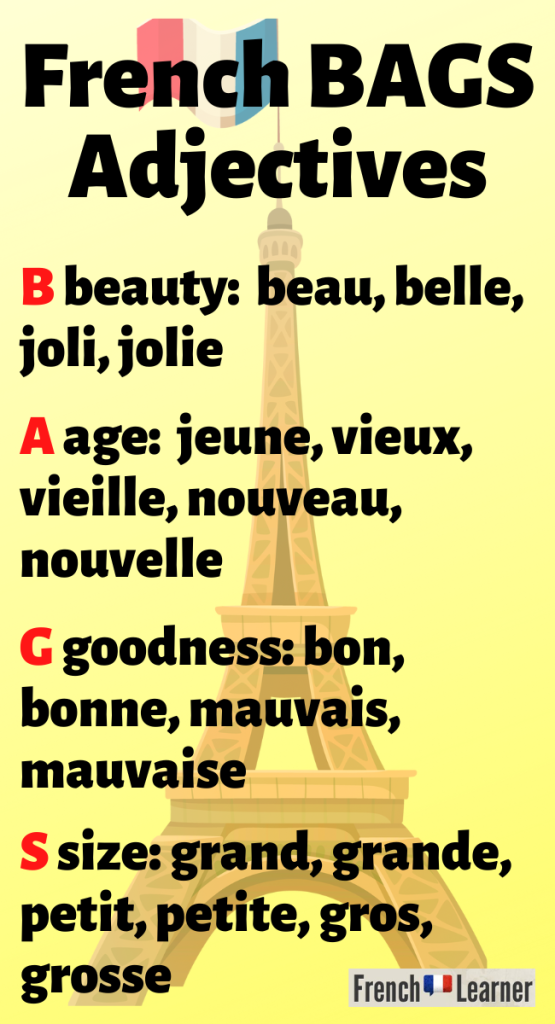
French BAGS Adjectives
The first group of adjectives in French that most students learn are called BAGS adjectives. BAGS is an acronym that stands for Beauty, Age, Goodness and Size.
The key thing to understand about these adjectives is that they must come before the noun they modify. In general, French adjectives come after the noun.
- B (Beauty): beau, belle (beautiful), joli, jolie (pretty)
- A (Age): jeune (young), vieux, vielle (old), nouveau, nouvelle (new)
- G (Goodness): bon, bonne (good), mauvais, mauvaise (bad)
- S (Size): grand, grande (big, tall), gros, grosse (big), petit, petite (small, short), long, longue (long)
Here are a few examples of sentences including BAGS adjectives:
- Je regarde un vieux film. I watch an old movie.
- J’achète une nouvelle maison. I’m buying a new house.
- Sylvie est une jolie fille. Sylvie is a pretty girl.
- Pierre est un petit garçon. Pierre is a little boy.
- Paris est une belle ville. Paris is a beautiful city.
- J’arrive à l’hotel après un long voyage. I arrive at the hotel after a long trip.
Regular adjectives in French
Regular French adjectives are adjectives where you simply add an -e to change it from the masculine to feminine form.
Here are several examples with example sentences. After the first example of grand, note the position of these adjectives. They come after the nouns they modify as they’re not BAGS adjectives.
- grand -> grande = big, tall
un grand garçon (a big boy), une grande fille (a big girl) - bleu -> bleue = blue
le ciel bleu (the blue sky), la voiture bleue (the blue car) - gris -> grise = gray
un pantelon gris (a gray pair of pants), une chemise grise (a gray shirt) - américain -> américaine = American
un homme américain (an American man), une femme américaine - intelligent -> intelligente = smart, intelligent
un homme intelligent (a smart man), une femme intelligente (a smart woman)
This page offers a complete list of adjectives for nationalities.
Irregular French adjectives
Adjectives that end in -e
Many adjectives do not follow this cookie-cutter form of simply adding an -e to make the feminine form.
If an adjective ends in -e in the masculine form, it stays the same in the feminine form. Here are some examples.
- timde = shy
un garçon timide (a shy boy), une fille timide (a shy girl) - rapide = fast
un train rapide (a fast train), une voiture rapide (a fast car) - difficile = difficult
un problème difficile (a difficult problem), une personne difficile (a difficult person) - rouge = red
un vélo rouge (a red bike), une voiture rouge (a red car)
Adjectives with spelling changes
There are lots of adjectives where the masculine and feminine endings are different, meaning you don’t just add an -e. There are groups of adjectives with similar endings.
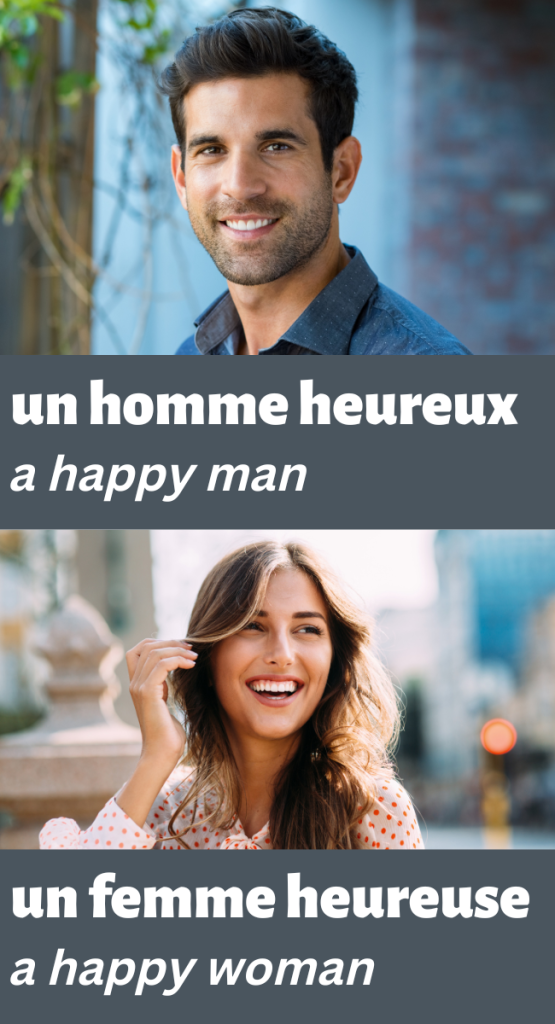
Masculine adjectives ending in -eux end -euse in the feminine form.
- heureux -> heureuse = happy
un homme heureux (a happy man), une femme heureuse (a happy woman) - dangereux -> dangereuse (dangerous)
un endroit dangereux (a dangerous place), une situation dangereuse (a dangerous situation)
Masculine adjectives ending in -f end in -ive in the feminine form.
- actif -> active = active
un homme actif (an active man), une femme active (an active woman) - sportif -> sportive = athletic
un garçon sportif (an athletic boy), une fille sportive (an athletic girl)
Adjectives ending in -on, -en and -el double the final consonant before adding an -e.
- bon -> bonne = good
un bon film (a good movie), une bonne idée (a good idea) - canadien -> canadienne = Canadian
un homme canadien (a Canadian man), une femme canadienne (a Canadian woman) - cruel -> cruelle = cruel
un homme cruel (a cruel man), une femme cruelle (a cruel woman)
There are many other irregular adjective patterns which you simply have to memorize.
Adjectives ending in -er in the masculine form end in -ère in the feminine form.
- premier -> première = first
le premier jour (the first day), la première fois (the first time)
Some adjectives ending -et end in -ète in the feminine form. Additionally, some adjective ening in -et become -ette in the feminine form.
- secret -> secrète = secretive
un homme secret (a secretive man), une femme secrète (a secretive woman) - muet -> muette = mute
un homme muet (a mute man), une femme muette (a mute woman)
Adjectives that are totally different masculine and feminine forms
Some adjectives are spelled totally differently in the masculine and feminine forms. You simply have to memorize these. This is a partial list. There are many more.
- fou -> folle (crazy)
- nouveau -> nouvelle (new)
- blanc -> blanche (white)
- doux -> douce (soft)
- faux -> fausse (false, wrong)
- long -> longue (long)
- public -> publique (public)
- sec -> sèche (dry)
- vieux -> vieille (old)
Plural adjectives
All French adjectives must agree in number (singular or plural) with the noun they modify. For most French adjectives, you simply add an -s to make it plural. Here are some examples.
- intelligent -> intelligents = intelligent, smart
un homme intelligent (a smart man), des hommes intelligents (smart men) - petite -> petites = small, short
une petite maison (a little house), des petites maison (little houses) - grand -> grands (big, tall)
un grand garçon (a big boy), des grands garçons (big boys)
When masculine adjectives end in -s or -x they don’t change in the plural from.
- un garçon français (a french boy), des garcons français (French boys)
- un homme courageux (a brave man), des hommes courageux (brave men)
Masculine adjectives ending in -al in the singular end in -aux in the plural.
- un homme génial (a great man), des hommes homme géniaux (great men)
Masculine adjectives ending in -eau take an -x in the plural form.
- un beau paysage (a beautiful landscape), de beaux paysages (beautiful landscapes)
- un nouveau camion (a new truck), de nouveaux camions (new trucks)
Adjectives that can come both before and after the noun
Some adjectives in French can come both before and after the noun. In these situations the meaning of the adjective changes. Here are some examples.
- ancien = former, old
un ancien ami (a former friend), un ancien livre (an old book) - cher = expensive, dear
un cher ami (a dear friend), une voiture chère (an expensive car) - propre = one’s own, clean
ma propre voiture (my own car), une voiture propre (a clean car) - pauvre = poor (pity), economically poor
mon pauvre ami (my poor friend), un pays pauvre (a poor country) - prochain = next in a series, next
la prochiane semaine (next week in a series of weeks), la semamine prochaine (next week) - dernier = last in a series, last
la dernier mois (last month in a series of months), le mois dernier (last month)

30 Most Common French adjectives
Are you looking for a list of top French adjectives which you can memorize? In the table below you’ll find the top-30 most commonly used French adjectives in both the masculine and feminine forms.
| English | Masculine | Feminine |
| old | vieux | vieille |
| young | jeune | jeune |
| good | bon | bonne |
| bad | mauvais | mauvaise |
| big | grand | grande |
| little | petit | petite |
| happy | heureux | heureuse |
| sad | triste | triste |
| nice | sympathique | sympathique |
| mean | méchant | méchante |
| polite | poli | polie |
| impolite | impoli | impolie |
| pretty | joli | jolie |
| beautiful | beau | belle |
| ugly | laid | laide |
| strong | fort | forte |
| weak | faible | faible |
| expensive | cher | chère |
| inexpensive | bon marché | bon marché |
| fat | gros | grosse |
| thin | maigre | maigre |
| horrible | horrible | horrible |
| wonderful | formidable | formidable |
| smart | intelligent | intelligente |
| stupid | stupide | stupide |
| interesting | intéressant | intéressante |
| boring | ennuyeux | ennuyeuse |
| rich | riche | riche |
| poor | pauvre | pauvre |
Conclusion
In addition to this lesson, you might find French Today’s Mastering French Adjectives course to be very helpful. You may also find our pages covering French colors, French numbers and vocabulary lists to be useful.
Discover more: