
🔊 Jump to examples now
👉 See also: Avoir expressions »
Level A2 (Upper Beginner)
Published March 12, 2026 — Lesson written by French teacher David Issokson for students who want to learn French online, with native audio by Marie Assel Cambier, a voice artist from France.
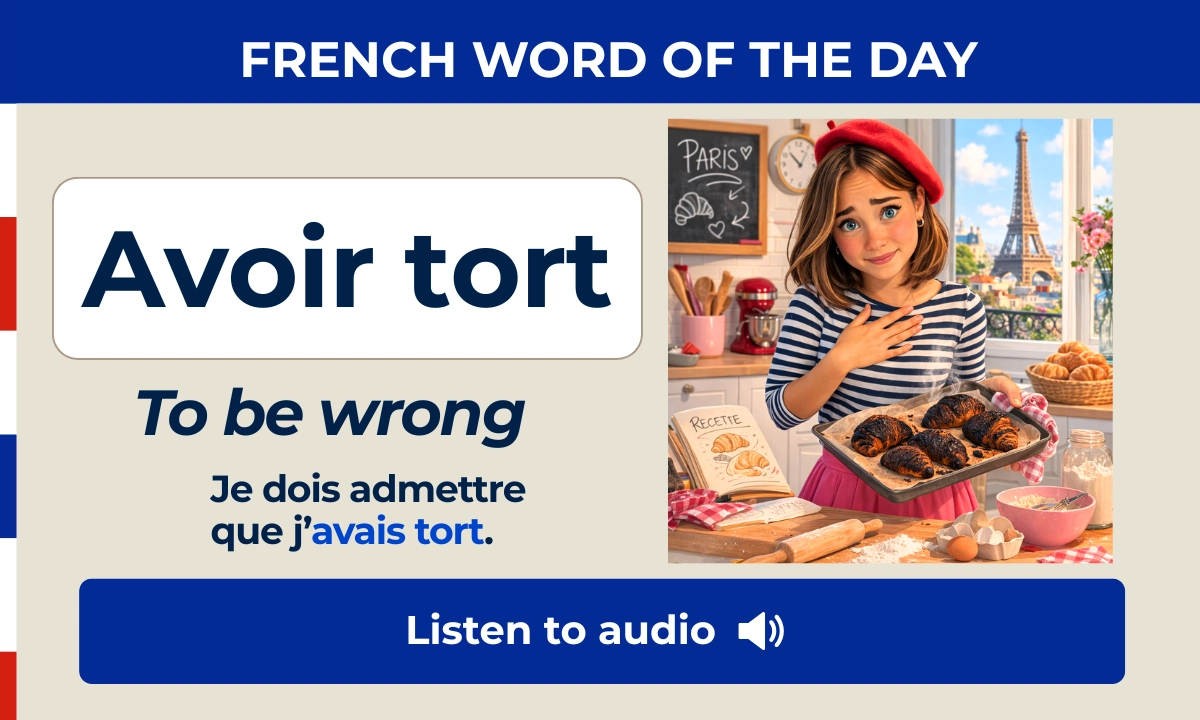
The French Word of the Day is avoir tort, an expression meaning “to be wrong.” In this lesson we’ll look at how to use it naturally in daily conversation and, more importantly, the meaning of tort and why it appears in this expression.
📘 Avoir tort meaning in French
Avoir tort is a French expression meaning “to be wrong” or “to be mistaken.” The word tort (m.) means “wrong,” “wrongdoing,” or “fault” and comes from tortus (twisted, crooked) in Latin. Hence, avoir tort translates literally to “to have the fault.” The opposite expression is avoir raison, meaning “to be right.” In everyday French, avoir tort is commonly used when admitting mistakes or being wrong.
⚠️ To be wrong in French — Common mistake
Important: In French you cannot say je suis tort for “I am wrong.” French uses the verb avoir for this expression. The correct wording is j’ai tort — I’m wrong.
🎧 Avoir tort pronunciation in French
The pronunciation of avoir tort is /a.vwaʁ tɔʁ/ (IPA), which sounds roughly like “ah-vwar tor.”
📝 Avoir tort usage examples
Je dois admettre que j’avais tort.
I must admit that I was wrong.
👉 See also: Devoir conjugation chart (must, to have to) »
Elle pense avoir raison, mais elle a tort.
She thinks she is right, but she is wrong.
Il a tort de partir maintenant.
He is wrong to leave now.
Elle a tort, mais elle est têtue.
She is wrong, but she is stubborn.
This lesson explains se tromper, an extremely useful close reflexive verb meaning “to be mistaken” or “to get wrong.”
👉 See also: Se tromper meaning and examples »
❓ Want to feel more confident in French?
🎯 À Moi Paris — This is my top recommendation for online French courses, and it pairs wonderfully with my daily lessons. Camille Chevalier teaches with engaging audio stories that she records at three speeds. Her specialty is helping students with pronunciation and bridging the gap between textbook French and real spoken French as you hear it on the streets of Paris.
👉 Explore À Moi Paris »
👉 Read my review »
🎧 French Verb Drills — Having trouble with French verb conjugations? Camille’s audio drills break everything down step by step so you can finally lock in the patterns and speak with confidence.
If you purchase the courses, I may earn a small commission — at no extra cost to you.
🔗 Related words and expressions
- avoir raison — to be right
- se tromper — to be mistaken
- faire une erreur — to make a mistake
- reconnaître ses torts — to admit one’s mistakes
- faux, fausse — wrong, false
📚 Related lessons on FrenchLearner!
👉 Se tromper (to be mistaken, get wrong) »
👉 Avoir expressions »
👉 Avoir conjugation chart (with audio) »


