

🔊 Jump to examples now
👉 See also: Je t’aime (I love you) »
Level A2 (Upper Beginner)
Published February 12, 2026 — Lesson written by French teacher David Issokson for students who want to learn French online, with native audio by Marie Assel Cambier, a voice artist from France.
The French Word of the Day is la Saint-Valentin, meaning Valentine’s Day. In today’s lesson you’ll learn how to say “Happy Valentine’s Day” in French (Joyeuse Saint-Valentin !) and discover a key cultural difference between France and North America regarding the holiday.
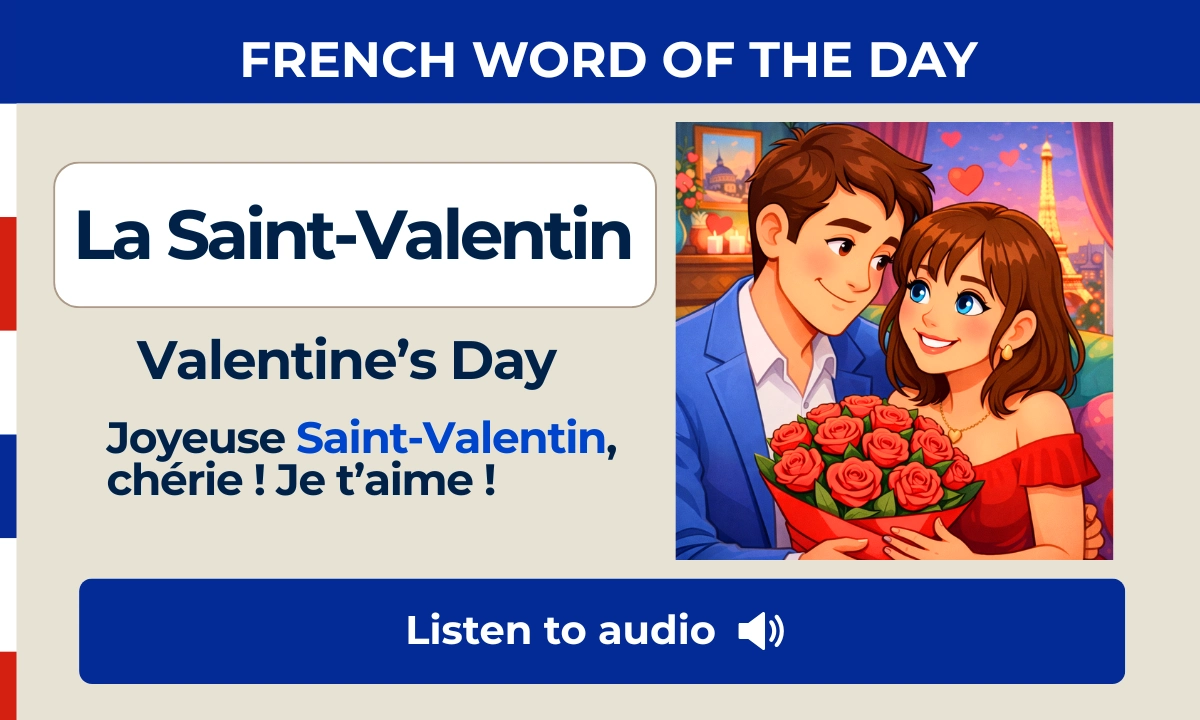
📘 La Saint-Valentin meaning in French
La Saint-Valentin means Valentine’s Day in French. It is celebrated on February 14 and is mainly a romantic occasion for couples, marked by gestures of affection such as giving flowers, chocolates, jewelry, or sharing a special dinner together. You’ll often hear “Joyeuse Saint-Valentin !” (Happy Valentine’s Day!) and “Bonne fête des amoureux !” (Happy lovers’ day!).
❤️ Cultural note
In France, Valentine’s Day is mainly reserved for romantic partners and is not typically celebrated among friends, family, or in schools. It remains essentially la fête des amoureux — a simple couples-focused holiday that tends to feel less commercial overall.
🎧 La Saint-Valentin pronunciation in French
The pronunciation of la Saint-Valentin is /la sɛ̃ valɑ̃tɛ̃/ (IPA), which sounds roughly like “lah san valahn-tan.”
📝 La Saint-Valentin usage examples
Joyeuse Saint-Valentin, chérie ! Je t’aime !
Happy Valentine’s Day, darling! I love you!
Elle reçoit un bouquet de fleurs pour la Saint-Valentin.
She receives a bouquet of flowers for Valentine’s Day.
Je te souhaite une joyeuse Saint-Valentin.
I wish you a happy Valentine’s Day.
Offrir des chocolats est une tradition de la Saint-Valentin.
Giving chocolates is a Valentine’s Day tradition.
Je t’aime (I love you) is a key phrase to know for Valentine’s Day!
👉 See also: Je t’aime pronunciation and examples »
❓ Want to feel more confident in French?
🎯 À Moi Paris — This is my top recommendation for online French courses, and it pairs wonderfully with my daily lessons. Camille Chevalier teaches with engaging audio stories that she records at three speeds. Her specialty is helping students with pronunciation and bridging the gap between textbook French and real spoken French as you hear it on the streets of Paris.
👉 Explore À Moi Paris »
👉 Read my review »
🎧 French Verb Drills — Having trouble with French verb conjugations? Camille’s audio drills break everything down step by step so you can finally lock in the patterns and speak with confidence.
If you purchase the courses, I may earn a small commission — at no extra cost to you.
🔗 Related words and expressions
- la fête des amoureux — lovers’ holiday
- amoureux / amoureuse (adj.) — in love
- un câlin — a hug
- un bouquet de fleurs — a bouquet of flowers
- des roses rouges — red roses
- un bijou — jewelry
- une carte de vœux — greeting card
- du chocolat — chocolate
📚 Related lessons on FrenchLearner!
👉 Je t’aime (I love you) »
👉 Calîn (hug, cuddle) »
👉 French terms of endearment »
👉 Valentine’s Day in France + vocabulary »


