
Published July 9, 2020 • Updated July 6, 2026 — By French teacher David Issokson, teaching French online since 2014
In French there are two kinds of speech: direct speech (le discours direct) and indirect speech (le discours indirect). With direct speech, you quote another person’s exact words. In French, quotation marks are often written as « ». Some textbooks also call this direct and indirect discourse.
✅ Direct vs. indirect speech basics
✅ Agreement of tenses
✅ Examples
✅ Common changes in indirect speech
✅ Verbs used with indirect speech
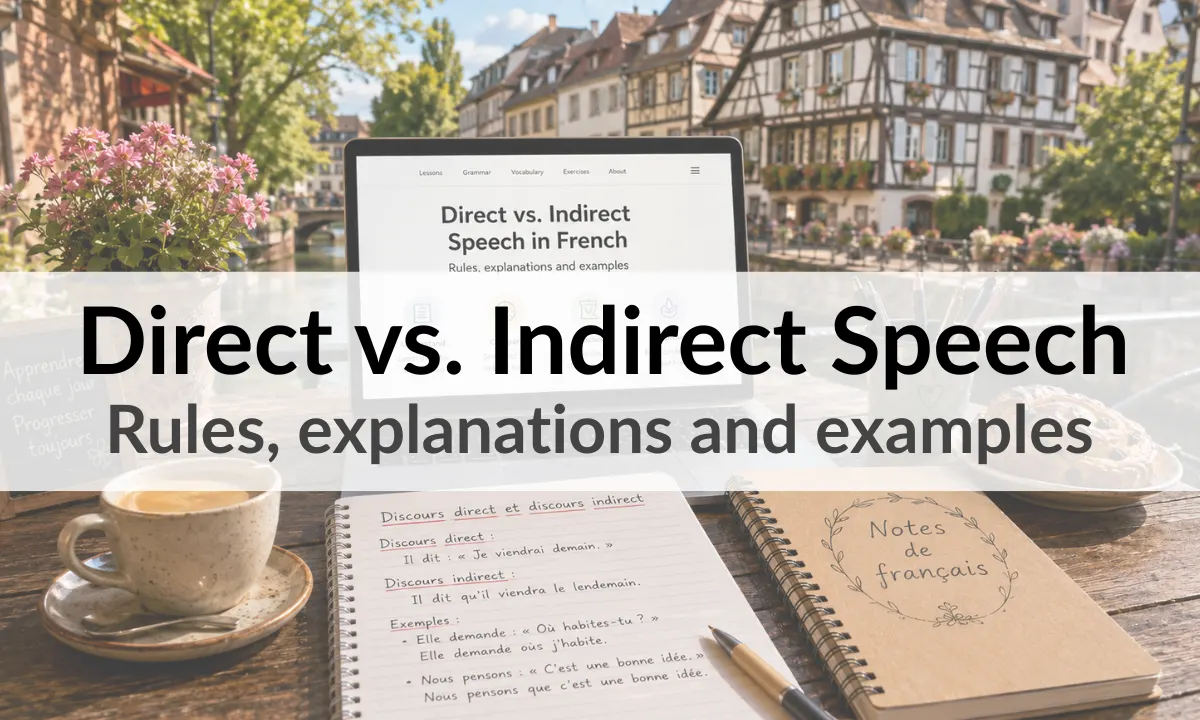
For example:
Paul dit : « J’ai faim. »
Paul says, I am hungry.
Marie demande : « Où sont les toilettes ? »
Marie asks, Where is the restroom?
With indirect speech (le discours indirect), you report what another person says without using quotation marks. Indirect speech can become more complicated because pronouns, possessive adjectives, object pronouns and verb tenses can change.
Paul dit qu’il a faim.
Paul says that he is hungry.
Marie demande où sont les toilettes.
Marie asks where the restroom is.
The basic idea is simple: direct speech quotes exact words, while indirect speech reports what someone says.
Basic rules
For statements, French often uses que in indirect speech.
Paul dit : « J’ai faim. »
Paul dit qu’il a faim.
Paul says that he is hungry.
Elle dit : « Je comprends. »
Elle dit qu’elle comprend.
She says that she understands.
For yes/no questions, French uses si.
Il demande : « Tu viens ? »
Il demande si tu viens.
He asks if you are coming.
Elle demande : « Est-ce que tu travailles ? »
Elle demande si tu travailles.
She asks if you are working.
For information questions, keep the question word, but remove est-ce que and use normal word order.
Elle demande : « Où habites-tu ? »
Elle demande où tu habites.
She asks where you live.
Il demande : « Pourquoi est-ce que tu pars ? »
Il demande pourquoi tu pars.
He asks why you are leaving.
For commands, the imperative usually becomes de + infinitive.
Il dit : « Ferme la porte. »
Il dit de fermer la porte.
He says to close the door.
Elle me dit : « Ne parle pas. »
Elle me dit de ne pas parler.
She tells me not to speak.
Agreement of tenses
When switching from direct speech to indirect speech, the tense often stays the same if the reporting verb is in the present tense.
Paul dit : « J’ai faim. »
Paul dit qu’il a faim.
Paul says that he is hungry.
Marie dit : « J’ai fini. »
Marie dit qu’elle a fini.
Marie says that she has finished.
When the reporting verb is in the past tense, the verb in indirect speech often shifts back.
Paul a dit : « J’ai faim. »
Paul a dit qu’il avait faim.
Paul said that he was hungry.
Marie a dit : « J’ai fini. »
Marie a dit qu’elle avait fini.
Marie said that she had finished.
The most common tense changes are:
présent → imparfait
passé composé → plus-que-parfait
futur simple → conditionnel présent
Il a dit : « Je travaille. »
Il a dit qu’il travaillait.
He said that he was working.
Elle a dit : « J’ai compris. »
Elle a dit qu’elle avait compris.
She said that she had understood.
Il a dit : « Je viendrai demain. »
Il a dit qu’il viendrait le lendemain.
He said that he would come the next day.
Example 1 – Le présent
In this example, the reporting verb is in the present tense: Marie dit. The tense stays the same, but mes amis becomes ses amis, and me becomes lui.
Direct speech
Marie dit : « Mes amis sont en retard et ils me rendront visite demain. »
Marie says, My friends are late and they will visit me tomorrow.
Indirect speech
Marie dit que ses amis sont en retard et qu’ils lui rendront visite demain.
Marie says that her friends are late and that they will visit her tomorrow.
Example 2 – Le passé composé
In this example, the reporting verb is in the present tense: Marie dit. The passé composé stays the same, but mon mari becomes son mari, and moi becomes elle.
Direct speech
Marie dit : « Mon mari et moi, nous sommes partis en vacances l’année dernière. »
Marie says, My husband and I went on vacation last year.
Indirect speech
Marie dit qu’elle et son mari sont partis en
l’année dernière.
Marie says that she and her husband went on vacation last year.
If the reporting verb is in the past, the tense changes.
Marie a dit qu’elle et son mari étaient partis en vacances l’année précédente.
Marie said that she and her husband had gone on vacation the previous year.
Example 3 – L’impératif
When direct speech uses the imperative, the verb usually becomes de + infinitive in indirect speech.
Direct speech
« Assieds-toi ! Ne parle pas ! Donne-moi l’argent ! »
Sit down! Do not speak! Give me the money!
Indirect speech
Il m’a dit de m’asseoir, de ne pas parler et de lui donner l’argent.
He told me to sit down, not to speak and to give him the money.
Example 4 – Indirect yes/no questions
For yes/no questions, French uses si in indirect speech. In this example, tu becomes je because I am reporting a question that was asked to me.
Direct speech
« Tu travailles ? »
« Est-ce que tu travailles ? »
Are you working?
Indirect speech
Il me demande si je travaille.
He asks me if I am working.
Example 5 – Qu’est-ce qui
In indirect speech, qu’est-ce qui becomes ce qui. Use ce qui when “what” is the subject of the verb.
Direct speech
« Qu’est-ce qui est difficile ? »
What is difficult?
Indirect speech
Il me demande ce qui est difficile.
He asks me what is difficult.
Example 6 – Qu’est-ce que
In indirect speech, qu’est-ce que becomes ce que. Use ce que when “what” is the object of the verb.
Direct speech
« Qu’est-ce que tu manges ? »
What are you eating?
Indirect speech
Il me demande ce que je mange.
He asks me what I am eating.
Example 7 – Information questions
For information questions with où, quand, comment, pourquoi, à quelle heure, etc., est-ce que disappears in indirect speech.
Direct speech
« À quelle heure est-ce que tu t’en vas ? Où est-ce que tu vas ? Quand est-ce que tu reviens ? »
What time are you leaving? Where are you going? When are you coming back?
Indirect speech
Je me demande à quelle heure il s’en va, où il va et quand il revient.
I wonder what time he is leaving, where he is going and when he is coming back.
Common changes in indirect speech
Pronouns often change because the point of view changes.
Marie dit : « Je suis prête. »
Marie dit qu’elle est prête.
Marie says that she is ready.
Possessive adjectives can also change.
Elle dit : « C’est mon livre. »
Elle dit que c’est son livre.
She says that it is her book.
Object pronouns may also change.
Il dit : « Elle me parle. »
Il dit qu’elle lui parle.
He says that she is speaking to him.
Time expressions can change when the reporting verb is in the past.
demain → le lendemain
hier → la veille
aujourd’hui → ce jour-là
la semaine prochaine → la semaine suivante
l’année dernière → l’année précédente
Il a dit : « Je pars demain. »
Il a dit qu’il partait le lendemain.
He said that he was leaving the next day.
Verbs used with indirect speech
The following verbs are commonly used to introduce indirect speech. They can be followed by que (that), si (if), où (where), quand (when), pourquoi,(why) comment (how), etc.
affirmer – to state, claim
annoncer – to announce
assurer – to assure, maintain
avouer – to admit, confess
confier – to confide
constater – to note, notice
crier – to shout
déclarer – to state, declare
demander – to ask
dire – to say, tell
expliquer – to explain
insister – to insist
observer – to observe, notice
prétendre – to claim
promettre – to promise
remarquer – to notice
répondre – to answer
révéler – to reveal
s’apercevoir – to realize
savoir – to know
se rendre compte – to realize
soutenir – to maintain, argue
📚 Related lessons
- Asking questions in French
- French object pronouns
- French possessive adjectives
- French imperative mood
- French imperfect tense
🚀 More lessons on FrenchLearner


