
Published November 8, 2025 • Updated April 1, 2026 — Lesson written by French teacher David Issokson for students who want to learn French online, with native audio by Marie Assel Cambier, a voice artist from France.
📘 Avoir meaning
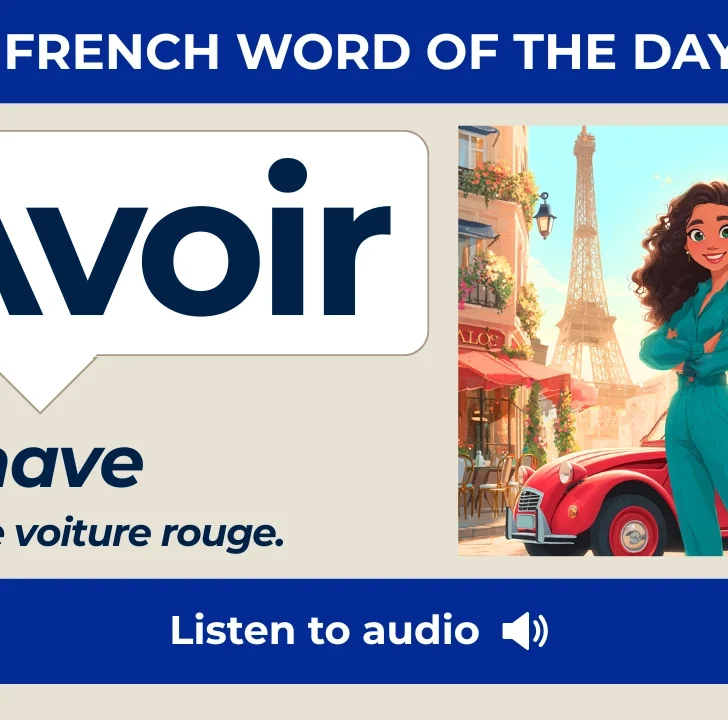
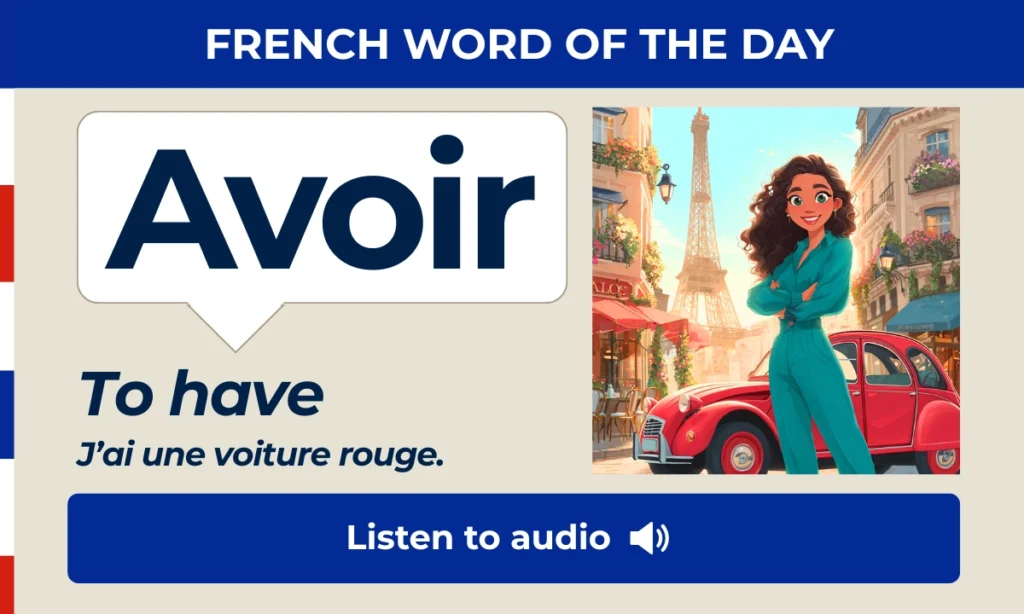
Avoir is a French verb meaning “to have.” It is used to express possession (j’ai un chien — I have a dog), age and physical sensations (j’ai faim — I’m hungry), and functions as an auxiliary verb in compound tenses such as the passé composé (j’ai mangé — I ate).
🔊 Listen to examples.
🎧 Avoir pronunciation
The pronunciation of avoir is /avwaʀ/, which sounds like “ah-vwar”.
📝 Avoir examples
1. Possession
J’ai une voiture rouge. Je la conduis tous les jours.
I have a red car. I drive it every day.
2. Age
J’ai trente ans et ma petite sœur en a vingt-deux.
I am thirty years old, and my little sister is twenty-two.
3. Physical sensations / needs
J’ai soif. Je vais boire un verre d’eau.
I’m thirsty. I’m going to drink a glass of water.
J’ai faim. Je vais manger un steak-frites au restaurant.
I’m hungry. I’m going to eat steak and fries at the restaurant.
4. Illness / feelings
J’ai mal à la tête. Je vais me reposer un peu.
I have a headache. I’m going to rest a little.
5. Idiomatic expressions
J’ai de la chance ! Franchement, j’adore mon travail !
I’m lucky! Honestly, I love my job!
👉 See also: Avoir conjugation chart (with audio) »
⚠️ Use Avoir for Age & Hungry/Thirsty
The French use avoir for talking about age, thirst, and hunger. For these expressions, never use the verb être (to be). This is a common mistake among beginners.
Rules:
Avoir + number + ans = to be x years old
Avoir faim, avoir soif = to be hungry, thirsty
✅ J’ai vingt ans. I’m 20 years old.
❌ Je suis vingt ans. I’m 20 years old.
✅ J’ai faim / soif. I’m hungry / thirsty.
❌ Je suis faim / soif. I’m hungry / thirsty.
❓ Need extra help with verbs?
🎯 French Verb Drills — Camille’s course from French Today gives you clear, step-by-step audio drills to lock in conjugation patterns.
👉 See Verb Drills »
📖 À Moi Paris — Prefer a complete self-study program? Camille’s flagship course teaches French through stories and includes verb work in real conversations.
👉 Explore À Moi Paris »
If you purchase the courses, I may earn a small commission — at no extra cost to you.
🔗 Related words and expressions
There are many useful French expressions that use avoir, but these are the most common and essential ones to learn first.
- avoir faim — to be hungry
- avoir peur (de) — to be afraid (of)
- avoir besoin de — to need
- avoir envie de — to want / to feel like
- avoir honte — to be ashamed
- avoir l’habitude de — to be used to / to have the habit of
- avoir failli — to almost
👉 See also: Avoir expressions »
🚀 Continue learning on FrenchLearner!
👉 French Word of the Day (200+ lessons) »
👉 French word meanings (hub) »
👉 French vocabulary lists »
👉 French grammar lessons »
👉 Passé composé overview »


