

Published February 8, 2026 — Lesson written by French teacher David Issokson for students who want to learn French online, with native audio by Marie Assel Cambier, a voice artist from France.
📘 Charcuterie meaning
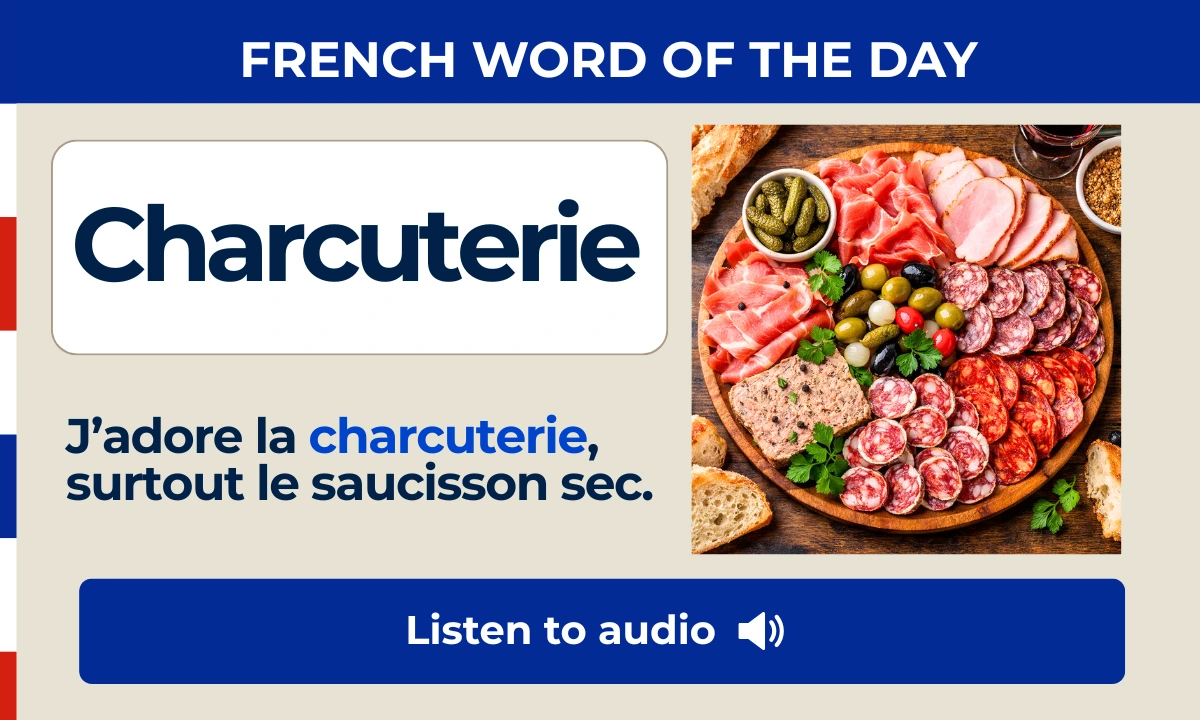
Charcuterie is a French term that refers to a range of prepared meat products, traditionally made from pork, such as ham, sausages, pâté, rillettes, and other cured, cooked, or smoked meats. In English, charcuterie is a loanword with essentially the same meaning. The word comes from the French chair (flesh) and cuit (cooked). In France, une charcuterie can also mean a delicatessen or pork butcher where these products are sold. You’ll also see une assiette de charcuterie (a plate of charcuterie) or une planche de charcuterie (a charcuterie board). 🔊 Jump to examples now
💡Cultural note
In France, charcuterie is commonly served with the apéritif, a pre-meal drink shared with family and friends. Charcuterie is also a common food served at le réveillon, which refers to both Christmas Eve and New Year’s Eve dinners. The French often buy cured meats at the charcuterie, choosing just a few slices of high-quality ham or sausage, unlike modern international “charcuterie boards” loaded with fruits, crackers, and cheeses.
🎧 Charcuterie pronunciation
The pronunciation of charcuterie is /ʃaʀkytʀi/ (IPA), which sounds roughly like “sha-ky-tree.” Pronunciation tips: For the -er, the -e is either silent or said very quickly. The IPA /y/ sound is the same -u sound you hear in tu (you, singular).
📝 Charcuterie examples
La charcuterie est un ensemble de viandes préparées comme le jambon, le saucisson, le pâté et les rillettes.
Charcuterie is a range of prepared meats such as ham, sausage, pâté, and rillettes.
Nous achetons de la charcuterie pour préparer un petit plateau pour l’apéritif.
We buy charcuterie to prepare a small platter for the aperitif.
Il adore la charcuterie, surtout le saucisson sec.
He loves charcuterie, especially dry sausage.
Elle passe à la charcuterie du quartier pour prendre du jambon.
She stops by the neighborhood deli to get some ham.
True fluency in French is achieved by vocabulary accumulation.
👉 See also: French food vocabulary (100 words with audio) »
❓ Want to feel more confident in French?
🎯 À Moi Paris — This is my top recommendation for online French courses, and it pairs wonderfully with my daily lessons. Camille Chevalier teaches with engaging audio stories that she records at three speeds. Her specialty is helping students with pronunciation and bridging the gap between textbook French and real spoken French as you hear it on the streets of Paris.
👉 Explore À Moi Paris »
👉 Read my review »
🎧 French Verb Drills — Having trouble with French verb conjugations? Camille’s audio drills break everything down step by step so you can finally lock in the patterns and speak with confidence.
If you purchase the courses, I may earn a small commission — at no extra cost to you.
🔗 Related words and expressions
- le jambon — ham
- le saucisson — sausage
- le saucisson sec — dry sausage
- le pâté — pâté
- les rillettes — shredded pork spread
- la terrine — terrine
- la viande froide — cold meat
- une planche mixte — board of charcuterie and cheeses
- un plateau de charcuterie — charcuterie platter
- une planche de charcuterie — charcuterie board
📚 Related lessons on FrenchLearner!
👉 French food vocabulary (with audio) »
👉 Réveillon (Christmas and New Years Eve) »


