
👉 See also: Par la suite — after that, subsequently »
Level A2 (Upper Beginner)
Published January 24, 2026 — Lesson written by French teacher David Issokson for students who want to learn French online, with native audio by Marie Assel Cambier, a voice artist from France.
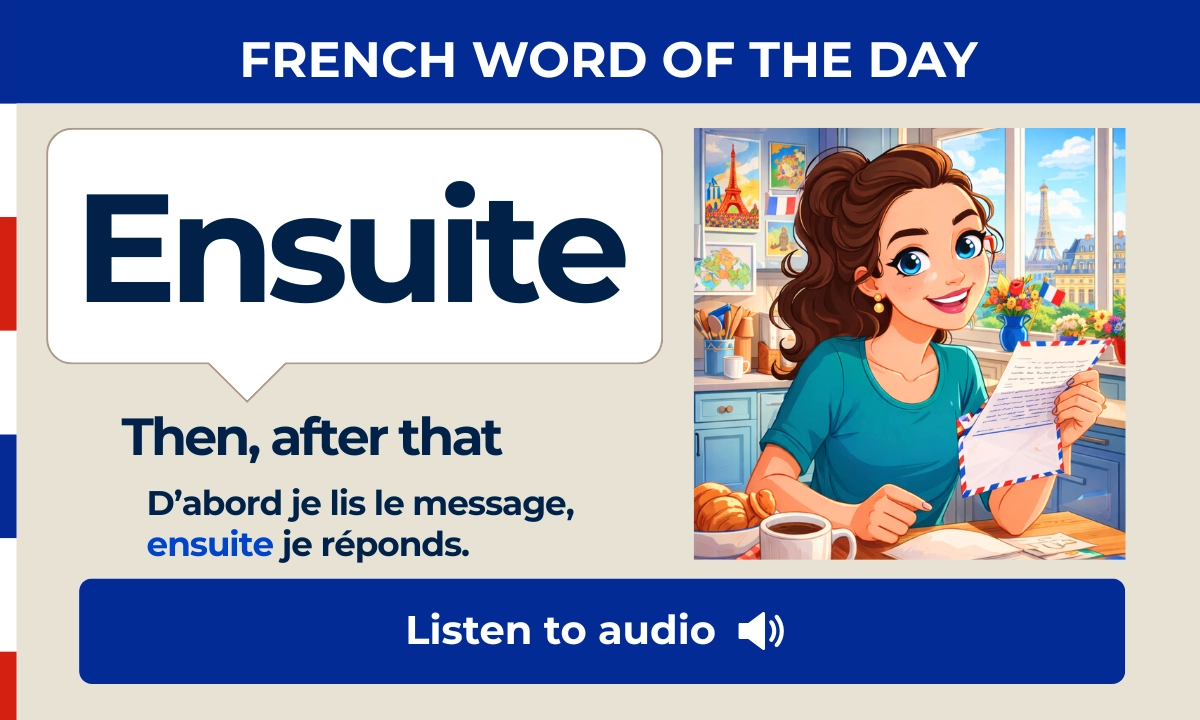
The French Word of the Day is ensuite, meaning “then” or “after that”. Learn how to use this word naturally in French when telling stories and describing events with my useful audio examples.
📘 Ensuite meaning in French
Ensuite is a French adverb meaning “then” or “after that”. It is often used to show clear sequence. It is a near-synonym of puis, though ensuite sounds slightly more structured.
➞ Je finis le travail, ensuite je rentre à la maison.
I finish the work, then I go home.
➞ J’ai mangé, puis je suis parti.
I ate, then I left.
👉 See puis lesson »
🎧 Ensuite pronunciation in French
The pronunciation of ensuite is /ɑ̃.sɥit/ (IPA), which sounds roughly like “on-sweet.” The -en is a nasal /ɑ̃/ sound. Do not pronounce the -n.
📝 Ensuite usage examples
D’abord je lis le message, ensuite je réponds.
First I read the message, then I reply.
On va au cinéma, ensuite on mange une pizza.
We go to the movies, then we eat a pizza.
👉 See also: Aller conjugation (to go) — essential verb for fluency »
Prenez ce bus, ensuite changez à la gare.
Take this bus, then change at the station.
Finissons ce projet, ensuite on fera une pause.
Let’s finish this project, then we’ll take a break.
💡 Ensuite vs. puis — What’s the difference?
Ensuite and puis both mean “then” and are often interchangeable, but they differ slightly in tone: Ensuite sounds more structured and explanatory, while puis sounds more natural and conversational.
👉 See also: Puis usage examples (with audio) »
❓ Want to feel more confident in French?
🎯 À Moi Paris — This is my top recommendation for online French courses, and it pairs wonderfully with my daily lessons. Camille Chevalier teaches with engaging audio stories that she records at three speeds. Her specialty is helping students with pronunciation and bridging the gap between textbook French and real spoken French as you hear it on the streets of Paris.
👉 Explore À Moi Paris »
👉 Read my review »
🎧 French Verb Drills — Having trouble with French verb conjugations? Camille’s audio drills break everything down step by step so you can finally lock in the patterns and speak with confidence.
If you purchase the courses, I may earn a small commission — at no extra cost to you.
🔗 Related words and expressions
- après — after
- puis — then
- plus tard — later
- par la suite — afterwards
- ensuite de cela — following that
- d’abord — first, first of all
📚 Related lessons on FrenchLearner!
👉 D’abord — Frist, first of all »
👉 Par la suite — after that, subsequently »
👉 Puis — then, next, finally »
Ensuite meaning — Frequently Asked Questions (FAQ)
What does ensuite mean in French?
In French, ensuite means “then” or “after that”. It is used to show the order of actions or events, especially when explaining what happens next.
How is ensuite used in a sentence?
Ensuite is usually placed after a comma or at the beginning of a clause to introduce the next step in a sequence. It is commonly used in instructions, explanations, and storytelling.
What is the difference between ensuite and puis?
Ensuite and puis are near-synonyms and both mean “then”. However, ensuite sounds slightly more structured and explanatory, while puis is more neutral and common in everyday spoken French.


