
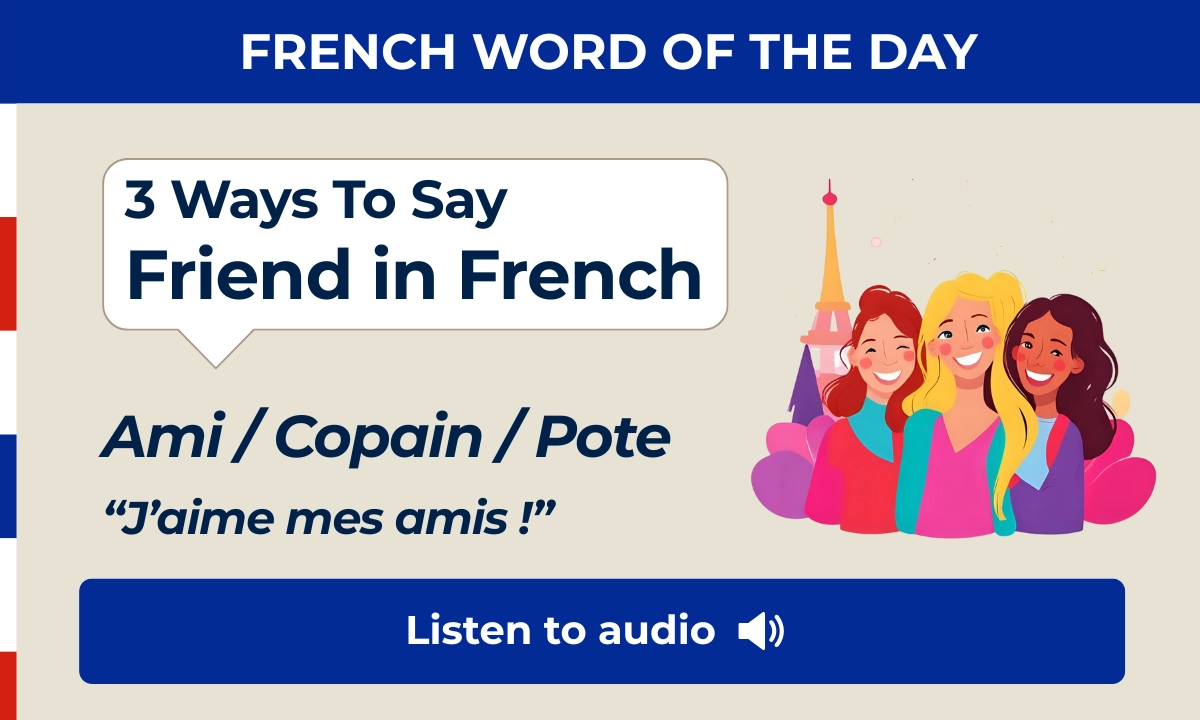
In French, there are three main ways to say “friend”: ami/amie, copain/copine, and pote (slang for “buddy”). In this lesson, you’ll learn how to pronounce these words, understand their subtle differences, and see useful expressions with each. Keep reading!
🎧 How to pronounce ami and copain
Before we go any further, let’s take a look at how to pronounce the two French words for “friend.” The pronunciation of “ami” is ah-mee. The feminine form, “amie,” is pronounced exactly the same way.
un ami, une amie
friend
The other word for friend, “copain,” is a bit trickier to pronounce. The “ain” letter combination makes a nasal sound, similar to the “in” in the word “inviter” (to invite), and is represented by the IPA symbol /ɛ̃/.
un copain, une copine
friend
🤝 How to say friend in French
1. “A friend” and “The friend”
In this section we’ll look at how to say “a friend” and “the friend” in French. “A friend” is “un ami” (masculine) or “une amie” (feminine), while “some friends” is “des amis”.
J’ai un ami à Paris.
I have a (male) friend in Paris.
J’ai une amie en Suisse.
I have a (female) friend in Switzerland.
J’ai des amis à Montréal.
I have (some) friends in Montreal.
👉 These sentences use geographical prepositions, which can cause a lot of confusion.
To say “the friend,” use “l’ami” (masculine) or “l’amie” (feminine). The pronunciation is the same in both forms because “le” and “la”, the words for “the,” both become “l’” before a vowel. The plural form, “the friends,” is “les amis”.
L’ami de Sarah s’appelle Jean.
Sarah’s friend is named Jean.
L’amie de Sylvie s’appelle Julie.
Sylvie’s friend is named Julie.
Les amis de Marc habitent au Canada.
Marc’s friends live in Canada.
👉 This page covers the French articles (le, la, les / un, une, des) in detail.
My friend
In French, “my friend” in the masculine form is “mon ami” (pronounced mohn-ah-mee). The feminine form is also “mon amie” — not “ma amie”, because “mon” is used before a vowel sound, even with feminine nouns. Both forms are pronounced exactly the same.
mon ami, mon amie
my friend
“My friends” in French is “mes amis” in the masculine or mixed form, and “mes amies” in the feminine form. Both are pronounced the same: mays-ah-mee.
Thomas est mon ami. Thomas is my friend.
Sarah est mon amie aussi. Sarah is also my friend.
Thomas et Sarah sont mes amis.
Thomas and Sarah are my friends.
2. Copain / copine – another to say friend in French
As mentioned above, the word “copain” (masculine) and “copine” (feminine) also mean “friend” in French. Generally speaking, copain is slightly less formal than ami. For example, “un bon copain” could translate to “a good buddy” or “a good pal.”
Put another way, ami can suggest a more serious or long-term friend, whereas copain often refers to a more casual friend — or even a friendly acquaintance.
J’ai un copain à Paris.
I have a friend in Paris.
Julie est une copine de Sarah.
Julie is Sarah’s friend.
Nous avons quelques copains à Londres.
We have a few friends in London.
👉 This lesson dives deeper into copain / copine, explaining the linguistic nuances.
Need more help?
🗼 À Moi Paris is my top recommendation for self-study. I’ve known Camille from French Today since 2016 — her courses are excellent. Try it out or read my review.
If you purchase the courses, I may earn a small commission — at no extra cost to you.
3) Boyfriend and girlfriend in French
In French, the word for “boyfriend” is “un petit copain”, which literally translates to “a little friend.” The word for “girlfriend” is “une petite copine.”
Marc est le petit ami de Julie.
Marc is Julie’s boyfriend.
Julie est la petite amie de Marc.
Julie is Marc’s girlfriend.
Interestingly, the meanings of “copain” and “copine” become boyfriend and girlfriend when proceeded by the possessive adjectives (mon and ma). Observe:
Marc est un copain.
Marc is a friend.
Marc est mon copain.
Marc is my boyfriend.
Or:
Sylvie est une copine.
Sylvie is a friend.
Sylvie est ma copine.
Sylvie is my girlfriend.
Ex-boyfriend and ex-girlfriend
In French, to say ex-boyfriend or ex-girlfriend, simply put “ex” before petit ami / petite amie or copain / copine. You can also use ancien / ancienne. For example:
Marc est l’ex-petit ami de Julie. → Marc is Julie’s ex-boyfriend.
Julie est l’ancienne petite copine de Marc. → Julie is Marc’s ex-girlfriend.
4. How to say pal and buddy in French
French has a fun word used to express “pal” or “buddy”: “un pote”. Pote also translates to “mate” and “bro”. For example:
Salut mon pote ! Ça va?
Hey buddy! How’s it going?
Friendship in French
The French word for “friendship” is “l’amitié” (pronounced amee-tee-ay; feminine noun). For example, “Notre amitié dure depuis le lycée.” (Our friendship has lasted since high school).
amitié
friendship
Expressions with ami / amie in French
- Meilleur ami / meilleure amie — best friend
- Vieil ami / vieille amie or ami(e) de longue date — old friend / longtime friend
- Ami(e) proche or ami(e) de cœur — close friend / dear friend
- Ami(e) de la famille — family friend
- Ami(e) peu fiable — fair-weather friend (literally “unreliable friend”)
- Ami commun / amie commune — mutual friend
🚀 Continue growing your French vocabulary!
👉 French Word of the Day »
👉 French Vocabulary lists »
👉 French for beginners guide »
👉 French song lyrics hub »
👉 French conjugations hub »


