
Published March 9, 2026 — Lesson written by French teacher David Issokson for students who want to learn French online, with native audio by Marie Assel Cambier, a voice artist from France.
The French Word of the Day is macaron, the brightly colored bite-sized pastry. We’ll look at some common macaron flavors and, more importantly, the difference between “macaron” in French and “macaroon” in English.
📘 Macaron meaning in French
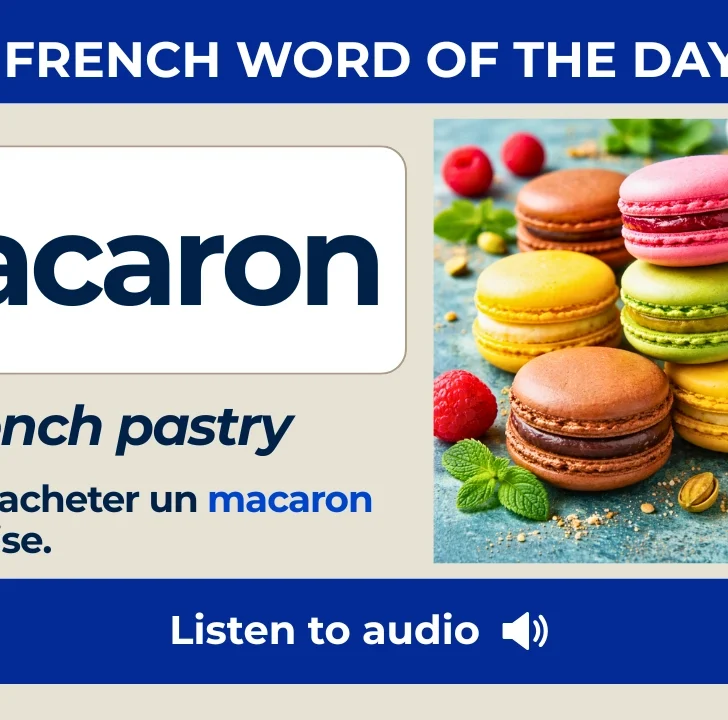
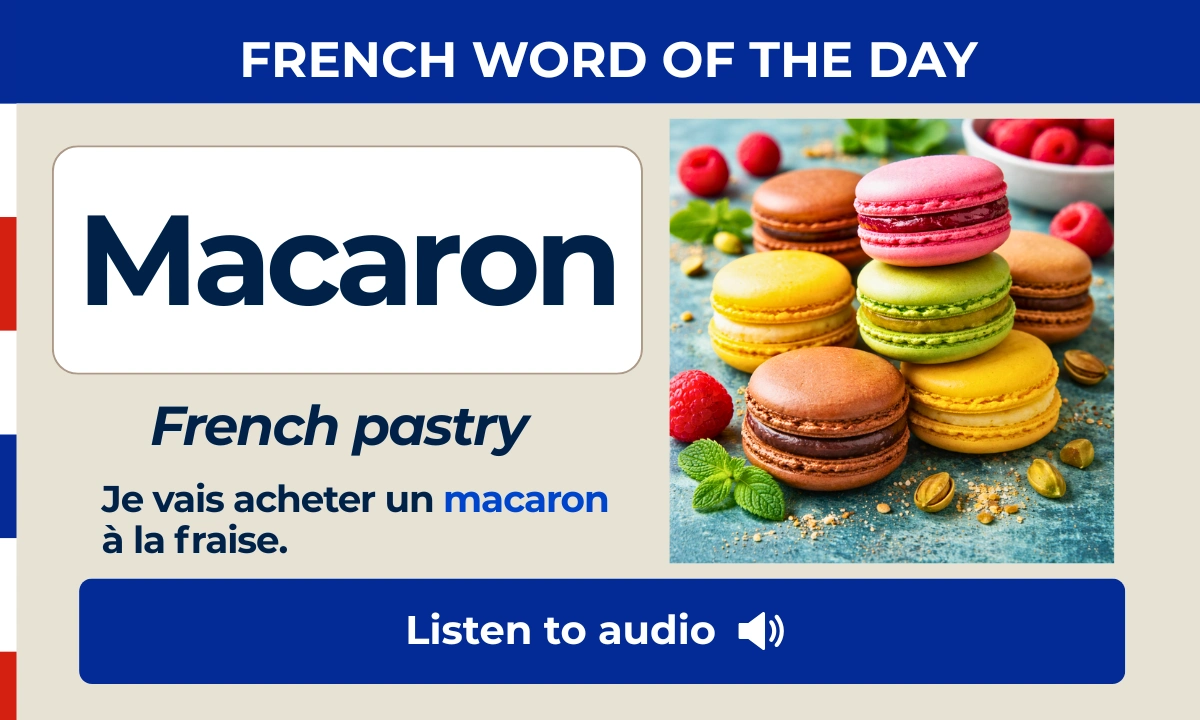
A macaron (m.) is a small French pastry made from almond flour, egg whites, and sugar. It consists of two light meringue shells with a filling such as ganache, buttercream, or jam. Macarons are known for their bright colors because pastry chefs often tint the shells to match the flavor—pink for raspberry, green for pistachio, yellow for lemon, and so on.
🎧 Macaron pronunciation in French
The pronunciation of macaron is /ma.ka.ʁɔ̃/ (IPA), which sounds roughly like “mah-kah-ron.”
❓ Macaron in French vs. macaroon in English
It is important not to confuse macaron with the English word macaroon. A macaroon is a different cookie made mainly from shredded coconut and egg whites. In French, this coconut cookie is usually called un rocher à la noix de coco or un congolais. A helpful way to remember the difference is that macarOn (one “o”) is the colorful French almond pastry, while macarOOn (two “o’s”) is the coconut cookie.
🧁 Most common macaron flavors
👉 le macaron au chocolat — chocolate macaron
👉 le macaron à la framboise — raspberry macaron
👉 le macaron à la pistache — pistachio macaron
👉 le macaron à la vanille — vanilla macaron
👉 le macaron au caramel au beurre salé — salted caramel macaron
📝 Macaron usage examples
Je vais acheter un macaron à la fraise.
I am going to buy a strawberry macaron.
👉 See also: Aller conjugation chart (to go) »
Lequel de ces macarons choisiras-tu ?
Which of these macarons will you choose?
Il aimerait goûter ce macaron à l’amande.
He would like to taste this almond macaron.
J’ai acheté un macaron au chocolat dans une petite pâtisserie.
I bought a chocolate macaron in a small pastry shop.
The millefeuille is another famous French dessert and also happens to be one of the hardest words to pronounce in French language.
👉 See also: millefeuille pronunciation »
❓ Want to feel more confident in French?
🎯 À Moi Paris — This is my top recommendation for online French courses, and it pairs wonderfully with my daily lessons. Camille Chevalier teaches with engaging audio stories that she records at three speeds. Her specialty is helping students with pronunciation and bridging the gap between textbook French and real spoken French as you hear it on the streets of Paris.
👉 Explore À Moi Paris »
👉 Read my review »
🎧 French Verb Drills — Having trouble with French verb conjugations? Camille’s audio drills break everything down step by step so you can finally lock in the patterns and speak with confidence.
If you purchase the courses, I may earn a small commission — at no extra cost to you.
🔗 Related words and expressions (pastries)
- le millefeuille — millefeuille (layered puff pastry with cream)
- le croissant — croissant
- le pain au chocolat — chocolate-filled pastry
- l’éclair — éclair (choux pastry filled with cream and topped with icing)
- la tarte aux pommes — apple tart
📚 Related lessons on FrenchLearner!
👉 Soufflé »
👉 Millefeuille »
👉 French desserts »
👉 French pastry names »
👉 Pâtisserie (pastry, pastry shop) »
👉 French food vocabulary »


