
👉 See also: Monsieur — Mr., Sir »
Level: A1–A2 (Beginner)
🎧 Audio by Marie Assel Cambier, a native speaker & professional voice artist from France
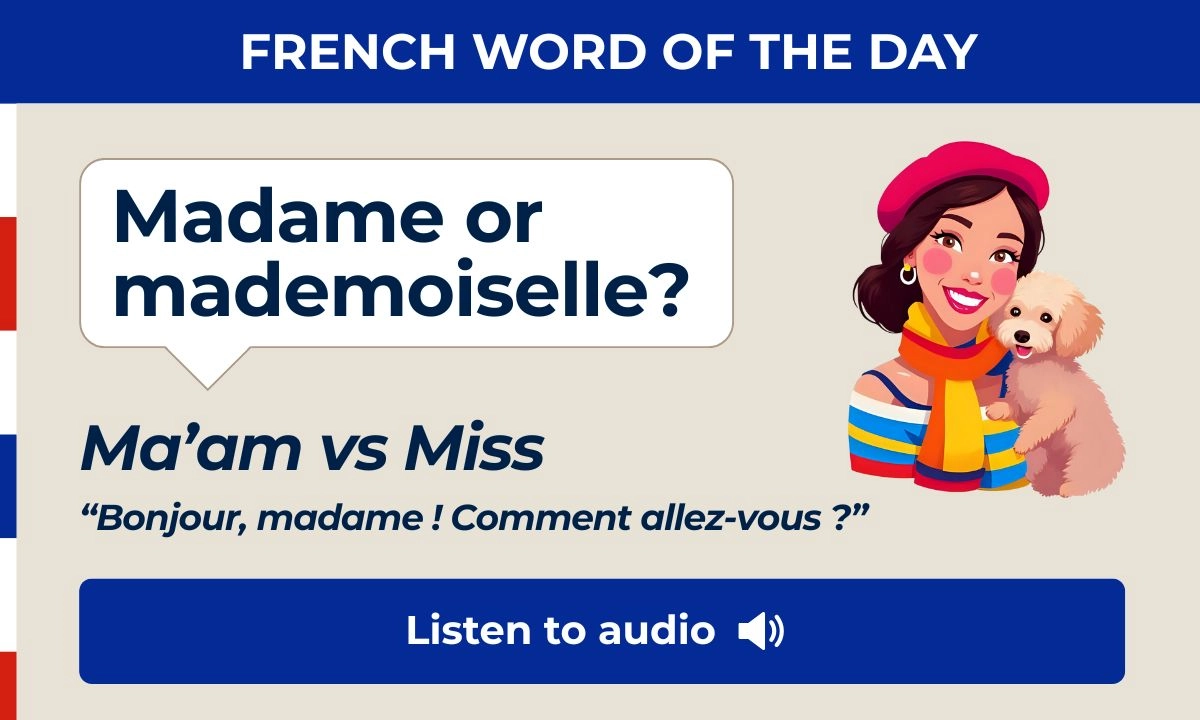
Today’s French Words of the Day are madame and mademoiselle — “Ma’am / Mrs.” and “Miss.” Choosing correctly is key to good etiquette in France. This lesson explains the history and nuances so you’ll know exactly which to use.
✅ Meaning
✅ Pronunciation
✅ Explanation
✅ Example sentences
✅ Related Words & Expressions
✅ Related lessons
Subscribe to the French Word of the Day
📘 Madame and mademoiselle meaning
Madame is the standard way to address an adult woman in French, similar to “Ma’am” or “Mrs.” in English.
Mademoiselle once meant “Miss,” traditionally used for young or unmarried women. Today, it’s largely outdated — even viewed as sexist — and is rare outside playful remarks or when speaking to very young girls.
📜 Madame or Mademoiselle? — Cultural and Historical Nuances
For centuries, French etiquette linked a woman’s title to her marital status: madame for married women, mademoiselle for those unmarried.
By the late 20th century, many considered mademoiselle discriminatory. In 2012, the French government removed it from administrative forms, promoting madame as the default for adult women.
Nowadays, most speakers — especially younger ones — choose madame regardless of age or marital status. Older people may still use mademoiselle out of habit, and you might hear it jokingly or as a compliment in casual settings.
The clear exception is with very young girls, where mademoiselle (or jeune fille, “young girl”) remains appropriate and polite.
🎧 Madame and mademoiselle pronunciation
- Madame — /ma.dam/ — “mah-dahm” (final e is very light).
- Mademoiselle — /mad.mwa.zɛl/ — “mad-mwah-zel.”
📝 French and English examples
Madame vs Mademoiselle – “Madam” and “Miss”
Bonjour, madame ! Comment allez-vous ?
Hello, ma’am! How are you?
Madame Dupont est notre professeure.
Mrs. Dupont is our teacher.
Mademoiselle, votre table est prête.
Miss, your table is ready.
Elle n’est plus mademoiselle, elle est madame.
She’s no longer “mademoiselle,” she’s “madame.“
👩🏫 Looking for a great French teacher?
I often get asked who I recommend for structured lessons. Since 2016 I’ve trusted Camille from French Today — a native speaker and experienced teacher who’s brilliant at explaining cultural nuances. Her À Moi Paris program uses engaging audio stories to teach the real French you’ll hear every day.
👉 Try the course »
📖 Read my review »
If you purchase the courses, I may earn a small commission — at no extra cost to you.
🔗 Related words and expressions
- monsieur — sir; male equivalent
- messieurs-dames — ladies & gentlemen
- jeune fille — young girl
- fillette — little girl
- madame la présidente — female official title
- Mesdames, Messieurs… — speech opening
- Mademoiselle d’honneur — bridesmaid
🚀 Continue growing your French vocabulary!
Now that you’ve mastered madame and mademoiselle, take a look at my lesson on garçon (boy, or male waiter) — a word that can also spark debate because of its outdated usages.
👉 Master garçon »
Discover more on FrenchLearner
👉 Beginners French – Start Here! »
👉 French Word of the Day »
👉 French song lyrics hub »
👉 French Vocabulary lists »


