
Level A2 (Upper Beginner)
🎧 Audio by Marie Assel Cambier, a native speaker & professional voice artist from France
The French Word of the Day is rendez-vous, meaning “meeting,” “appointment,” or “date.” It’s one of the most common gallicisms, a French word borrowed directly into English. In this lesson, you’ll learn what rendez-vous really means, how to pronounce it, and how to use it naturally in everyday French conversation.
✅ Meaning
✅ Pronunciation
✅ Example sentences
✅ Related Words & Expressions
Subscribe to the French Word of the Day
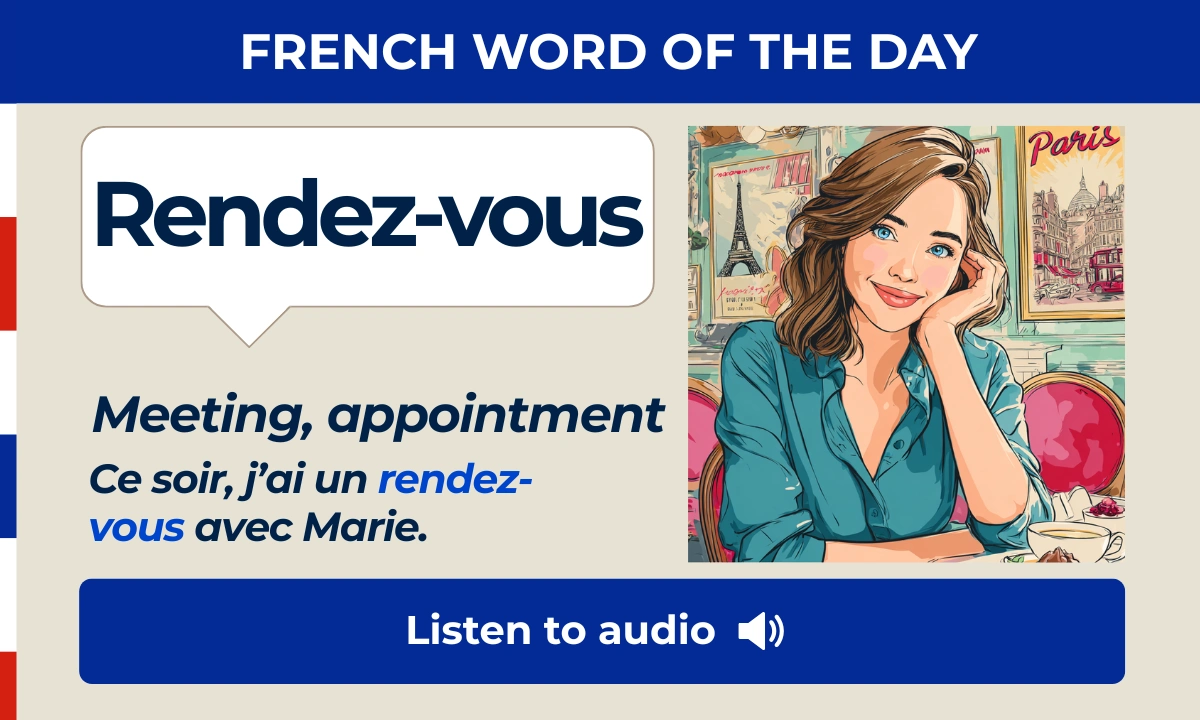
📘 Rendez-vous meaning
The French word rendez-vous can mean “meeting,” “appointment,” “rendezvous,” “date,” or even “meeting place,” depending on the context. You’ll often hear avoir un rendez-vous (to have an appointment) and prendre un rendez-vous (to make or schedule an appointment).
Interestingly, rendezvous is a gallicism — a word borrowed directly from French and used in English. When used in English, the hyphen is dropped, so it’s written rendezvous instead of rendez-vous.
🗒️ Article usage
You can say either avoir un rendez-vous or simply avoir rendez-vous — both are correct. The version without the article (avoir rendez-vous) is slightly more idiomatic and common in speech, while the version with the article (avoir un rendez-vous) sounds a bit more specific, emphasizing a particular appointment.
🎧 Rendez-vous pronunciation
👉 The pronunciation of rendez-vous is /ʁɑ̃.de.vu/ — roughly “rahn-deh-voo.”
📝 Rendez-vous example sentences
Ce soir, j’ai rendez-vous avec Marie… notre premier rendez-vous !
Tonight I have a date with Marie… our first date!
J’ai un rendez-vous chez le coiffeur demain.
I have an appointment at the hairdresser’s tomorrow.
On se donne rendez-vous à 18h, d’accord ?
Let’s meet at 6 p.m., okay?
Ce café est le rendez-vous des étudiants du quartier.
This café is the meeting place for the students in the neighborhood.
👉 Check out my lesson on c’est la vie (that’s life), another gallicism. »
🤔 Rendez-vous vs. réunion — What’s the difference?
In French there are two words for “meeting”: un rendez-vous and une réunion. Rendez-vous usually means an appointment or meeting between a few people, while réunion refers to a more organized or formal group meeting, often in a professional context.
👉 J’ai un rendez-vous chez le dentiste.
I have an appointment at the dentist’s.
👉 J’ai une réunion avec mon équipe cet après-midi.
I have a meeting with my team this afternoon.
🇫🇷 Need more help learning French?
Many readers have told me they love the daily Word of the Day, but still feel they need more help. If that’s you, I highly recommend À Moi Paris, the flagship audio program from French Today. Camille teaches French through engaging real-life stories, recorded at three speeds — and it’s available for all levels.
👉 Try the course »
👉 Read my review »
If you purchase a course, I may earn a small commission — at no extra cost to you.
🔗 Related words and expressions
- un rendez-vous amoureux — romantic date
- un rendez-vous médical — doctor’s appointment
- un lieu de rendez-vous — meeting place
- se donner rendez-vous — to arrange to meet, to set a meeting
- prendre un rendez-vous — to make an appointment
- fixer un rendez-vous — to set up an appointment or meeting
- annuler un rendez-vous — to cancel an appointment
- une rencontre — a meeting, encounter, or date
🚀 Continue growing your French vocabulary!
👉 French Word of the Day »
👉 French adverbs overview »
👉 French Vocabulary lists »
👉 French for beginners guide »
👉 French song lyrics hub »
👉 French conjugations hub


