
Level A2 – B1 (Upper Beginner / Lower Intermediate)
Updated December 13, 2025 — Lesson written by French teacher David Issokson for students who want to learn French online, with native audio by Marie Assel Cambier, a voice artist from France.
The French Word of the Day is touché, which literally means “touched.” This is a French loanword that we all know very well: “Touché!” — Good point! But do the French really use touché in natural conversation, and what does it actually mean? Keep reading and everything will become very clear with Marie’s native audio examples.
✅ Meaning
✅ Pronunciation
✅ Example sentences
✅ Related Words & Expressions
Subscribe to the French Word of the Day
📘 Touché meaning
Depending on the context, touché in French has several meanings and can express agreement, impact, or emotional reaction, which is why it doesn’t have a single fixed translation in English. In conversation, touché ! acknowledges that someone has made a good or accurate point, often with a light or slightly ironic tone — the same way the English borrowed expression “touché!” is used.
Touché is also the past participle of toucher (to touch), meaning “touched,” and is used more literally to describe being hit or affected, either physically (la ville a été touchée par la tempête — the city was hit by the storm) or emotionally (j’ai été touché par son discours — I was touched by his speech).
🤺 Cultural note — fencing origin
The expression touché comes from fencing, where it is called out to signal that an opponent has been successfully hit and scores a point. From this idea of a clean, undeniable hit, the word later took on its conversational meaning of conceding a good point in an argument. This fencing origin explains why touché ! often feels sharp, precise, and final when used in speech.
🎧 Touché pronunciation
The pronunciation of touché is /tu.ʃe/, which sounds like “too-SHAY.”
📝 Touché examples & usages
1. Acknowledging a good point in an argument
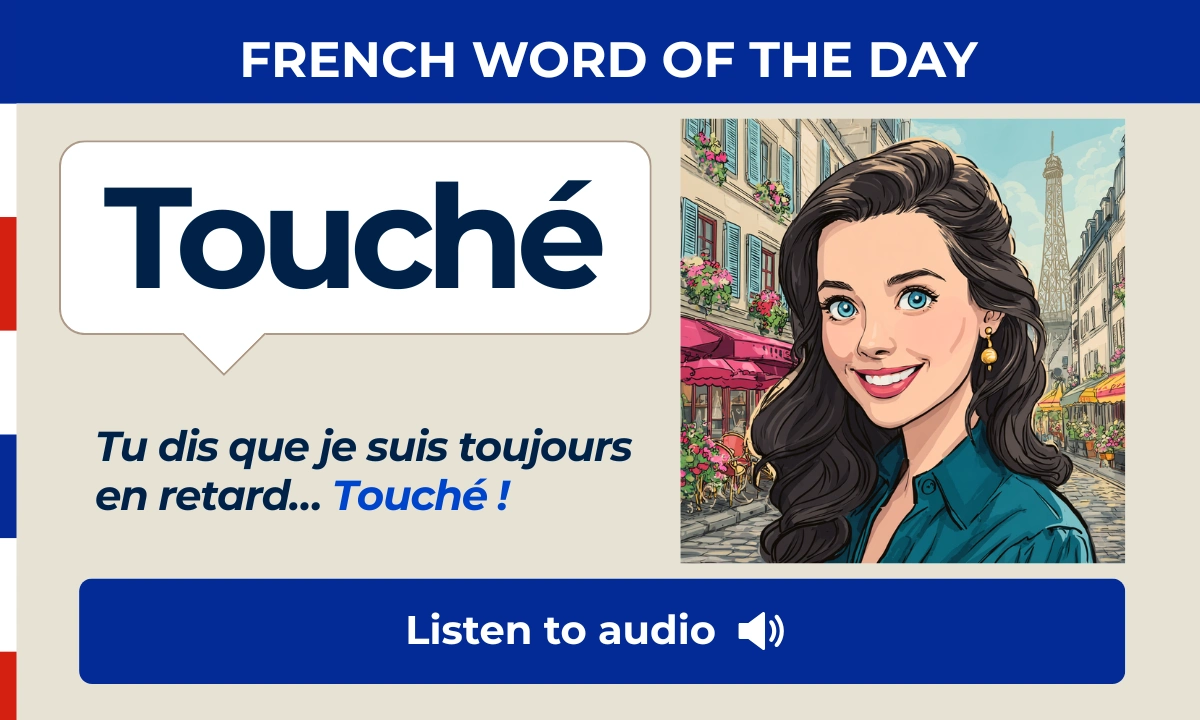
Tu dis que je suis toujours en retard… Touché !
You say I’m always late… touché!
2. In sports or games (esp. fencing origin)
L’adversaire a crié “Touché !” après le coup.
The opponent shouted “touché!” after the strike.
3. Figurative sense = “touched, moved” (emotionally or physically)
J’ai été touché par son discours.
I was touched by his speech.
4. Metaphorical / extended use (natural disaster, tragedy, missiles, illness)
La ville a été touchée par la tempête.
The city was hit by the storm.
Looking for another great quick word you can interject into converation? Try “d’accord !”, meaning “okay” or “alright.”
👉 See: D’accord — meaning, pronunciation, and examples »
❓ Want to feel more confident in French?
🎯 À Moi Paris — This is my top recommendation for online French courses, and it pairs wonderfully with my daily lessons. Camille Chevalier teaches with engaging audio stories that she records at three speeds. Her specialty is helping students with pronunciation and bridging the gap between textbook French and real spoken French as you hear it on the streets of Paris.
👉 Explore À Moi Paris »
👉 Read my review »
🎧 French Verb Drills — Having trouble with French verb conjugations? Camille’s audio drills break everything down step by step so you can finally lock in the patterns and speak with confidence.
If you purchase the courses, I may earn a small commission — at no extra cost to you.
🔗 Related words and expressions
- bien vu — well spotted
- tu marques un point — you score a point
- atteindre — to affect / hit
- frapper — to strike / hit
- être atteint(e) — to be affected
- ému(e) — moved
- bouleversé(e) — deeply shaken
🚀 Continue learning French online on FrenchLearner!
👉 French Word of the Day »
👉 French Vocabulary lists »
👉 French for beginners guide »
👉 French song lyrics hub »
👉 French conjugations hub »


