
Level A2–B1 (Upper Beginner / Lower Intermediate)
Lesson written by French teacher David Issokson for students who want to learn French online, with native audio by Marie Assel Cambier, a voice artist from France.
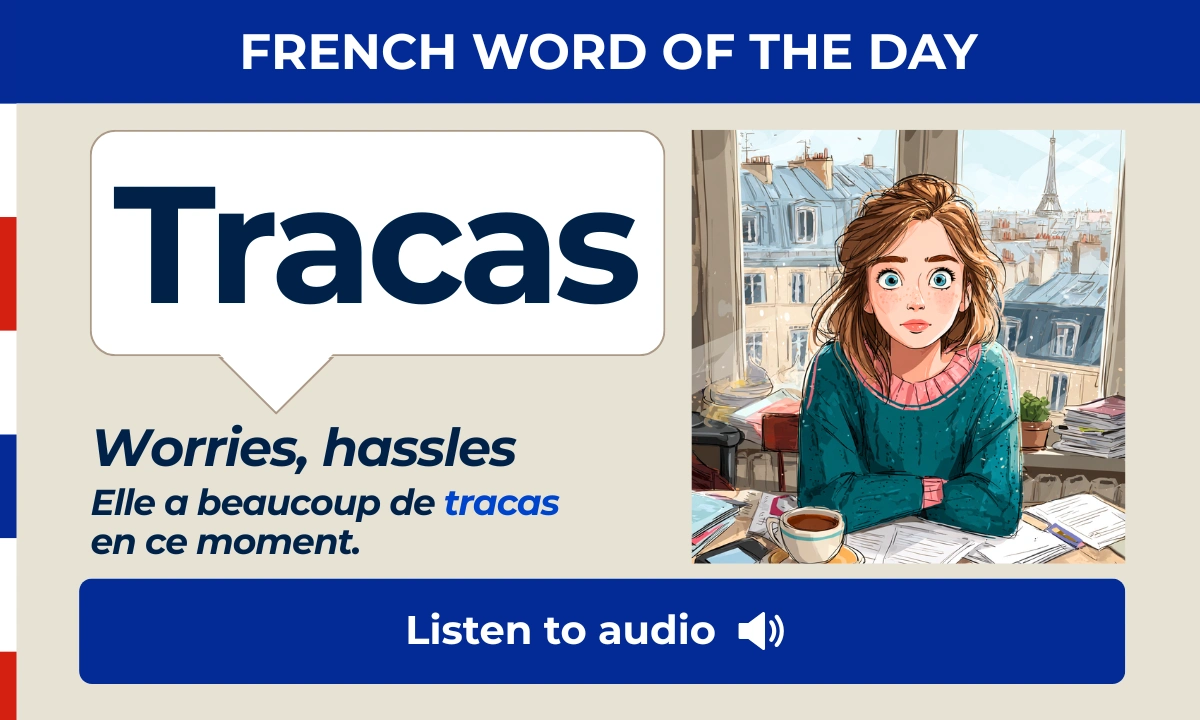
The French Word of the Day is tracas, meaning “worries” or “hassles”. I picked this word because you’ll almost never see it in the textbooks, yet it’s the super useful “real” French you’ll hear all the time in France. Keep reading and you’ll have a great new word for talking about your everyday worries!
✅ Meaning
✅ Pronunciation
✅ Example sentences
✅ Related Words & Expressions
Subscribe to the French Word of the Day
📘 Tracas meaning
Tracas (m) is a common French noun meaning “worries,” “hassles,” or “troubles.” It’s almost always used in the plural — des tracas — to talk about the everyday problems or stresses that weigh on your mind, especially the small personal annoyances of daily life. You’ll hear it in natural expressions like avoir des tracas (to have worries), se faire du tracas (to worry) or oublier ses tracas (to forget your troubles).
Synonyms for tracas
➜ le problème — very neutral, everyday
➜ le souci — neutral, slightly emotional
➜ le tracas — neutral, softer / slightly literary
➜ la galère — slang (colloquial)
🎧 How to pronounce tracas in French
👉 The pronunciation of tracas is /tʁa.ka/ — roughly trah-kah.
📝 Tracas example sentences
Elle a beaucoup de tracas en ce moment.
She has a lot of worries at the moment.
Il veut partir en vacances pour oublier ses tracas.
He wants to go on vacation to forget his worries.
Ce problème m’a causé bien des tracas.
This problem has caused me a lot of trouble.
Ne te fais pas de tracas, tout ira bien.
Don’t worry, everything will be fine.
👉 Useful and fun related expression: Pas de souci! (no worries!) »
🇫🇷 Interested in learning the real spoken French?
Most apps only teach isolated words and sentences. À Moi Paris is different — my friend Camille teaches the essential grammar and vocabulary while weaving in the authentic spoken French you’ll actually hear in France. Her lessons are built around engaging audio stories recorded at three speeds, making it easy to follow and improve naturally.
👉 Try the course »
👉 Read my review »
If you purchase a course, I may earn a small commission — at no extra cost to you.
🔗 Related words and expressions
- le souci — a worry, concern
- l’ennui — trouble, difficulty
- le problème — problem
- se faire du souci — to worry
- ne te fais pas de souci / de tracas — don’t worry
- avoir des ennuis — to have trouble
- s’inquiéter — to worry
📚 Related Word of the Day lesson
🚀 Continue learning French online on FrenchLearner!
👉 French Word of the Day »
👉 French Vocabulary lists »
👉 French for beginners guide »
👉 French song lyrics hub »
👉 French conjugations hub »


