
Published May 24, 2020 • Updated July 13, 2026 — By French teacher David Issokson, teaching French online since 2014
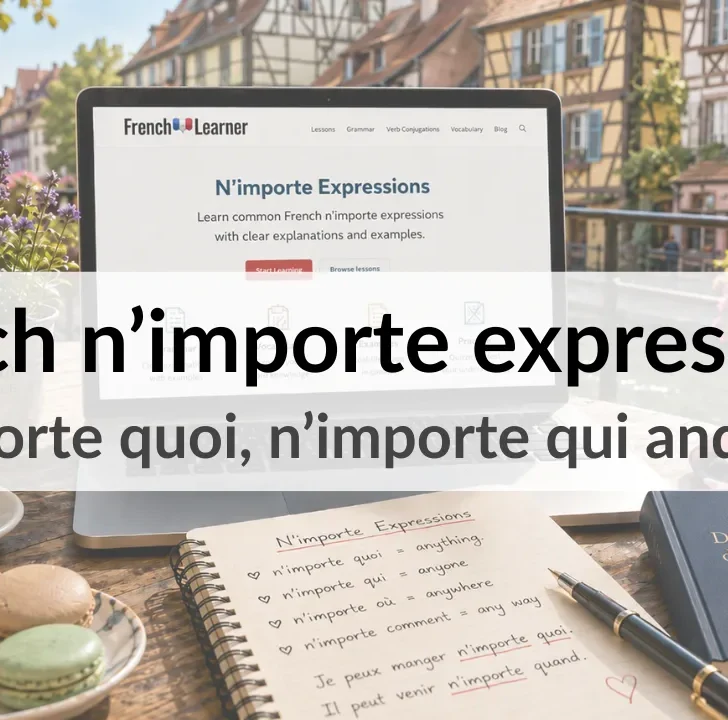
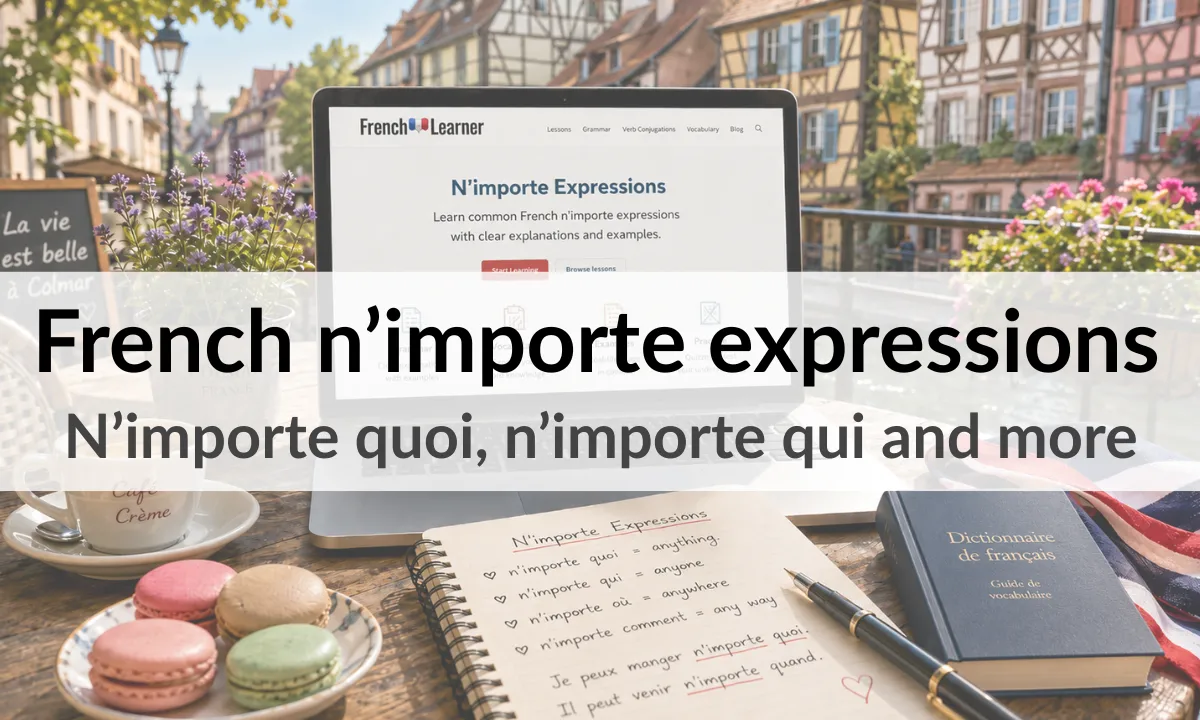
The French expression n’importe is used to express ideas such as “any,” “anyone,” “anything,” “anywhere” and “whichever.” It is usually combined with a question word, such as qui (who), quoi (what), où (where), quand (when) or comment (how). These expressions are extremely common in everyday spoken and written French. For example, “Tu peux choisir n’importe quoi.” (You can choose anything.)
What does n’importe mean?
The expression n’importe comes from il n’importe, meaning “it does not matter.” In modern French, however, it is rarely used alone. It normally appears as part of a longer expression.
The underlying meaning is generally “any,” “no matter which” or “it does not matter.”
Common expressions with n’importe
N’importe quoi — anything; nonsense
N’importe qui — anyone; anybody
N’importe où — anywhere
N’importe quand — anytime; whenever
N’importe comment — anyhow; in any way; carelessly
N’importe quel / quelle / quels / quelles — any; whichever
N’importe lequel / laquelle / lesquels / lesquelles — any one; whichever one
N’importe combien — any amount; no matter how much
N’importe quoi — Anything or nonsense
N’importe quoi usually means “anything.”
Tu peux manger n’importe quoi.
You can eat anything.
Elle ferait n’importe quoi pour ses enfants.
She would do anything for her children.
In informal French, n’importe quoi can also mean “nonsense,” “ridiculous” or “complete rubbish.”
Il raconte n’importe quoi.
He’s talking nonsense.
C’est n’importe quoi !
That’s ridiculous!
👉 N’importe quoi – complete lesson »
N’importe qui — Anyone
N’importe qui means “anyone” or “anybody.” It can also mean “just anybody,” especially in a negative sentence.
N’importe qui peut apprendre le français.
Anyone can learn French.
Je ne sors pas avec n’importe qui !
I don’t go out with just anybody!
Tu peux demander à n’importe qui.
You can ask anyone.
👉 N’importe qui appears in the lyrics of the song Les Champs Elysées by Joe Dassin.
N’importe où — Anywhere
N’importe où means “anywhere.”
On peut aller n’importe où.
We can go anywhere.
Tu peux t’asseoir n’importe où.
You can sit anywhere.
Je pourrais vivre n’importe où en France.
I could live anywhere in France.
N’importe quand — Anytime
N’importe quand means “anytime” or “whenever.”
Tu peux venir n’importe quand.
You can come anytime.
Appelez-moi n’importe quand.
Call me anytime.
Nous pouvons partir n’importe quand.
We can leave whenever.
N’importe comment — Anyhow or carelessly
N’importe comment can mean “in any way” or “however you like.”
Tu peux organiser les livres n’importe comment.
You can arrange the books any way you like.
It can also have a negative meaning and describe something done badly or carelessly.
Il fait son travail n’importe comment.
He does his work carelessly.
Il chante n’importe comment ! Quelle horreur !
He sings terribly! How awful!
N’importe quel — Any or whichever
N’importe quel means “any” or “whichever” and comes directly before a noun.
It agrees in gender and number with the noun:
N’importe quel — masculine singular
N’importe quelle — feminine singular
N’importe quels — masculine plural
N’importe quelles — feminine plural
Tu peux acheter n’importe quel fromage.
You can buy any cheese.
Choisis n’importe quelle robe.
Choose any dress.
N’importe quels documents feront l’affaire.
Any documents will do.
Elle peut répondre à n’importe quelles questions.
She can answer any questions.
N’importe lequel — Any one or whichever one
N’importe lequel means “any one” or “whichever one.” Unlike n’importe quel, it replaces the noun instead of coming before it.
It also agrees in gender and number:
N’importe lequel — masculine singular
N’importe laquelle — feminine singular
N’importe lesquels — masculine plural
N’importe lesquelles — feminine plural
Quel morceau de gâteau veux-tu ? N’importe lequel me convient.
Which piece of cake do you want? Any one is fine with me.
Quelle chemise préfères-tu ? N’importe laquelle.
Which shirt do you prefer? Any one.
Tu peux prendre n’importe lesquels.
You can take any of them.
N’importe quel vs. n’importe lequel
Use n’importe quel before a noun:
Choisis n’importe quel livre.
Choose any book.
Use n’importe lequel when the noun has already been mentioned:
Voici plusieurs livres. Choisis n’importe lequel.
Here are several books. Choose any one.
N’importe combien — Any amount or no matter how much
N’importe combien refers to an unspecified amount or quantity. It can mean “any amount” or “no matter how much.”
Tu peux en prendre n’importe combien.
You can take any amount.
Il dépenserait n’importe combien pour cette voiture.
He would spend any amount on that car.
In many situations, French speakers instead use expressions such as peu importe combien or quel que soit le montant.
Peu importe combien j’ai dormi, je suis toujours fatigué.
No matter how much I slept, I am still tired.
N’importe as an interjection
In informal French, n’importe may occasionally be used on its own to mean “it doesn’t matter,” “either one” or “any one.”
Quelle chemise veux-tu ? N’importe.
Which shirt do you want? Either one.
However, speakers more commonly say:
N’importe laquelle.
Either one.
Peu importe.
It doesn’t matter.
Ça m’est égal.
I don’t mind.
Ce n’est pas n’importe qui
The expression ce n’est pas n’importe qui means that someone is important, impressive or not just an ordinary person.
Ce n’est pas n’importe qui : c’est une actrice célèbre.
She’s not just anybody: she’s a famous actress.
The same structure can be used with things.
Ce n’est pas n’importe quel restaurant.
This isn’t just any restaurant.
Ce n’est pas n’importe quoi.
This is no ordinary thing.
Related expressions
Peu importe — it does not matter
Qu’importe — what does it matter
Ça m’est égal — I do not mind; it is all the same to me
Quel que soit — whatever; whichever
Qui que ce soit — anyone at all
Où que ce soit — anywhere at all
🇫🇷 Add structure to your learning with an audio course
Want to improve both your spoken French and your verb skills? I’ve recommended Camille’s French Today courses for years.
À Moi Paris is excellent for learning natural spoken French through realistic audio.
👉 Discover À Moi Paris »
👉 Read my review »
French Verb Drills helps you master the verbs and patterns that appear throughout lessons like this one.
👉 Discover French Verb Drills »
👉 Read my review »
If you purchase the courses, I may earn a small commission — at no extra cost to you.
📚 Related lessons
🚀 More lessons on FrenchLearner


