

Lesson written by French teacher David Issokson with native audio by Marie Assel Cambier, a voice artist from France.
This lesson teaches 20 ways to say hello in French — greetings you’ll actually hear on the streets of Paris and across France.
1. Bonjour — Hello / Good morning
Bonjour means both “good morning” and “hello.” It’s the most common French greeting and can be used throughout the day in almost any situation.
2. Salut — Hi / Bye (informal)
Salut means “hi” and is used between friends, classmates, or people your age. It’s also used to say “bye.” Avoid using salut in very formal situations.
3. Bonsoir — Good evening
Bonsoir means “good evening.” It’s the polite greeting to use after about 6 p.m., when bonjour starts to sound out of place.
4. Coucou — Hey there
Coucou is a super friendly, informal way to say “hi there!” It’s often used with children, close friends, or in text messages.
5. Bien le bonjour — Well hello! (old-fashioned)
Bien le bonjour literally means “well, hello!” It’s an old-fashioned or theatrical greeting you might hear jokingly, but it’s not common in everyday conversation.
6. Bienvenue — Welcome
Bienvenue means “welcome” and can also be used as a greeting when someone arrives.
Example: “Bienvenue à Paris !” — “Welcome to Paris!”
7. Ça gaze ? — How’s it going? (slang)
Ça gaze ? is a slightly dated slang expression that means “How’s it going?” or “What’s up?” The literal translation is “It gasses?” but in practice, it means “Everything okay?”
8. Quoi de neuf ? — What’s new?
Quoi de neuf ? literally means “What’s new?” It’s a casual way to ask how someone’s doing or what’s been happening, as in “Salut, quoi de neuf ?” (Hey, what’s new?).
9. Allô — Hello (on the phone)
Allô is only used when answering the phone, as in “Allô ? Oui, c’est moi !” (Hello? Yes, it’s me!).
10. Enchanté(e) — Nice to meet you
Enchanté(e) both means “Nice to meet you.” For example, Enchanté de faire votre connaissance means “Nice to meet you.” The -e is added for feminine speakers.
11. Ça roule ? — How’s it going? (casual)
Ça roule ? literally means it rolls and is a friendly way to say “How’s it going?” You can reply Ça roule ! — “It’s going great!”
12. Ça fait longtemps ! — Long time no see!
Ça fait longtemps ! means it’s been a long time, or long time no see. Use it when you meet someone you haven’t seen for a while.
13. Ça baigne ? — Everything going smoothly?
Ça baigne ? literally means it bathes but is a slangy way to ask “Everything okay?” or “All good?” You can answer Oui, ça baigne ! — “Yep, all good!”
14. Quoi de beau ? — What’s up? / What’s new?
Quoi de beau ? translates literally to what’s beautiful and is another casual “What’s up?” type greeting that shows curiosity about what’s going on in someone’s life.
15. Salut toi ! — Hey you!
Salut toi ! means “Hey you!” and is very familiar and affectionate. Use it with friends, kids, or people you’re close to.
16. Salut mon grand / ma grande — Hey big guy / big girl
Salut mon grand (to a male) and Salut ma grande (to a female) are warm, friendly greetings for siblings, kids, or older peers you know well.
17. Salut ma belle — Hi beautiful
Salut ma belle means “Hi beautiful!” It’s an affectionate greeting for a woman you’re close to, whether romantic or friendly.
18. Tiens, un revenant ! — Hello stranger!
Tiens, un revenant ! literally means well, a ghost and is used jokingly when someone you haven’t seen in a long time shows up.
19. Salut ma puce — Hi honey / sweetheart
Salut ma puce literally means hi my flea, but ma puce is a common term of endearment like “sweetie” or “honey.”
20. Bon matin — Good morning (Canada only)
Bon matin means “Good morning!” but is used only in Quebec and other parts of French-speaking Canada — not in France.
🎧 Learn French the fun way — with Camille’s À Moi Paris course!
If you’re a beginner, I highly recommend the À Moi Paris audio course by French Today. It’s a fun, story-based program taught by my friend Camille, an experienced French teacher I’ve personally known since 2016. You’ll hear real-life conversations, build confidence, and finally understand how French is spoken naturally.
👉 Try the course »
👉 Read my review »
If you purchase the courses, I may earn a small commission — at no extra cost to you.
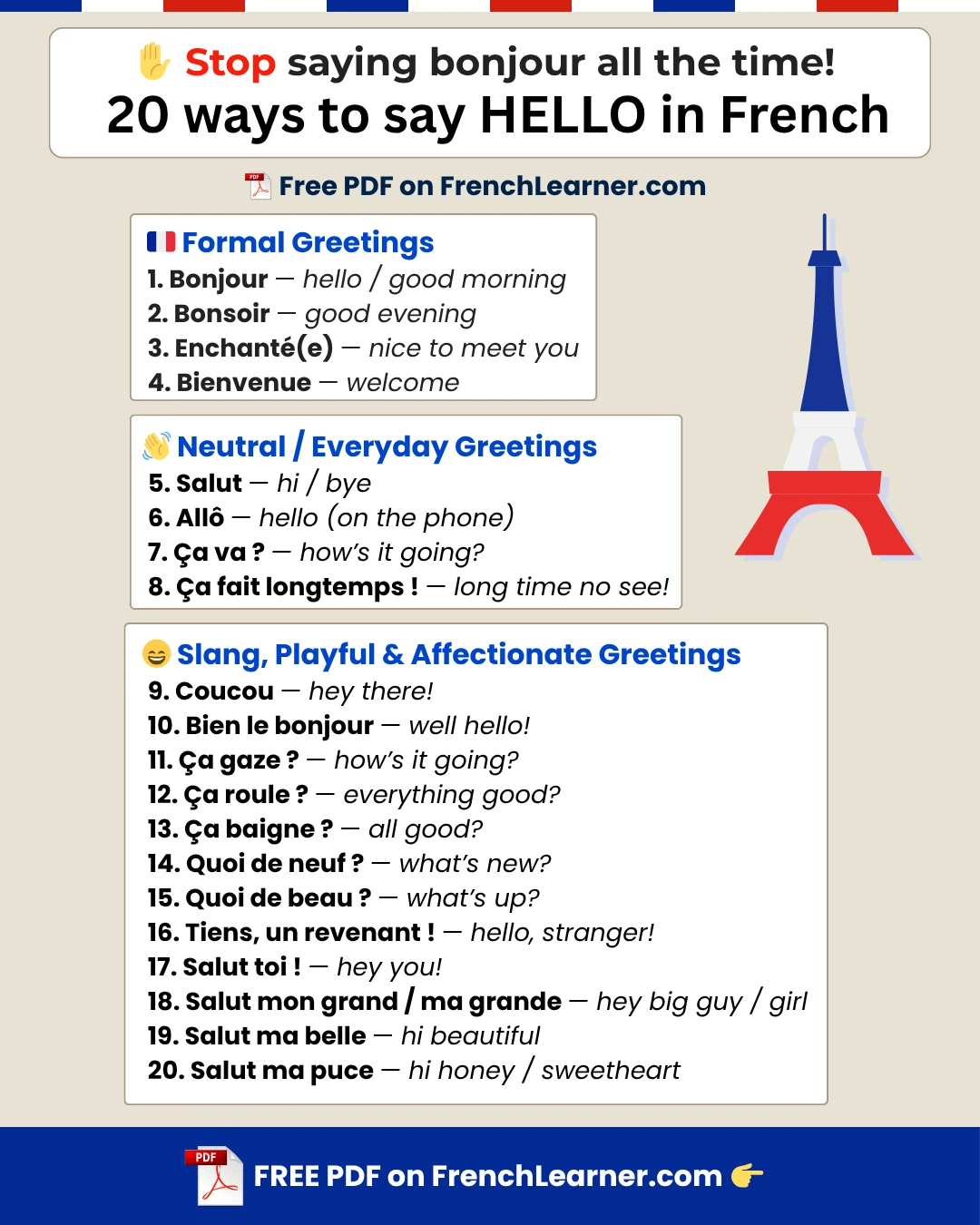
🖼️ Here’s a quick recap you can save or share:
📚 Related lessons
👉 Bonjour (hello) »
👉 French Greetings »
👉 Goodbye in French »
🚀 Continue growing your French vocabulary!
👉 French Word of the Day »
👉 French Vocabulary lists »
👉 French for beginners guide »
👉 French numbers 1-100 »
👉 French song lyrics hub »
👉 French conjugations hub »


