
Published August 14, 2026 — By French teacher David Issokson with native audio by Marie Assel Cambier
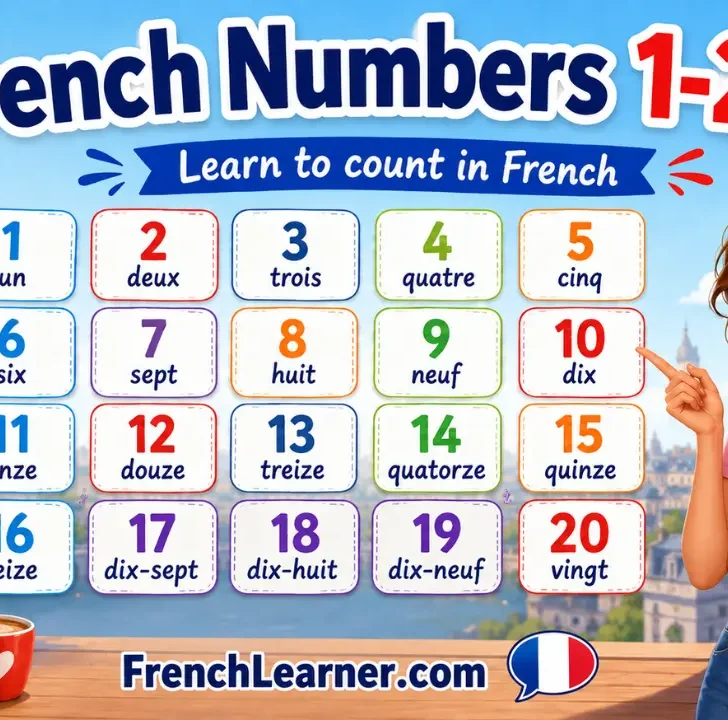
Learning the French numbers 1-20 is an essential first step for beginners. The table below shows how to count from one to twenty in French, with an easy pronunciation guide and native French audio for every number.
| Number | French | Sounds like |
|---|---|---|
| 1 | un | uhn |
| 2 | deux | duh |
| 3 | trois | trwah |
| 4 | quatre | katr |
| 5 | cinq | sank |
| 6 | six | sees |
| 7 | sept | set |
| 8 | huit | weet |
| 9 | neuf | nuhf |
| 10 | dix | dees |
| 11 | onze | onz |
| 12 | douze | dooz |
| 13 | treize | trehz |
| 14 | quatorze | kah-torz |
| 15 | quinze | kanz |
| 16 | seize | sehz |
| 17 | dix-sept | dees-set |
| 18 | dix-huit | deez-weet |
| 19 | dix-neuf | deez-nuhf |
| 20 | vingt | van |
The “sounds like” spellings above are only approximations. French has several sounds, particularly nasal vowels, that do not have exact equivalents in English. The audio on the page will help you to hear the correct pronunciation.
French Numbers 1-10
The French numbers 1-10 are the foundation for learning how to count in French.
1 — un
2 — deux
3 — trois
4 — quatre
5 — cinq
6 — six
7 — sept
8 — huit
9 — neuf
10 — dix
The first ten numbers are worth memorizing individually. You’ll use them constantly for telling time, giving prices, talking about age, counting objects and forming larger French numbers.
French Numbers 11-20
Here are the French numbers 11-20:
11 — onze
12 — douze
13 — treize
14 — quatorze
15 — quinze
16 — seize
17 — dix-sept
18 — dix-huit
19 — dix-neuf
20 — vingt
Numbers 11 through 16 each have their own forms, so they need to be memorized.
Starting with 17, however, French becomes much more logical:
dix-sept = ten-seven = 17
dix-huit = ten-eight = 18
dix-neuf = ten-nine = 19
The numbers 17, 18 and 19 are written with hyphens.
How to Count to 20 in French
To count from 1 to 20 in French, say:
un, deux, trois, quatre, cinq, six, sept, huit, neuf, dix, onze, douze, treize, quatorze, quinze, seize, dix-sept, dix-huit, dix-neuf, vingt.
A good way to learn these numbers is to practice them in small groups:
1-5: un, deux, trois, quatre, cinq
6-10: six, sept, huit, neuf, dix
11-16: onze, douze, treize, quatorze, quinze, seize
17-20: dix-sept, dix-huit, dix-neuf, vingt
Listen to the native audio and repeat each group aloud several times before trying to count from 1 to 20 without looking.
How to Pronounce French Numbers 1-20
Some French numbers have sounds that can be difficult for English speakers at first.
Un
Un means “one.” Its vowel is nasal, meaning some of the air passes through the nose when you pronounce it. The approximate pronunciation “uhn” is useful for beginners, but listening to a native speaker is the best way to learn the sound.
Deux
Deux sounds approximately like “duh,” but the French vowel is pronounced with rounded lips.
Trois
Trois sounds approximately like “trwah.” The final s is silent when the number is pronounced by itself.
Cinq
Cinq sounds approximately like “sank.” The vowel is nasal and the final q is pronounced like a k when counting.
Six
When counting, six sounds like “sees.”
It’s pronounced “see” when it precedes a noun starting with a consonant.
J’ai six livres.
I have six books.
It’s pronounced “seez” with a liaison when it precedes a noun starting with a vowel.
J’ai six amis.
I have six friends.
Huit
Huit sounds approximately like “weet” when counting. The letter h is not pronounced.
Dix
The same pronunciation rules for six apply to dix.
J’ai dix pommes.
I have ten apples.
J’ai dix ans.
I am ten years old.
Vingt
Vingt has the same pronounciation is vin (wine), with a nasal “in” which sounds like /vɛ̃/ IPA. There’s a liaison on the -t when it’s followed by a noun starting with a vowel.
J’ai vingt ans.
I’m 20 years old.
Un vs. Une: The Number One in French
The French number un has a feminine form: une.
Use un with masculine nouns.
J’ai un frère.
I have one brother.
Use une with feminine nouns.
J’ai une sœur.
I have one sister.
The other French numbers do not change according to gender.
J’ai deux frères.
I have two brothers.
J’ai deux sœurs.
I have two sisters.
Using French Numbers in Sentences
Here are several examples of the French numbers 1-20 in everyday sentences.
J’ai trois enfants.
I have three children.
Nous avons dix minutes.
We have ten minutes.
Elle a douze ans.
She is twelve years old.
Il y a quinze personnes dans la salle.
There are fifteen people in the room.
J’ai dix-huit euros.
I have eighteen euros.
Le billet coûte vingt euros.
The ticket costs twenty euros.
French Numbers 17, 18 and 19
Numbers 17, 18 and 19 are particularly easy once you know the word dix (ten).
17 — dix-sept
literally “ten-seven”
18 — dix-huit
literally “ten-eight”
19 — dix-neuf
literally “ten-nine”
This pattern is different from 11-16, which have their own individual words.
Don’t forget the hyphens in dix-sept, dix-huit and dix-neuf.
Once you’ve mastered the French numbers 1-20, the next step is learning the numbers up to 100, including the special patterns used for 21, 70, 80 and 90.
Need extra help with the French numbers?
I’ve known French teacher Camille Chevalier for many years and recommend her audio course: Mastering French Numbers. After each lesson you can test yourself with drills recorded at 3 different speeds.
👉 Discover Mastering French Numbers »
If you purchase the course, I may earn a small commission — at no extra cost to you.
📚 Related lessons
👉 French numbers 1-100 »
👉 Telling time in French »
👉 Combien (how much?) »
🚀 Continue learning on FrenchLearner!
👉 French Word of the Day »
👉 French A1 lessons »
👉 French verb conjugations »
👉 French vocabulary lists »
👉 French song lyrics »
👉 French grammar lessons »


