
Published April 27, 2026 — By French teacher David Issokson
The passé composé and imparfait are the two most important French past tenses. The passé composé is used for completed past actions, while the imparfait (imperfect) is used for background descriptions, habits, and actions in progress. Learn the difference with clear rules and easy examples.
Passé composé vs imparfait: quick answer
Use the passé composé for:
✅ Finished actions
✅ Specific events
✅ Changes or sudden actions
✅ What happened next in a story
Use the imparfait for:
✅ Ongoing past actions
✅ Repeated habits
✅ Descriptions in the past
✅ Weather, feelings, age, time
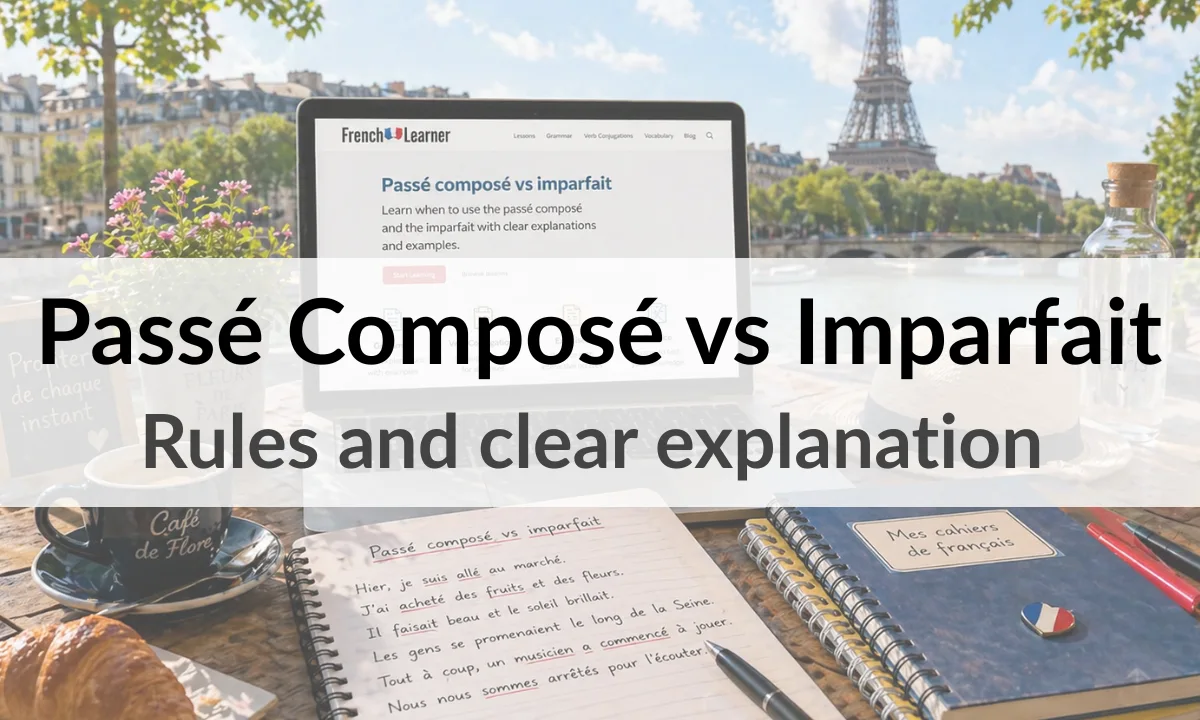
Passé composé = completed past actions
Use the passé composé when something happened and was completed.
J’ai mangé.
I ate.
Elle est arrivée à midi.
She arrived at noon.
Nous avons fini le travail.
We finished the work.
Imparfait = ongoing past actions, habits, descriptions
Use the imperfect for things that used to happen, were happening, or describe the situation.
Quand j’étais enfant, je jouais au football.
When I was a child, I used to play soccer.
Il pleuvait.
It was raining.
Nous regardions la télé.
We were watching TV.
Passé composé vs imparfait in one sentence
Very often, the imparfait gives the background and the passé composé gives the main event.
Je dormais quand le téléphone a sonné.
I was sleeping when the phone rang.
Nous dînions quand Marie est arrivée.
We were having dinner when Marie arrived.
Il lisait quand la lumière s’est éteinte.
He was reading when the light went out.
Repeated habit vs one specific event
Use the imperfect for habits and the passé composé for one completed event.
Je visitais ma grand-mère chaque dimanche.
I used to visit my grandmother every Sunday.
J’ai visité ma grand-mère dimanche dernier.
I visited my grandmother last Sunday.
Description vs action
Use the imparfait to describe the scene. Use the passé composé for what happened.
Il faisait froid et le vent soufflait.
It was cold and the wind was blowing.
Soudain, la porte s’est ouverte.
Suddenly, the door opened.
Common clue words
Imparfait often appears with:
Passé composé often appears with:
- soudain (suddenly)
- tout à coup (all of a sudden)
- un jour (one day)
- hier (yesterday)
- ce matin (this morning)
Passé composé vs imparfait summary table
| Use | Passé composé | Imparfait |
|---|---|---|
| Finished action | ✅ | |
| Habit / repeated past action | ✅ | |
| Description | ✅ | |
| Interrupted action | ✅ | |
| Main event in story | ✅ | |
| Specific completed event | ✅ |
📚 French verb tenses
- Passé composé
- Imperfect tense (imparfait)
- Present tense
- Future tense (futur simple)
- Near future tense (futur proche)
- Conditional (conditionnel)
- Subjunctive (subjonctif)
- Imperative mood (impératif)
Verb conjugations


