
Level A2 (Upper Beginner)
Lesson written by French teacher David Issokson for students who want to learn French online, with native audio by Marie Assel Cambier, a voice artist from France.
The French Word of the Day is cul-de-sac, meaning “dead-end street.” This word has always fascinated me, from childhood through my French teaching career. Why does French use the idea of the “bottom” or “end of a bag” to describe a dead end? How is it pronounced in French? And why did English borrow such an unusual expression? You’ll love Marie’s audio examples today — keep reading!
✅ Meaning
✅ Pronunciation
✅ Example sentences
✅ Related Words & Expressions
✅ Related lessons
Subscribe to the French Word of the Day
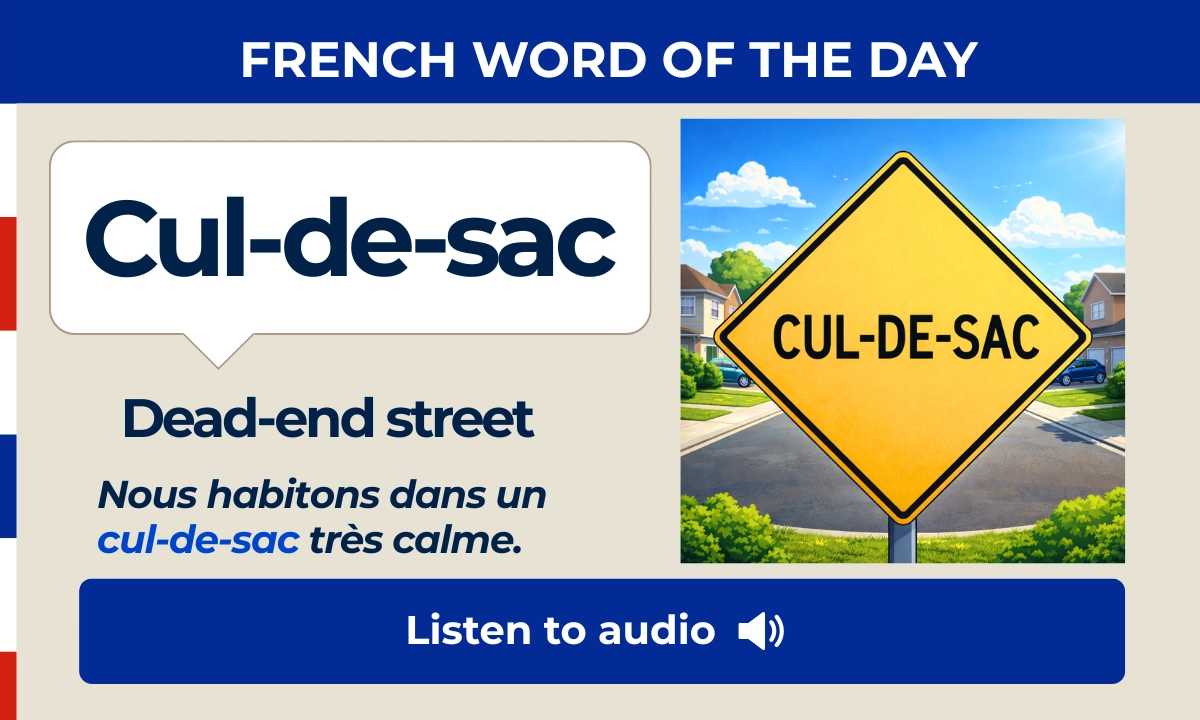
📘 Cul-de-sac meaning
Cul-de-sac means “dead-end street” or “dead end” in French. It’s a French loanword, but the pronunciation in French (kewd-sak) is completely different from the way the -l is pronounced in English. In French, cul means “bottom” or “buttocks,” (anatomical term) and sac means “bag,” so the literal translation is “the bottom of a bag,” an image for a place with no way through. Despite this origin, modern European French rarely uses cul-de-sac in everyday speech. Instead, a dead-end street is usually called une impasse or une rue sans issue.
⚜️ Historical note
Historically, cul-de-sac entered English in the 18th century, at a time when English borrowed many French terms for urban planning, anatomy, and technical concepts. Over time, English kept the expression and made it standard, while French usage shifted toward simpler alternatives like impasse. In Quebec, however, cul-de-sac is still commonly used and widely understood.
🎧 Cul-de-sac pronunciation in French
The pronunciation of cul-de-sac is most commonly /kyl.sak/ (IPA) in natural, everyday French, which sounds like “kewd-sak.” This happens because the weak e sound in de is usually dropped in fast speech.
You may also hear /ky.də.sak/, where the e in de is clearly heard, sounding like “kew-duh-sak.” This version is correct, but it sounds slightly slower or more deliberate.
For learners, kewd-sak is the French pronunciation you’ll hear most often and the one Marie has used in the example sentences below.
📝 Cul-de-sac examples & usages
Nous habitons dans un cul-de-sac très calme.
We live on a very quiet cul-de-sac.
J’ai garé ma voiture au fond du cul-de-sac.
I parked my car at the end of the dead-end street.
Le taxi ne peut pas passer ; c’est un cul-de-sac.
The taxi can’t get through; it’s a dead end.
Il y a un petit parc au bout du cul-de-sac.
There is a small park at the end of the cul-de-sac.
Le projet est dans un cul-de-sac pour le moment.
The project is at a dead end for the moment.
Curious about je ne sais quoi, another fun loanword? It means “a special something” and in this lesson we’ll look at its pronunciation and usages.
👉 Je ne sais quoi — Meaning, pronunciation, examples »
❓ Want to feel more confident in French?
🎯 À Moi Paris — This is my top recommendation for online French courses, and it pairs wonderfully with my daily lessons. Camille Chevalier teaches with engaging audio stories that she records at three speeds. Her specialty is helping students with pronunciation and bridging the gap between textbook French and real spoken French as you hear it on the streets of Paris.
👉 Explore À Moi Paris »
👉 Read my review »
🎧 French Verb Drills — Having trouble with French verb conjugations? Camille’s audio drills break everything down step by step so you can finally lock in the patterns and speak with confidence.
If you purchase the courses, I may earn a small commission — at no extra cost to you.
🔗 Related words and expressions
- une impasse — a dead end (street or situation)
- une rue sans issue — a dead-end street
- au fond de la rue — at the end of the street
- au bout de la rue — at the end of the street
- un sens interdit — no-way street, wrong way
- faire demi-tour — to turn around
- se garer — to park
- un quartier résidentiel — a residential neighborhood
📚 Related lessons on FrenchLearner!
👉 La rue (street) — meaning, pronunciation, examples
👉 Asking and giving directions in French
👉 French words used in English
🚀 Continue learning French online on FrenchLearner!
👉 French Word of the Day »
👉 French Vocabulary lists »
👉 French for beginners guide »
👉 French song lyrics hub »
👉 French conjugations hub »


