
Published December 12, 2025 — By French teacher David Issokson with native audio by Marie Assel Cambier
Je ne sais quoi meaning
Je ne sais quoi literally means “I don’t know what,” but in French it’s used to describe an indefinable, special quality — a certain charm or unique appeal that you can’t easily explain. It suggests a subtle, almost mysterious element that makes someone or something stand out, even if you can’t put your finger on why. Je-ne-sais-quoi is hyphenated when the expression functions as a noun.
Je ne sais quoi pronunciation
The pronunciation of je-ne-sais-quoi is /ʒə nə sɛ kwa/, which sounds like “zhuh nuh say kwah.”
Je ne sais quoi example sentences
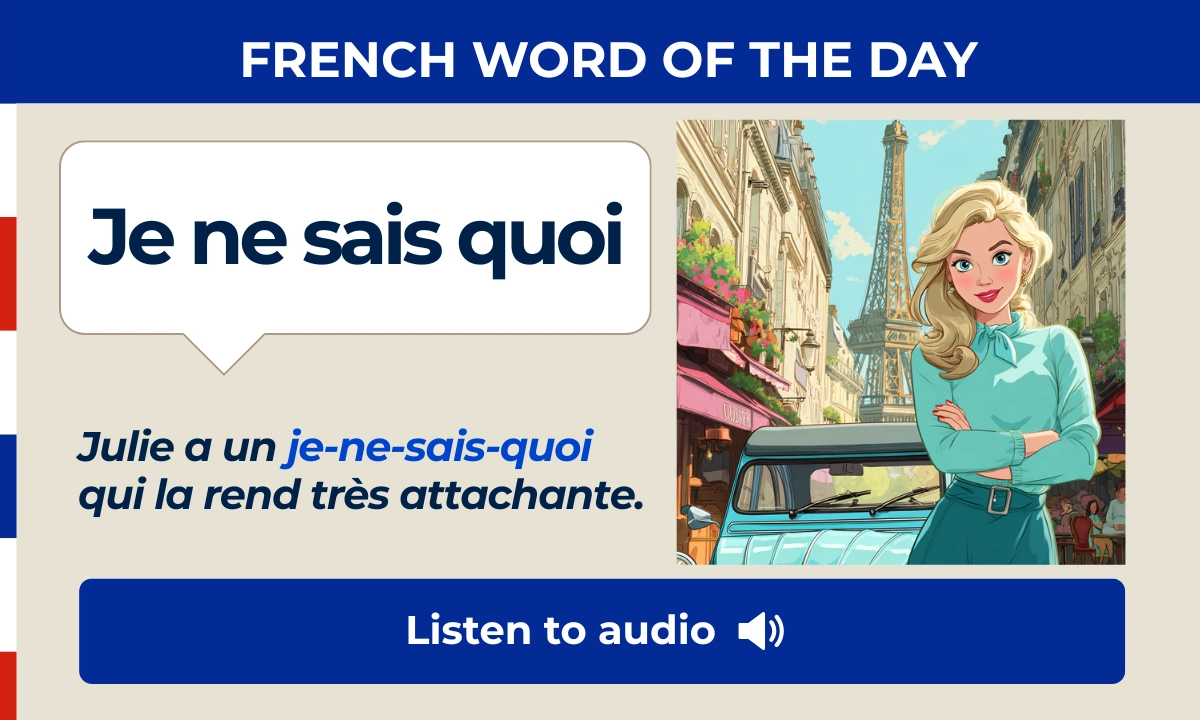
Julie a un je-ne-sais-quoi qui la rend très attachante.
Julie has a certain something that makes her very endearing.
Ce village a un je-ne-sais-quoi de magique.
This village has something magical about it.
Il y a un je-ne-sais-quoi dans son sourire.
There is a certain something in his smile.
Ce film a un je-ne-sais-quoi qui plaît au public.
This film has a certain something that appeals to the public.
Je-ne-sais-quoi comes from savoir, an essential French verb meaning to know factual things. Check out my complete lesson:
👉 Savoir examples »
🇫🇷 Cultural note
Although English speakers use “je ne sais quoi,” in French it’s much rarer and carries a slightly literary or poetic tone. In everyday conversation, native speakers usually use simpler expressions like un certain charme (a certain charm), un petit truc en plus (a little extra something), or quelque chose (something). The phrase is correct in French — it just sounds more elegant and old-fashioned than what people normally say.
❓ Want to feel more confident in French?
🎯 À Moi Paris — This is my top recommendation for online French courses, and it pairs wonderfully with my daily lessons. Camille Chevalier teaches with engaging audio stories that she records at three speeds. Her specialty is helping students with pronunciation and bridging the gap between textbook French and real spoken French as you hear it on the streets of Paris.
👉 Explore À Moi Paris »
👉 Read my review »
🎧 French Verb Drills — Having trouble with French verb conjugations? Camille’s audio drills break everything down step by step so you can finally lock in the patterns and speak with confidence.
If you purchase the courses, I may earn a small commission — at no extra cost to you.
🔗 Related words and expressions
- un petit quelque chose — a little something
- un charme indéfinissable — an indefinable charm
- un attrait mystérieux — a mysterious appeal
- une touche d’originalité — a touch of originality
- quelque chose d’unique — something unique
- avoir du charme — to have charm
📚 Related lessons on FrenchLearner!
👉 Savoir conjugation chart (with audio) »
👉 Quoi (what) — meaning, pronunciation, usages »
🚀 Continue learning French online on FrenchLearner!
👉 French Word of the Day »
👉 French Vocabulary lists »
👉 French for beginners guide »
👉 French song lyrics hub »
👉 French conjugations hub »


