
Published October 11, 2025 • Updated April 2, 2026 — Lesson written by French teacher David Issokson for students who want to learn French online, with native audio by Marie Assel Cambier, a voice artist from France.
📘 Savoir meaning
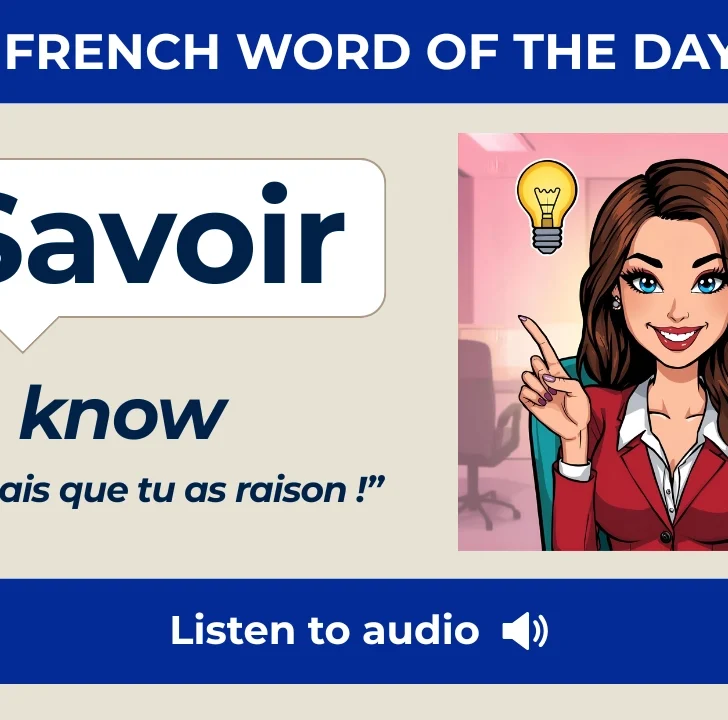
Savoir is a common and essential irregular French verb meaning “to know” when referring to facts, information, or skills — unlike connaître, which is used for people and places. It expresses objective or learned knowledge and is widely used in everyday conversation. Facts: Je sais que le train arrive à 18h — I know the train arrives at 6pm; Information: Je sais où tu habites — I know where you live; Skills: Je sais cuisiner — I know how to cook. 🔊 Listen to examples.

🎧 Savoir pronunciation
The pronunciation of savoir is /sa.vwaʁ/, which sounds like sah-vwahr.
📝 Savoir examples
Je sais où tu habites, mais je n’ai jamais visité ton quartier.
I know where you live, but I’ve never visited your neighborhood.
Savez-vous conduire une voiture avec une boîte manuelle ?
Do you know how to drive a car with a manual transmission?
Je sais que tu ne travailles pas le week-end.
I know that you don’t work on weekends.
J’ai su hier soir que le concert avait été annulé à cause de la pluie.
I found out last night that the concert had been cancelled because of the rain.
👉 See also: Savoir conjugation chart »
💡 Savoir usages & common mistakes
- Use savoir when it is followed by a question word, such as: qui (who), où (where), comment (how), pourquoi (why), combien (how much / how many), or que (that).
- If someone tells you something and you simply want to reply “Yes, I know,” use savoir:
La France est un pays. → Oui, je sais. ✅
Saying Oui, je connais ❌ would be incorrect. - If you have known (or haven’t known) something “all along,” use the imperfect of savoir:
Oui, je savais. — Yes, I knew (it all along).
Non, je ne savais pas. — No, I didn’t know. - For people, places, and areas of study, you must use connaître:
Je connais Jean. / Je connais Paris. / Je connais la biologie. - The past participle of savoir is su. In the passé composé, j’ai su means “I found out” or “I learned (for the first time).”
❓ Need extra help with verbs?
🎯 French Verb Drills — Camille’s course from French Today gives you clear, step-by-step audio drills to lock in conjugation patterns.
👉 See Verb Drills »
📖 À Moi Paris — Prefer a complete self-study program? Camille’s flagship course teaches French through stories and includes verb work in real conversations.
👉 Explore À Moi Paris »
If you purchase the courses, I may earn a small commission — at no extra cost to you.
🔗 Related words and expressions
- connaître — to know (a person, place, or be familiar with something)
- À l’insu de — without someone knowing
- le savoir-faire — the know-how / practical skill
- faire savoir — to let someone know / to inform
- je ne sais pas — I don’t know
- le je-ne-sais-quoi — that special something / “i don’t know what”
- Tu savais ? — Did you know?
📚 Related lessons
👉 Savoir conjugation chart »
👉 Connaître meaning and examples »
👉 Connaître conjugation chart »
👉 Savoir vs. connaître »
🚀 Discover more on FrenchLearner
👉 Verb conjugations hub »
👉 French Word of the Day »
👉 French Vocabulary lists »


