
Published September 12, 2012 • Updated June 30, 2026 — By French teacher David Issokson, teaching French online since 2014
In French, savoir and connaître both mean “to know,” but they are used differently. Use savoir for facts, information, and knowing how to do something. Use connaître for knowing or being familiar with people, places, things, and subjects.
The basic rule is: savoir = to know information and connaître = to know or be familiar with someone or something.
✅ Quick summary: savoir vs. connaître
✅ How to use savoir
✅ How to use connaître
✅ Common mistakes with savoir and connaître
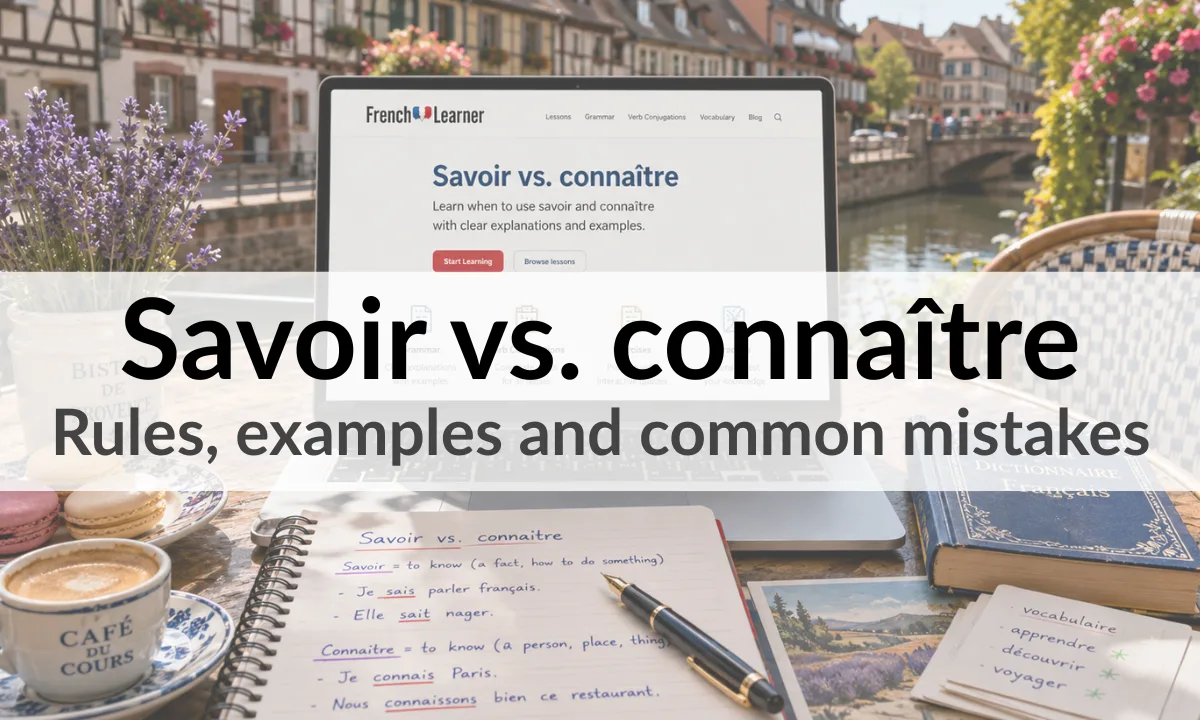
This lesson explains the difference between savoir and connaître, two French verbs that both mean “to know.” For full verb forms, you can also review the savoir conjugation charts and connaître conjugation charts.
Quick summary table: savoir vs. connaître
| French verb | Use | Pattern | Example |
|---|---|---|---|
| savoir | To know a fact | savoir que + sentence | Je sais que tu parles français. I know you speak French. |
| savoir | To know where, when, why, how, etc. | savoir + question word | Je sais où il habite. I know where he lives. |
| savoir | To know how to do something | savoir + infinitive | Elle sait conduire. She knows how to drive. |
| connaître | To know a person | connaître + person | Je connais Paul. I know Paul. |
| connaître | To know a place | connaître + place | Je connais Paris. I know Paris. / I am familiar with Paris. |
| connaître | To know a thing, subject, book, song, movie, etc. | connaître + noun | Tu connais cette chanson ? Do you know this song? |
Basic difference
Use savoir for facts, information, and knowing how to do something.
Je sais que tu parles français.
I know you speak French.
Je ne sais pas où tu habites.
I don’t know where you live.
Je sais nager.
I know how to swim.
Use connaître for people, places, things, and areas of knowledge.
Je connais Paul, mais je ne connais pas Marie.
I know Paul, but I don’t know Marie.
Je connais Paris, mais je ne connais pas Rome.
I know Paris, but I don’t know Rome.
Je connais bien l’histoire de France.
I know French history well.
How to use savoir
The verb savoir is used for facts and information. In English, we say “I know the sky is blue” or “I know the earth is round.” In French, this kind of knowing uses savoir.
Le ciel est bleu. Oui, je sais !
The sky is blue. Yes, I know!
La terre est ronde. Oui, je sais !
The earth is round. Yes, I know!
Short expressions such as “I don’t know!” and “Who knows?” also use savoir.
Je ne sais pas !
I don’t know!
Qui sait ?
Who knows?
Savoir + que, si, où, pourquoi, comment, quand
A major clue is that savoir can be followed by words such as:
que = that
si = if / whether
où = where
pourquoi = why
comment = how
quand = when
à quelle heure = at what time
Examples:
Je sais que le ciel est bleu.
I know the sky is blue.
Est-ce que tu sais où il habite ?
Do you know where he lives?
Tu sais à quelle heure le train part ?
Do you know what time the train leaves?
Savoir + infinitive: to know how to do something
To say that you know how to do something, use:
savoir + infinitive
Je sais nager.
I know how to swim.
Est-ce que tu sais chanter ?
Do you know how to sing?
How to use connaître
The verb connaître means to know or be familiar with someone or something. Use connaître for people, places, things, and subjects.
The key pattern is:
connaître + noun
Examples:
Je connais Jacques.
I know Jacques.
Je connais bien l’histoire française.
I know French history well.
Je connais Paris, mais je ne connais pas Marseille.
I know Paris, but I don’t know Marseille.
Tu connais cette chanson ?
Do you know this song?
Vous connaissez ce restaurant ?
Do you know this restaurant?
Connaître can mean “to know of” or “to be familiar with”
When talking about a person, connaître does not always mean that you have met the person face-to-face. It can also mean “to know of” or “to be familiar with.”
Tu ne connais pas ce chanteur ?
You don’t know this singer?
Tu ne connais pas ce film ? Il est excellent !
You don’t know this movie? It’s excellent!
Connaître can mean “to experience”
In some contexts, connaître can mean “to experience” or “to go through.”
Il a connu un grand succès à partir de l’âge de quarante-cinq ans.
He experienced great success starting at age forty-five.
Cette région a connu beaucoup de changements.
This region has gone through many changes.
Connaître in the passé composé: met / got to know
In the passé composé, connaître can mean “met” or “got to know,” especially when talking about people.
Elle a connu son vrai père à l’âge de vingt-huit ans.
She met her real father when she was twenty-eight.
Comment est-ce que tu as connu ta femme ?
How did you meet your wife?
This usage is possible, but rencontrer is often the more direct verb for “to meet” someone for the first time.
Où avez-vous connu votre femme ?
Where did you meet your wife?
Où avez-vous rencontré votre femme ?
Where did you meet your wife?
Both sentences can work, but rencontrer is usually clearer for the first meeting.
Common mistakes with savoir and connaître
Mistake 1: Using connaître to say “Yes, I know”
A common beginner mistake is to use connaître when saying “Yes, I know” in response to a fact. Use savoir when reacting to a fact, statement, or piece of information.
Correct:
Le ciel est bleu. Oui, je sais !
The sky is blue. Yes, I know!
Incorrect:
Le ciel est bleu. Oui, je connais !
Mistake 2: Using connaître before que, où, quand, or comment
Use savoir, not connaître, before words such as que, où, quand, comment, and si.
Correct:
Je sais que tu parles français.
I know that you speak French.
Incorrect:
Je connais que tu parles français.
Correct:
Je sais où il habite.
I know where he lives.
Incorrect:
Je connais où il habite.
Mistake 3: Using connaître before an infinitive
To say “to know how to do something,” use savoir + infinitive.
Correct:
Je sais parler français.
I know how to speak French.
Incorrect:
Je connais parler français.
📚 Related lessons
- Savoir conjugation chart
- Connaître conjugation chart
- Savoir example sentences
- Connaître example sentences
🚀 More lessons on FrenchLearner


