

👉 This lesson covers the meaning and usage of connaître (to know a person, place, or thing). For full conjugation charts with audio, see the connaître conjugation page.
Level A2 (Upper Beginner)
Published January 4, 2026 — Lesson written by French teacher David Issokson for students who want to learn French online, with native audio by Marie Assel Cambier, a voice artist from France.
The French Word of the Day is connaître, meaning “to know”. It is used for people, places, things, and subjects of study. Below are five real-life usage examples, each with native audio by Marie.
✅ Meaning
✅ Pronunciation
✅ Example sentences
✅ Related Words & Expressions
✅ Related lessons
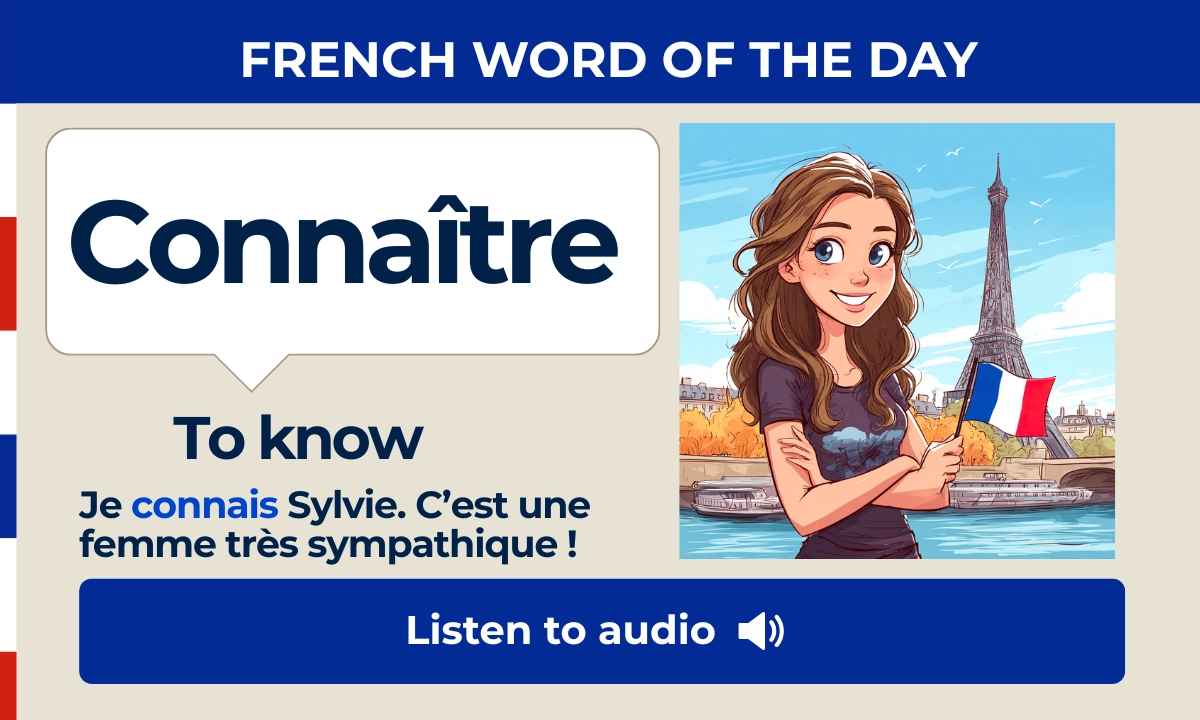
📘 Connaître meaning in French
Connaître means “to know” in French when talking about people, places, things or subjects you are familiar with. It is used to express familiarity, experience, or recognition. English often uses “know” in many situations, but French separates this idea into connaître and savoir. Use connaître with nouns, not verbs or facts. In the passé composé, j’ai connu means “I met.” For example:
➜ Je connais Sylvie. I know Sylvie.
➜ Il connaît Paris. He knows Paris.
➜ Elle connaît bien ce restaurant. She knows this restaurant well.
➜ J’ai connu Marc hier. I met Marc yesterday.
🎧 Connaître pronunciation in French
The pronunciation of connaître is /kɔ.nɛtʁ/ (IPA), which sounds roughly like “koh-netr.”
📝 Connaître usage examples
1. Knowing a person
Je connais bien ton frère.
I know your brother well.
2. Familiarity with a place
Est-ce que tu connais Lyon ?
Do you know Lyon?
3. Familiar with things
Elle connaît toutes les chansons de cet album.
She knows all the songs on this album.
4. General experience — to experience, go through
Le pays connaît une période de croissance.
The country is experiencing a period of growth.
5. Passé composé: to meet for the first time
J’ai connu ma femme lors d’une soirée chez des amis.
I met my wife at a party at friends’ place.
Continue learning with Marie’s audio
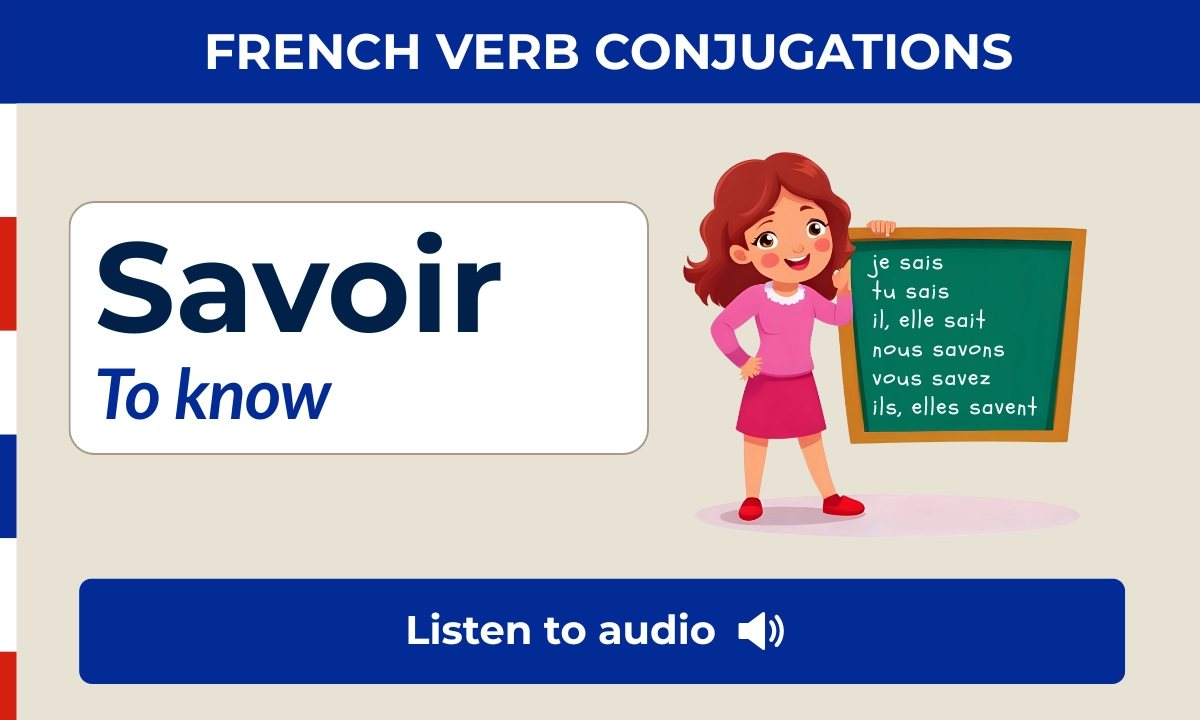
Explore more lessons on the topic of to know in French. I’ve included both essential savoir lessons as well. Savoir is used for knowing facts. Each lesson features native French audio by Marie Assel Cambier.


❓ Want to feel more confident in French?
🎯 À Moi Paris — This is my top recommendation for online French courses, and it pairs wonderfully with my daily lessons. Camille Chevalier teaches with engaging audio stories that she records at three speeds. Her specialty is helping students with pronunciation and bridging the gap between textbook French and real spoken French as you hear it on the streets of Paris.
👉 Explore À Moi Paris »
👉 Read my review »
🎧 French Verb Drills — Having trouble with French verb conjugations? Camille’s audio drills break everything down step by step so you can finally lock in the patterns and speak with confidence.
If you purchase the courses, I may earn a small commission — at no extra cost to you.
🔗 Related words and expressions
- savoir — to know (a fact or how to do something)
- faire connaissance — to meet someone
- bien connaître — to know well
- mal connaître — to know poorly
- se connaître — to know each other / oneself
- connu(e) — known / famous
- inconnu(e) — unknown
📚 Related lessons on FrenchLearner!
👉 connaitre conjugation charts (with audio) »
👉 savoir (to know) — usage examples »
👉 savoir conjugation charts (with audio) »
👉 reconnaissant — grateful »
🚀 Continue learning French online on FrenchLearner!
👉 French Word of the Day »
👉 French Vocabulary lists »
👉 French for beginners guide »
👉 French song lyrics hub »
❓ Connaître — Common Questions
What does connaître mean in French?
It means “to know” in the sense of being familiar with a person, place, or thing. For example, “Je connais Marie” (I know Marie).
When do I use connaître instead of savoir?
Use connaître with people, places, and nouns. For example, “Je connais Jean” (I know Jean), “Je connais Marseille” (I know Marseille), “Je connais la chanson” (I know the song). Use savoir with facts and verbs. For example, “Je sais où Jean habite” (I know where Jean lives).
Can connaître be used with places and things?
Yes. Connaître is commonly used with cities and places you’ve visited, and things you’re familiar with. For example, “Je connais Paris” (I know Paris), “Je connais ce livre” (I know this book).


