
👉 See also: Une fois que — once, as soon as »
Level B1 (Intermediate)
Lesson written by French teacher David Issokson for students who want to learn French online, with native audio by Marie Assel Cambier, a voice artist from France.
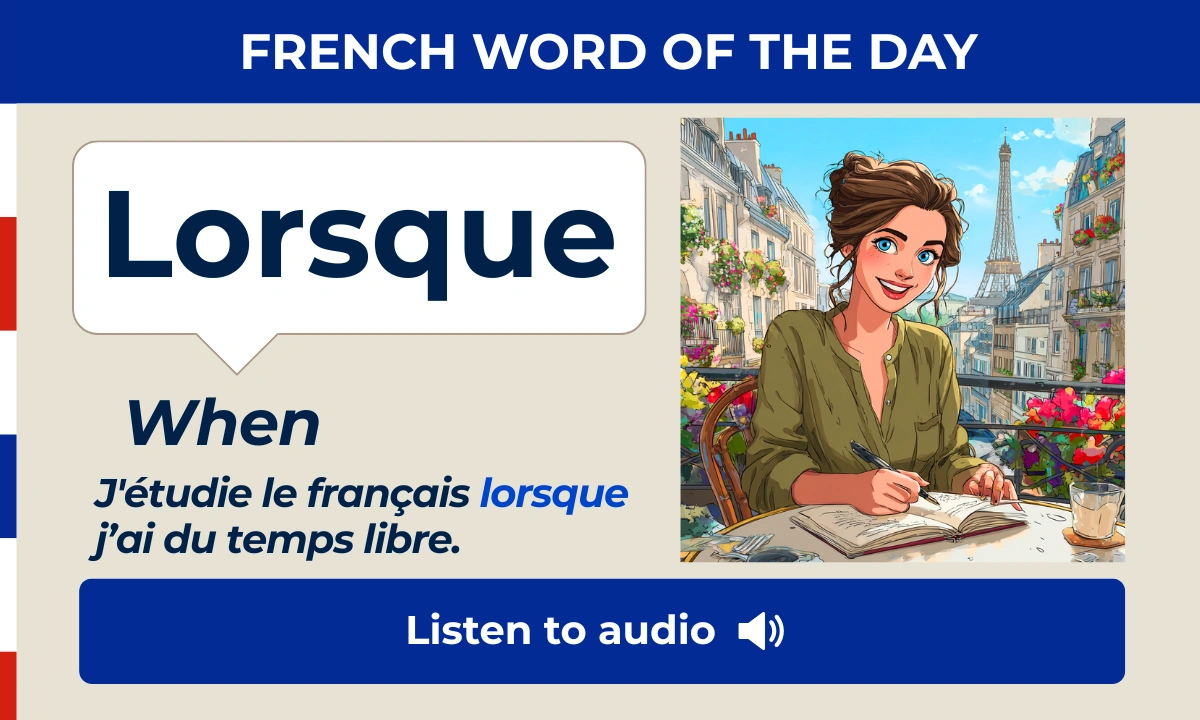
The French Word of the Day is lorsque, meaning “when.” Ever since I’ve been teaching French, this has been one of those tricky B1 connector words that has confused many of my advanced students. Lorsque has three key usages, which I’ll cover today with Marie’s wonderful audio examples.
✅ Meaning
✅ Pronunciation
✅ Example sentences
✅ Related Words & Expressions
✅ Related lessons
Subscribe to the French Word of the Day
Lorsque Meaning, Pronunciation and Examples
📘 Lorsque meaning
Lorsque is a French conjunction that means “when” or, sometimes, “as soon as.” It is generally considered a slightly more formal or literary equivalent of quand when connecting two clauses. You can use it to link actions in the past, present, or future. Unlike quand, lorsque is never used to ask a question.
🎧 Lorsque pronunciation
The pronunciation of lorsque is /lɔʁsk(ə)/, which sounds like lor-skuh (very light or silent uh).
📝 Lorsque examples & usages
1. Expressing time (when something happens)
J’étudie le français lorsque j’ai du temps libre.
I study French when I have free time.
Lorsque tu arriveras, appelle-moi.
When you arrive, call me.
2. In past or future actions
Lorsque je suis parti, il pleuvait.
When I left, it was raining.
👉 See also: Partir conjugation chart (to leave) »
Nous dînerons ensemble lorsque tu reviendras.
We will have dinner together as soon as you come back.
3. Stylistic / formal tone
Lorsque le président est arrivé, la foule a applaudi.
When the president arrived, the crowd applauded.
You can’t use lorsque for all the same meanings as quand, which also means “when.” Lorsque is not used for:
➔ Asking questions (Quand pars-tu ? ✅ / Lorsque pars-tu ? ❌)
➔ Exclamations (Depuis quand ? ✅ / Depuis lorsque ? ❌)
👉 See also: Quand vs lorsque — simple explanation »
❓ Want to feel more confident in French?
🎯 À Moi Paris — Camille’s step-by-step course teaches how French really sounds in everyday life. Her dialogues and stories are full of tricky connectors like “lorsque,” so you use them naturally in everyday conversations.
👉 Explore À Moi Paris »
👉 Read my review »
🎧 Secrets of French Pronunciation — If “lorsque” made you realize how tricky French sounds can be, Camille’s step-by-step pronunciation course will fix that fast. She breaks down nasal vowels, liaisons, silent letters, and real spoken French so you can pronounce words naturally and confidently.
👉 See Secrets of French Pronunciation »
If you purchase the courses, I may earn a small commission — at no extra cost to you.
🔗 Related words and expressions
- aussitôt que — as soon as
- tandis que — while, whereas
- dès que — as soon as
- pendant que — while
- quand — when
- au moment où — at the moment when
- chaque fois que — every time that
- avant que — before
- après que — after
- une fois que — once
📚 Related lessons on FrenchLearner!
🚀 Continue learning French online on FrenchLearner!
👉 French Word of the Day »
👉 French Vocabulary lists »
👉 French for beginners guide »
👉 French song lyrics hub »
👉 French conjugations hub »


