Skip to Content

Mettre — Meaning, Pronunciation, and Examples in French

Mettre — Meaning, Pronunciation, and Examples in French

👉 Note: This lesson focuses on the meaning and usage of the verb mettre. If you’re looking for full conjugation tables with native audio, visit the dedicated Mettre conjugation page »

Level A1-A2 (Beginner & Upper Beginner)

The French Word of the Day is mettre, meaning “to put.” This verb is extremely versatile because, in addition to its most basic meaning, it is also used to mean to put on (clothing or accessories) and to turn on (music, lights, etc.). It also appears in many common expressions, such as se mettre à (to start doing something). This lesson covers six of its key uses — all with native audio by Marie.

Meaning
Pronunciation
Example sentences
Related Words & Expressions
Related lessons

Mettre – To put – French Word of the Day

📘 Mettre meaning in French

Mettre means “to put,” “to place,” or “to set” in French. It is one of the most common and useful verbs in everyday conversation and is used to talk about putting objects somewhere, putting on clothes (mettre une veste — to put on a jacket), turning on something (mettre la lumière — to turn on the light), or causing a state or action (mettre quelqu’un en colère — to make someone angry).

🎧 Mettre pronunciation in French

The pronunciation of mettre is /mɛtʁ/ (IPA), which sounds roughly like “METT-ruh.”
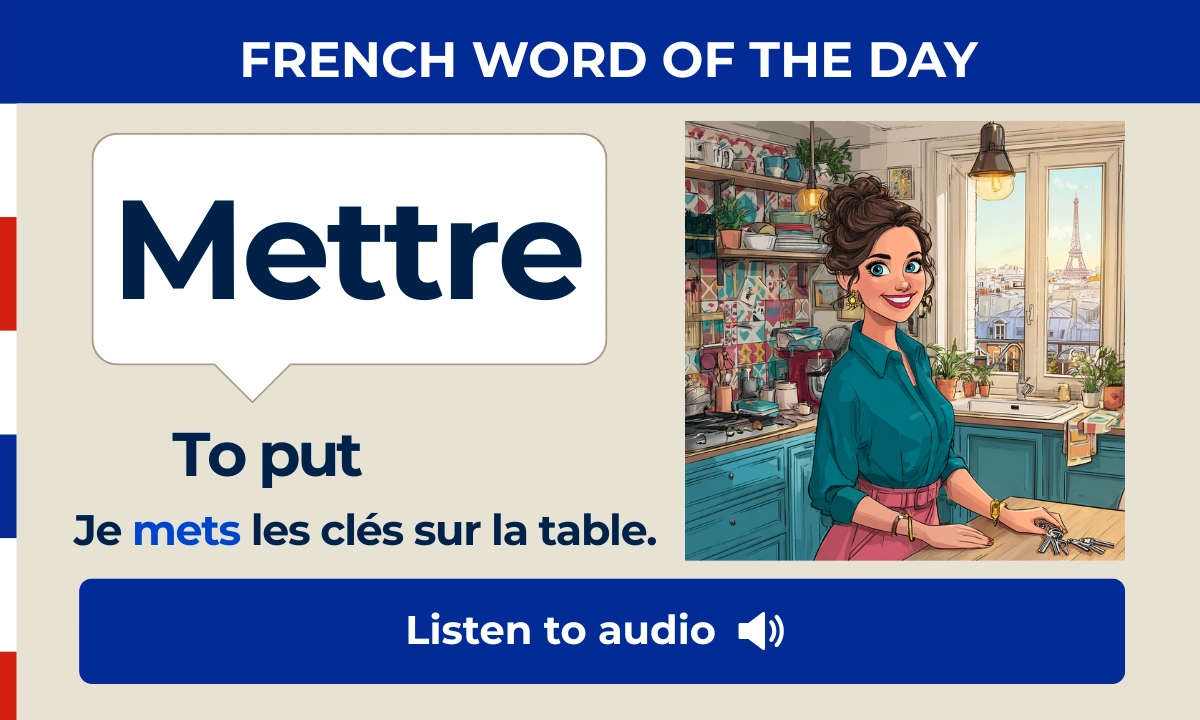
📝 Mettre usage examples

1. To put / place
Je mets les clés sur la table.
I put the keys on the table.

2. To put on (clothing)
Il met son blouson avant de sortir.
He puts on his jacket before going out.

3. To spend (time)
J’ai mis deux heures pour finir ce devoir.
I spent two hours finishing this homework.

4. To add / put (in food)
Vous mettez du sel dans la soupe ?
Are you putting salt in the soup?

5. To begin / start (oneself)
Je me mets à travailler sérieusement.
I’m starting to work seriously.

6. To turn on (a device)
Mets la radio, s’il te plaît.
Turn on the radio, please.

👉 Now that you’ve mastered the usages of mettre, check out my page covering mettre conjugation tables (with audio for six main tenses) »

The French use mettre constantly — not just to say “to put,” but in all kinds of expressions. Here are the top 5 most common ones.

  • mettre la table — to set the table
  • mettre du temps à — to take/spend time to do something
  • se mettre d’accord — to come to an agreement
  • se mettre en colère — to get angry
  • mettre au courant — to inform / bring someone up to date

👉 mettre conjugation charts (with audio) »
👉 se mettre à (to start doing) – usage examples »
👉 remettre (to hand over) — usage examples »

🚀 Continue learning French online on FrenchLearner!

👉 French Word of the Day »
👉 French Vocabulary lists »
👉 French for beginners guide »
👉 French song lyrics hub »

Mettre usage — Frequently asked questions (FAQ)

What are the primary meanings of mettre?

In its most basic sense, mettre means “to put,” “to place,” or “to set.” However, it is a versatile verb that also means “to put on” clothing, “to turn on” devices like a radio or light, and “to spend” time.

How is mettre used to talk about clothing?

Mettre is used to express “putting on” an item of clothing or an accessory, such as mettre un blouson (to put on a jacket).

What does the expression “se mettre à” mean?

When used as se mettre à, the verb means “to start” or “to begin” doing something, such as Je me mets à travailler (I’m starting to work).

Can mettre be used for food and cooking?

Yes, it is used to mean “adding” or “putting” ingredients into food, such as putting salt in a soup (mettre du sel dans la soupe).

author avatar
David Issokson Founder & French Teacher at FrenchLearner.com
David Issokson is the founder of FrenchLearner.com, where he’s been helping students master French through vocabulary, grammar, and cultural lessons since 2012.

    David Issokson

    About the Author – David Issokson David Issokson is an online French teacher and the founder of FrenchLearner.com (established 2012). He has been teaching French online since 2014 and brings over 30 years of experience as a passionate French learner and fluent speaker. David creates clear, structured lessons supported by native audio recorded by Marie Assel Cambier, a professional voice artist and native French speaker. A graduate of McGill University in Montreal, he has taught hundreds of learners worldwide and publishes daily French lessons for more than 12,000 email subscribers. 📘 About David » 🌐 David’s personal site » 👍 Follow on Facebook »

    See all posts by