
Published August 20, 2025 • Updated April 21, 2026 — By French teacher David Issokson • Native Audio by Marie Assel Cambier
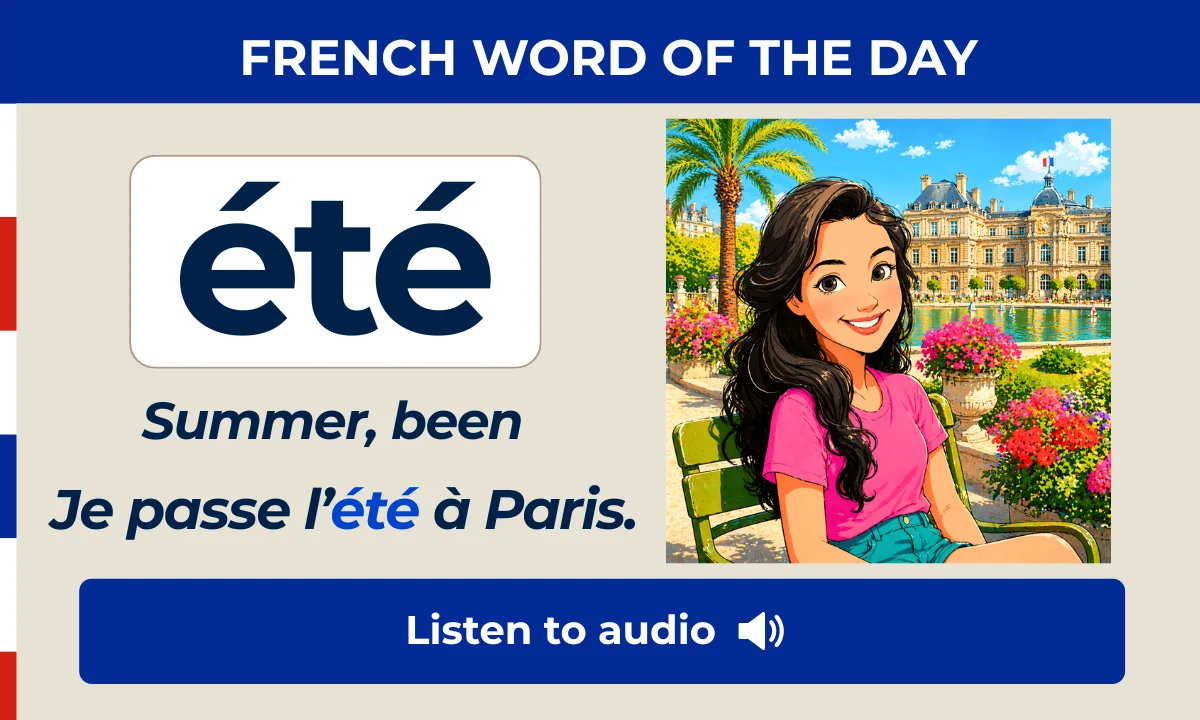
Été is a small French word with two completely different meanings: “summer” and “been.” This lesson shows you exactly how to use both in real spoken French with native audio.
📘 Été meaning
In French, été has two main meanings. As a noun, it means “summer.” As a verb form, it is the past participle of être (to be), meaning “been,” and is commonly used in the passé composé, such as j’ai été (I was / I have been).
🎧 Été pronunciation
The pronunciation of été is /ete/ (IPA), which sounds like “ay-tay”. See also: acute accent: é.
📝 Été examples
Example sentences
In these first two examples, été means summer. Les Jeux refers to les Jeux olympiques (the Olympic Games).
Préférez-vous regarder les Jeux d’été ou les Jeux d’hiver ?
Do you prefer to watch the winter games or the summer games?
Quels sont vos projets pour l’été prochain ?
What are your plans for next summer?
This sentence is in the passé composé because the time is specified (hier = yesterday). J’étais also means “I was,” but it’s in the imperfect, used for past actions without a specific time.
Je n’ai pas été à l’école hier. Je suis resté chez moi.
I wasn’t at school yesterday. I stayed home.
This last example shows both meanings of été: “summer” and “was.”
Cette année l’été a été pourri.
The summer was lousy this year.
👉 Listen to the full conjugation of être in the passé composé, which uses été.
❓ Want to feel more confident in French?
🎯 À Moi Paris — My top recommended course by Camille Chevalier, featuring engaging audio stories (3 speeds) to help you understand real spoken French and improve pronunciation.
👉 Explore À Moi Paris »
👉 Read my review »
🎧 French Verb Drills — Camille’s step-by-step audio drills help you finally master verb conjugations.
👉 See Verb Drills »
If you purchase the courses, I may earn a small commission — at no extra cost to you.
🔗 Related words & expressions
Related to été = summer 🌞
- l’été prochain — next summer
- tout l’été — all summer
- l’été indien — Indian summer
- en été — in (the) summer
- au cœur de l’été — in the height of summer
- pendant l’été — during the summer
Related to été = past participle of être 📖
- j’ai déjà été — I have already been
- il a été malade — he was sick
- ça a été — it was okay / it went fine
- où as-tu été ? — where have you been?
- elle a été prof — she was a teacher
- nous avons été surpris — we were surprised
📚 Related lessons
👉 Être conjugation chart »
👉 Hiver (winter) »
👉 Four seasons vocabulary »
👉 French past participles »
🚀 Continue learning on FrenchLearner!
👉 French Word of the Day (200+ lessons) »
👉 French word meanings (common words explained clearly) »
👉 French vocabulary lists »


