
See also:
👉 French alphabet (with audio) »
👉 30 French reading rules »
🎧 Audio by Marie Assel Cambier — native speaker & pro voice artist from France
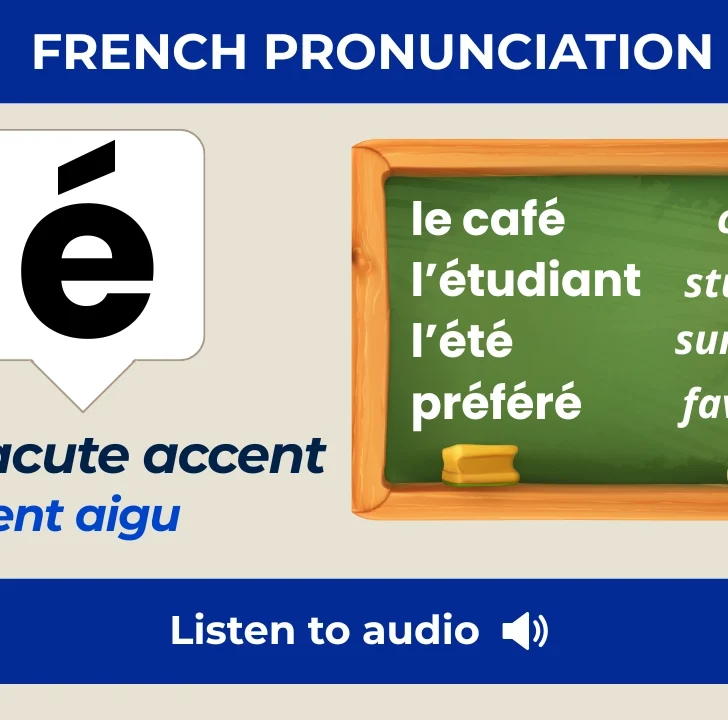
In French, the acute accent (or accent aigu) appears only on the letter e (é). But what is it exactly, why is it so common, and how do you pronounce it?
✅ Meaning
✅ Pronunciation
✅ Example sentences
✅ Related lessons
Subscribe to the French Word of the Day

📘 Acute accent meaning
In French, the acute accent (l’accent aigu) appears only on the letter e. With this mark, the letter becomes é (often called e accent aigu), pronounced [e]—a clear sound similar to “ay” in English. It is the most common French accent mark, often found in past participles, adjectives, and everyday words.
Example words with the acute accent
- du café (some) coffee
- parlé spoke
- la clé key
- la télévision television
- Un éléphant an elephant
🎧 Acute accent pronunciation
É is pronounced /e/ in IPA. It sounds like the “ay” in say but without the final glide. The sound is closed and crisp, different from the /ə/ in le.
📝 French and English examples
Acute accent in French (é) – e accent aigu
In Modern French, the acute-accented é often evolved from -es in Old French. For example, été (summer) in today’s French comes from the Old French form esté.
L’été: J’aime aller à la plage en été.
Summer: I like to go to the beach in the summer.
In this example, école (school) in Modern French comes from escole in Old French.
L’école: J’apprends le français à l’école.
School: I’m learning French in school.
For this example, the Modern French word état (state) comes from estat in Old French.
États-Unis: J’habite aux États-Unis depuis huit ans.
United States. I’ve been living in the United States for eight years.
In the passé composé, regular -er verbs form their past participle by replacing -er with -é. For example, manger (to eat) becomes mangé (ate).
Mangé: J’ai trop mangé ce soir.
Ate. I ate too much tonight.
For certain stem-changing verbs with a double é in the infinitive, like répéter (to repeat), the second é changes to è in the je, tu, il/elle, and ils/elles forms. The è is pronounced “eh” (/ɛ/).
Répète: Je répète la phrase.
Repeat: I repeat the sentence.
📘 Recommended resource
🎧 Camille makes French pronunciation clear and simple in her À Moi Paris audio course — with step-by-step lessons and natural examples.
👉 Try the course »
👉 Read my review »
Disclosure: This is an affiliate link. If you buy the course I will earn a small commission.
🚀 Improve your French reading and pronunciation!
👉 Next, learn another common accent mark: Grave Accent (è) »
👉 Or review the basics here: French Reading Rules »
👉 Want a new word every day? French Word of the Day Hub »


