
Level A2 (Upper Beginner)
Published January 15, 2026 — Lesson written by French teacher David Issokson for students who want to learn French online, with native audio by Marie Assel Cambier, a voice artist from France.
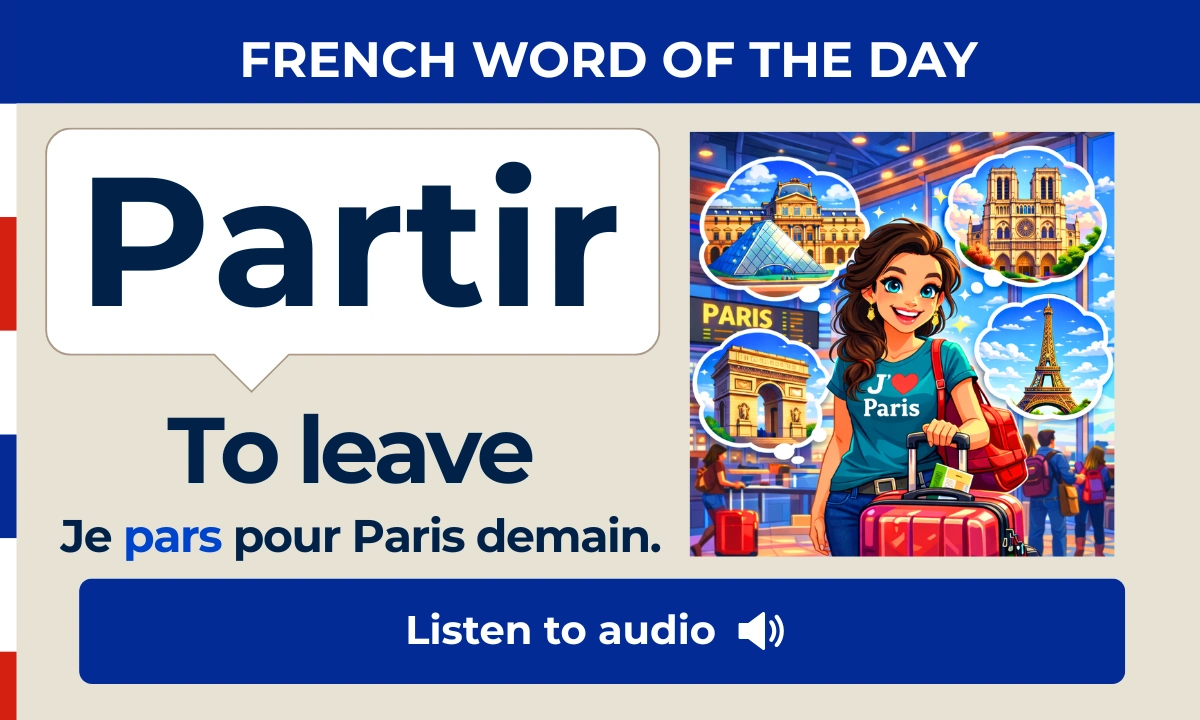
The French Word of the Day is partir, meaning “to leave.” Here are six real-life examples, plus the difference between partir and quitter.
👉 See separate lesson: Partir conjugation chart (with audio) »
📘 Partir meaning in French
Partir (verb) means “to leave” or “to depart.” It is commonly used when talking about leaving a place, going on a trip, or departing at a specific time. “Le train part à 7 heures.” (The train leaves at 7 o’clock.) The verb partir is often followed by the preposition de. For example, “Je pars de la maison.” (I’m leaving the house.)
💡 Partir vs. quitter – what’s the difference?
Unlike quitter, which focuses on what you leave behind, partir emphasizes the act of leaving itself.
Je pars de Paris demain.
I’m leaving Paris tomorrow.
➜ Neutral, factual departure (travel, plans, schedule)
Je quitte Paris demain.
I’m leaving Paris tomorrow.
➜ Stronger sense of leaving Paris behind (change of place, life, or situation)
👉 See also: Quitter usage examples »
🎧 Partir pronunciation in French
The pronunciation of partir is /paʁ.tiʁ/ (IPA), which sounds roughly like “par-teer.”
📝 Partir usage examples
1. Partir + time word
Je pars maintenant.
I’m leaving now.
Leaving early in the day
Il part tôt le matin.
He leaves early in the morning.
2. Partir de + place
Le train part de Paris à 7 h.
The train leaves Paris at 7 a.m.
3. Partir pour + place
Nous partons pour Lyon demain.
We’re leaving for Lyon tomorrow.
4. Partir en vacances (expression) — to go on vacation
Ils partent en vacances en août.
They go on vacation in August.
5. Partir en + mode of transportation
Nous partons en train.
We’re leaving by train.
6. Partir + à quelle heure (asking time to leave)
On part à quelle heure ?
What time are we leaving?
To answer this question, see: Telling time in French »
In addition to the usage examples, true fluency comes from knowing the verb forms.
👉 See also: Partir conjugation chart (with audio) »
Note that students often confuse partir with sortir, which means to go out.
👉 See also: Sortir usage examples »
❓ Want to feel more confident in French?
🎯 À Moi Paris — This is my top recommendation for online French courses, and it pairs wonderfully with my daily lessons. Camille Chevalier teaches with engaging audio stories that she records at three speeds. Her specialty is helping students with pronunciation and bridging the gap between textbook French and real spoken French as you hear it on the streets of Paris.
👉 Explore À Moi Paris »
👉 Read my review »
🎧 French Verb Drills — Having trouble with French verb conjugations? Camille’s audio drills break everything down step by step so you can finally lock in the patterns and speak with confidence.
If you purchase the courses, I may earn a small commission — at no extra cost to you.
🔗 Related words and expressions
- le départ — departure
- partir en voyage — to go on a trip
- partir en vacances — to go on vacation
- partir tôt / tard — to leave early / late
- partir de — to leave from
- partir pour — to leave for
📚 Related lessons on FrenchLearner!
👉 partir conjugation chart (with audio)
👉 sortir (to go out) usage examples
👉 Keep learning with the French Word of the Day »


