
Published June 15, 2024 • Updated May 11, 2026 — By French teacher David Issokson • Native Audio by Marie Assel Cambier
Pourvu que means “provided that,” “as long as,” or “hopefully.” It’s an advanced French conjunction used to express conditions, wishes, and hopeful expectations, and it always requires the subjunctive mood. Learn how to use it naturally with audio example sentences.
📘 Pourvu que meaning
Pourvu que is a French conjunction meaning “provided that,” “as long as,” or “hopefully.” It is used to express a condition, wish, or hope about a future situation. The expression is always followed by the subjunctive mood. For example: Pourvu qu’elle soit prête à temps ! (Hopefully she’s ready on time!)
You’ll also commonly see this structure: Clause A in simple future tense + pourvu que + Clause B in subjunctive mood. For example: Nous partirons ce soir pourvu que tout soit organisé. (We’ll leave tonight as long as everything is organized.)
🎧 Pourvu que pronunciation
The pronunciation of pourvu que is /puʁ.vy kə/ (IPA), which sounds roughly like “poor-vu kuh”.
📝 Pourvu que examples
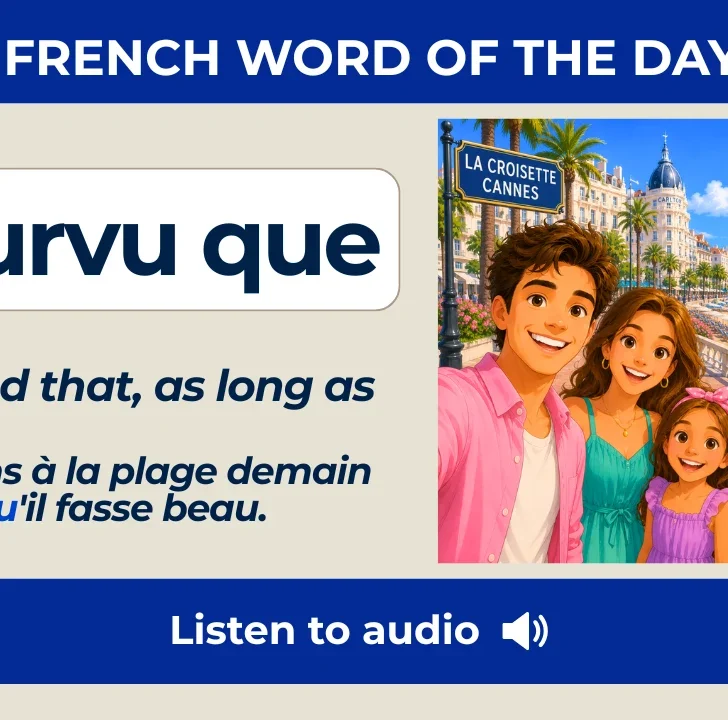
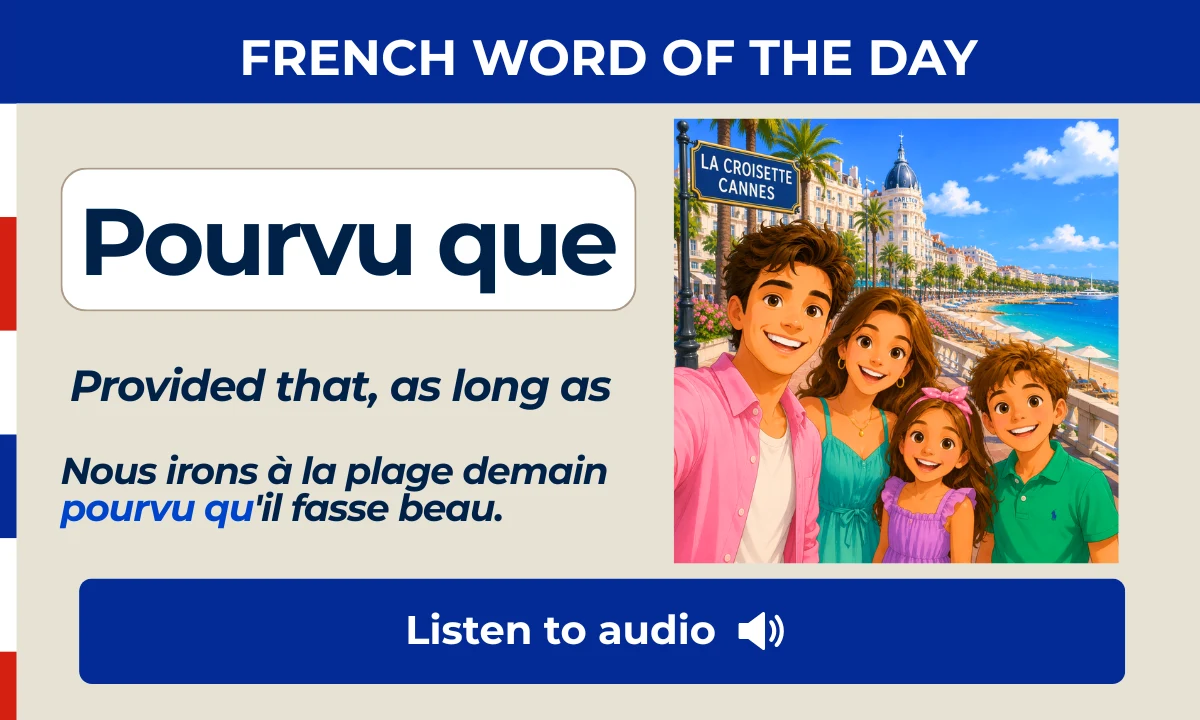
Nous irons à la plage demain pourvu qu‘il fasse beau.
We’ll go to the beach tomorrow as long as it’s nice out.
Je ferai la salade pourvu que tu fasses la pizza.
I’ll make the salad provided that you make the pizza.
Pourvu qu‘il neige ce week-end !
Let’s hope it snows this weekend!
💡 Pourvu que vs à condition que
Both pourvu que and à condition que mean “provided that” or “as long as”. Both use the subjunctive, often with a future-tense clause before them. The difference is mainly in tone and usage. À condition que expresses a neutral or logical condition, while pourvu que often sounds more emotional, hopeful, or expressive.
➞ Je viendrai à condition que tu sois là.
I’ll come provided that you are there.
➞ Je viendrai pourvu que tu sois là.
I’ll come as long as you’re there.
❓ Want to feel more confident in French?
🎯 À Moi Paris — My top recommended course by Camille Chevalier, featuring engaging audio stories (3 speeds) to help you understand real spoken French and improve pronunciation.
👉 Explore À Moi Paris »
👉 Read my review »
🎧 French Verb Drills — Camille’s step-by-step audio drills help you finally master verb conjugations.
👉 See Verb Drills »
If you purchase the courses, I may earn a small commission — at no extra cost to you.
🔗 Related words and expressions
- à condition que — on condition that
- tant que — as long as
- du moment que — as long as
- en espérant que — hoping that
- espérons que — let’s hope that
- j’espère que — I hope that
- à supposer que — assuming that
📚 Related lessons
🚀 Continue learning on FrenchLearner!
👉 French Word of the Day (200+ lessons) »
👉 French verb conjugations »
👉 French vocabulary lists »


