
👉 See also: le réveillon — a closely related term referring to the New Year’s Eve meal »
Level A2 (Upper Beginner)
Lesson written by French teacher David Issokson for students who want to learn French online, with native audio by Marie Assel Cambier, a voice artist from France.
The French Word of the Day is la Saint-Sylvestre, meaning “New Year’s Eve.” This term is surprisingly intriguing: Why do the French use a saint’s name to refer to New Year’s Eve? Who was Saint Sylvestre? And are la Saint-Sylvestre and le réveillon (the New Year’s Eve meal) actually the same thing? I’ll answer all of these key questions today. Keep reading and listen to Marie’s amazing audio! 🥂
✅ Meaning
✅ Pronunciation
✅ Example sentences
✅ Related Words & Expressions
✅ Related lessons
Subscribe to the French Word of the Day
📘 Saint-Sylvestre meaning in French
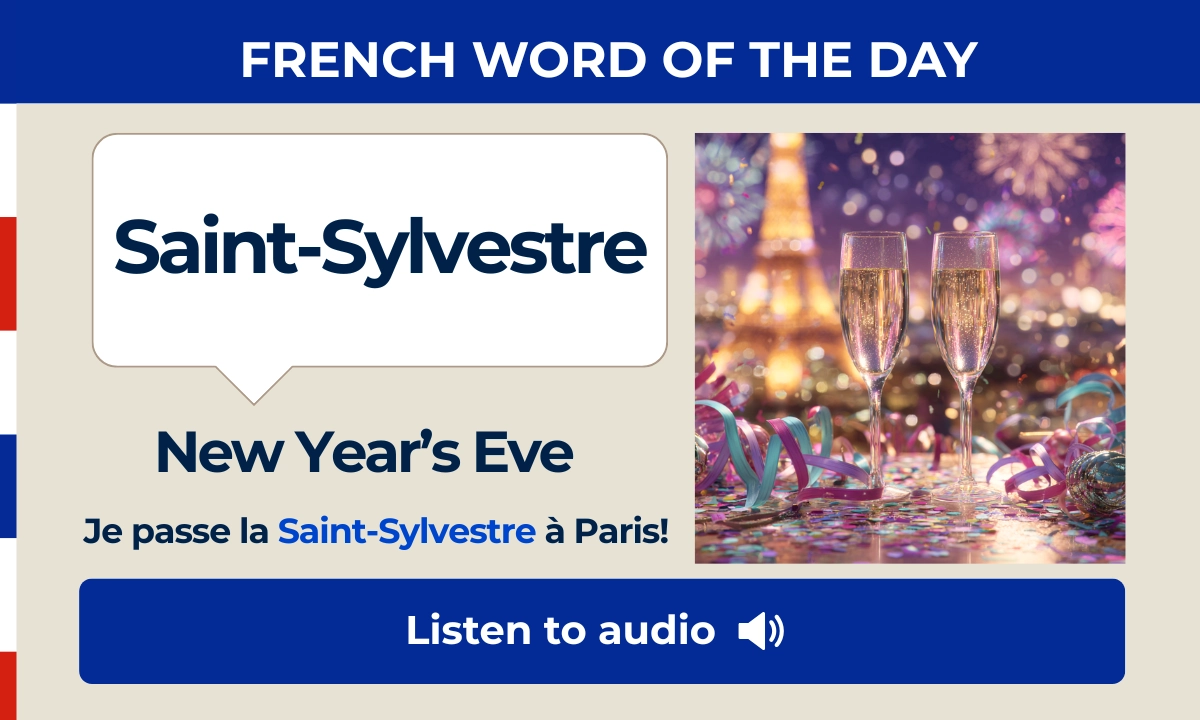
Saint-Sylvestre (or la Saint-Sylvestre) is the French term for New Year’s Eve, celebrated on December 31. The name comes from Saint Sylvester I, a pope who lived in the 4th century, whose feast day falls on this date. While its origins are religious, today it is a largely secular celebration focused on ending the year and welcoming the new one. In France, the Saint-Sylvestre is closely related to le réveillon du Nouvel An, a festive evening meal shared with family or friends. The night typically includes special food, champagne, music, and celebrations that last until midnight and beyond.
🥂 Are la Saint-Sylvestre and le réveillon du Nouvel An synonyms?
Not exactly. They are closely related, but they do not mean the same thing.
- La Saint-Sylvestre refers to New Year’s Eve itself — the date and occasion (December 31).
- Le réveillon du Nouvel An refers to the festive meal or celebration held that night.
You may also hear le réveillon de la Saint-Sylvestre, or simply le réveillon. On its own, le réveillon can refer to either the New Year’s Eve meal or the Christmas Eve meal, depending on context.
In everyday French, people sometimes use these terms interchangeably, but the key idea is simple: Saint-Sylvestre is the day, and le réveillon is the celebration.
🎧 Saint-Sylvestre pronunciation in French
The pronunciation of Saint-Sylvestre is /sɛ̃ sil.vɛstʁ/ (IPA), which sounds roughly like “san seel-VESTR.”
📝 Saint-Sylvestre examples & usage
La Saint-Sylvestre est la nuit du 31 décembre où l’on célèbre la fin de l’année.
New Year’s Eve is the night of December 31 when we celebrate the end of the year.
Nous fêtons la Saint-Sylvestre avec des amis et partageons un bon repas.
We celebrate New Year’s Eve with friends and share a good meal.
Ils organisent un repas pour la Saint-Sylvestre et invitent toute la famille.
They organize a meal for New Year’s Eve and invite the whole family.
Elle prépare la soirée de la Saint-Sylvestre avec de la musique et quelques desserts.
She prepares the New Year’s Eve evening with music and a few desserts.
💡 Note: While la Saint-Sylvestre refers to the date (December 31), the celebration and meal itself is called le réveillon. You can learn more about le réveillon here.
❓ Want to feel more confident in French?
🎯 À Moi Paris — This is my top recommendation for online French courses, and it pairs wonderfully with my daily lessons. Camille Chevalier teaches with engaging audio stories that she records at three speeds. Her specialty is helping students with pronunciation and bridging the gap between textbook French and real spoken French as you hear it on the streets of Paris.
👉 Explore À Moi Paris »
👉 Read my review »
🎧 French Verb Drills — Having trouble with French verb conjugations? Camille’s audio drills break everything down step by step so you can finally lock in the patterns and speak with confidence.
If you purchase the courses, I may earn a small commission — at no extra cost to you.
🔗 Related words and expressions
- la Saint-Sylvestre — New Year’s Eve
- le réveillon du Nouvel An — New Year’s Eve dinner
- le compte à rebours — countdown
- minuit — midnight
- les feux d’artifice — fireworks
- faire la fête — to party / celebrate
- trinquer — to toast (with drinks)
- le champagne — champagne
- se souhaiter la bonne année — to wish each other a happy new year
- danser jusqu’au bout de la nuit — to dance until morning
📚 Related lessons on FrenchLearner!
👉 le réveillon — Christmas / New Year’s Eve dinner »
👉 souhaiter (to wish) — examples and usage »
👉 félicitations — congratulations »
👉 French Christmas (holidays) lessons hub »
🚀 Continue learning French online on FrenchLearner!
👉 French Word of the Day »
👉 French Vocabulary lists »
👉 French for beginners guide »
👉 French song lyrics hub »
❓ Saint-Sylvestre — Common Questions
What does la Saint-Sylvestre mean in French?
La Saint-Sylvestre means “New Year’s Eve.” It refers to the night of December 31, when people celebrate the end of the year in France.
Why is New Year’s Eve called la Saint-Sylvestre?
The name comes from Saint Sylvester I, a pope whose feast day falls on December 31. Over time, the religious name became associated with the New Year’s Eve celebration.
Are la Saint-Sylvestre and le réveillon du Nouvel An the same thing?
Not exactly. La Saint-Sylvestre is the date (New Year’s Eve), while le réveillon du Nouvel An is the festive meal or party held that night.
How do people celebrate la Saint-Sylvestre in France?
Most people celebrate with a special meal, champagne, music, and friends or family, often staying up until midnight to welcome the new year. 🥂


