
🔊 Jump to examples now
👉 See also: French relative pronouns »
Level B2 (Upper Intermediate)
Updated February 3, 2026 — Lesson written by French teacher David Issokson for students who want to learn French online, with native audio by Marie Assel Cambier, a voice artist from France.
The French word of the day is dont, a tricky relative pronoun with meanings including “that”, “whose” or “of which”. Most students shy away from this tricky word. Following along, listen to the examples and you’ll get it!
📘 Dont meaning in French
Dont is a French relative pronoun meaning “that”, “whose”, “of which”, or “whom”. It replaces de + noun or de + verb and links two clauses together. You use dont after verbs and expressions that normally take de, such as parler de (to talk about), avoir besoin de (to need), and être fier de (to be proud of).
- parler de (to speak / to talk about)
👉 C’est le livre dont je parle. It’s the book I’m talking about. - avoir besoin de (to need)
👉 Tu as le vélo dont j’ai besoin. You have the bike I need. - être fier de (to be proud of)
👉 C’est un projet dont je suis fier. It’s a project that I’m proud of.
🎧 Dont pronunciation in French
The pronunciation of dont is /dɔ̃/ (IPA), which sounds roughly like “dohn.” Do not pronounce the final -t, and end with a nasal /ɔ̃/ sound.
📝 Dont usage examples
1. Possession
The first usage of the relative pronoun is to indicate possession with translations including “whose” and “of which.” In these sentences, the thing being talked about belongs to the antecedent.
Original sentence:
J’ai rencontré une femme. La maison de la femme est blanche.
I met a woman. The woman’s house is white.
Using the relative pronoun dont, the sentence looks like this:
J’ai rencontré une femme dont la maison est blanche.
I met a lady whose house is white.
2. Verbs and adjectives followed by de
Many verbs and adjectives in French are followed by the preposition de. In these sentences, when the object following de is the same as the object in the first sentence, the relative pronoun used is dont. Literal translations are “about which” and “of which.”
Original sentence:
C’est un livre. Je parle du livre.
It’s a book. I’m talking about the book.
C’est le livre dont je parle.
It’s the book I’m talking about. (It’s the book about which I’m talking)
The following sentence is another example of usage 2.
J’ai acheté la voiture. J’avais besoin de la voiture.
I bought the car. I needed the car.
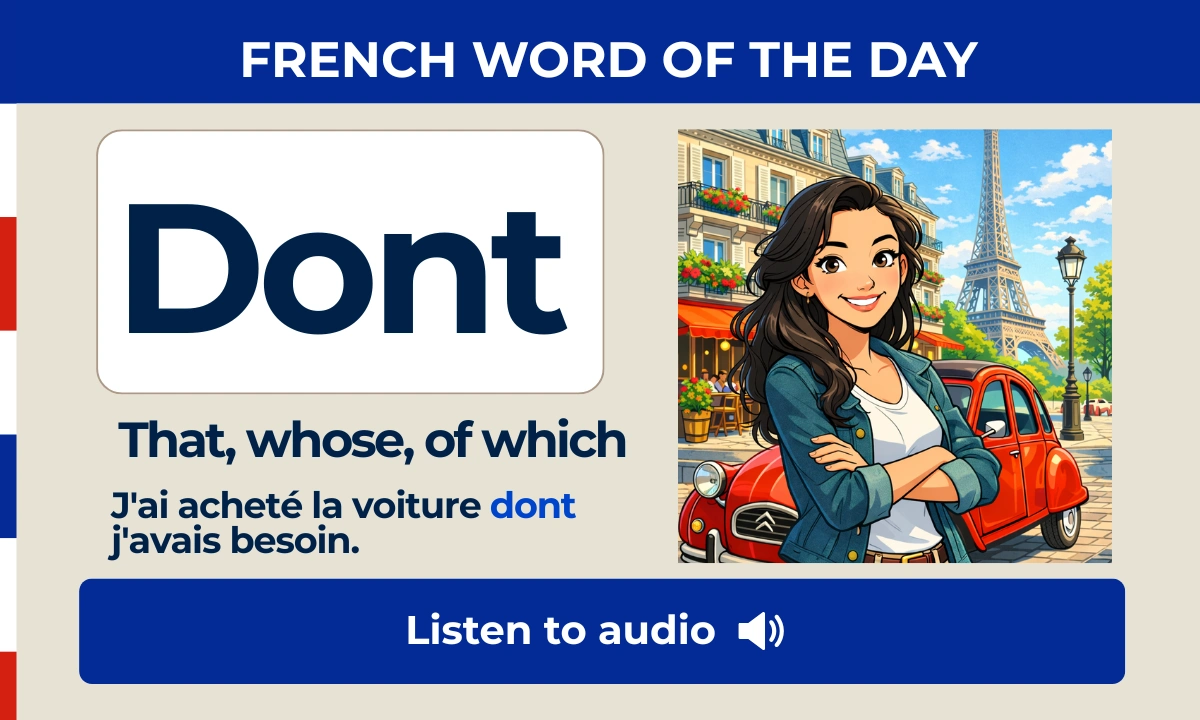
J’ai acheté la voiture dont j’avais besoin.
I bought the car I needed.
3. Quantity or a portion of the noun
Dont can also be used to refer to a quantity or a portion of the noun to which it’s making reference. Translations include ‘of whom’, ‘of which’ and ‘including’.
J’ai trois sœurs, dont une habite en France.
I have three sisters, one of whom lives in France.
Relative pronouns in French are words such as qui (who/which), que (whom/which), and dont (whose / of which). These can trip up a lot of students.
👉 See also: French relative pronouns »
❓ Want to feel more confident in French?
🎯 À Moi Paris — This is my top recommendation for online French courses, and it pairs wonderfully with my daily lessons. Camille Chevalier teaches with engaging audio stories that she records at three speeds. Her specialty is helping students with pronunciation and bridging the gap between textbook French and real spoken French as you hear it on the streets of Paris.
👉 Explore À Moi Paris »
👉 Read my review »
🎧 French Verb Drills — Having trouble with French verb conjugations? Camille’s audio drills break everything down step by step so you can finally lock in the patterns and speak with confidence.
If you purchase the courses, I may earn a small commission — at no extra cost to you.
🔗 Related words and expressions
- qui — who / which (subject)
- que — whom / which (object)
- dont — whose / of which / whom (replaces de)
- où — where / when
- lequel / laquelle / lesquels / lesquelles — which / whom (used after prepositions)
📚 Related lessons on FrenchLearner!
👉 French relative pronouns »
👉 qui – who / which »
👉 que – that / which »


