
Published April 18, 2026 — By French teacher David Issokson • Native Audio by Marie Assel Cambier
C’est means “it is” or “it’s” in French and is one of the most common expressions you’ll hear in everyday conversation. This lesson covers the 7 most important uses, each with clear examples and native audio by Marie.
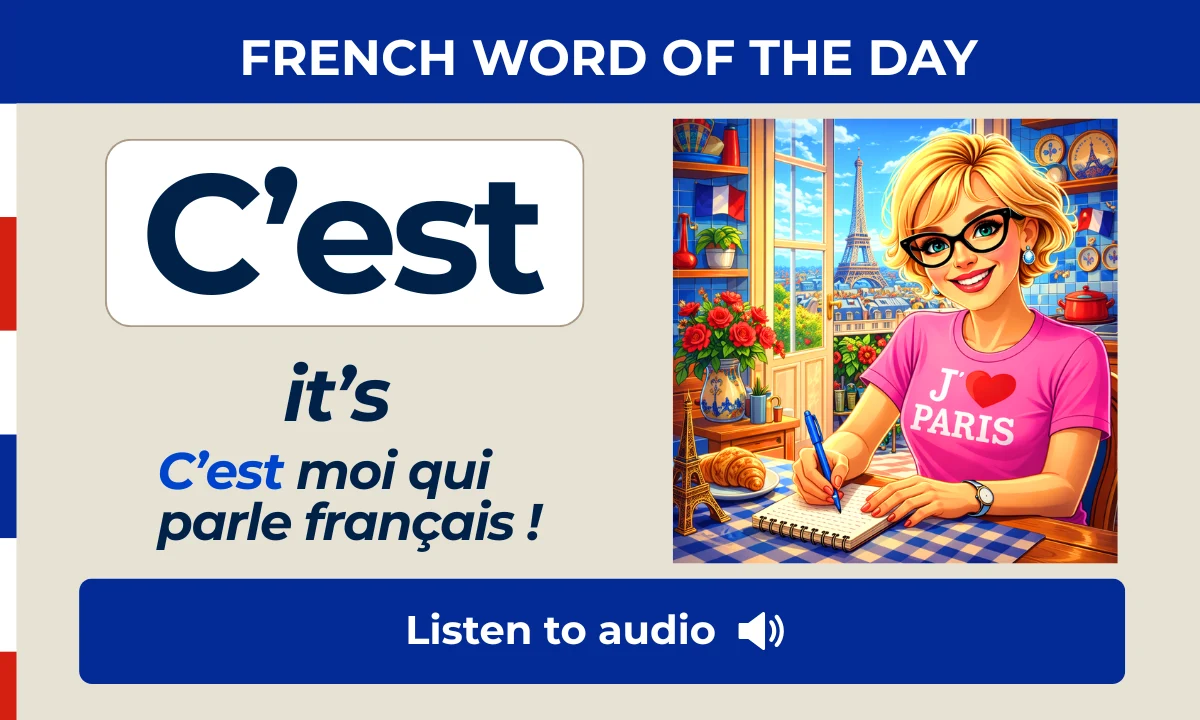
📘 C’est meaning
C’est means “it is” or “it’s” in French and is used to identify, describe, and introduce people, places, and things. Ce is a demonstrative pronoun meaning “this” or “that”, while est and sont are forms of être (to be). It’s followed by nouns, names, and articles: C’est un livre (It’s a book), C’est Marie (It’s Marie). The plural form is ce sont, used for multiple people or things: Ce sont mes amis (They are my friends).
🎧 C’est pronunciation
The pronunciation of c’est is /sɛ/ (IPA), which sounds roughly like “seh”.
📝 C’est examples
1. Identifying something (noun)
C’est un restaurant très populaire ici.
It’s a very popular restaurant here.
2. Identifying a person
C’est mon frère qui travaille à Paris.
He’s my brother who works in Paris.
3. With names / emphasis (c’est… qui)
C’est Marie qui organise la fête ce soir.
It’s Marie who is organizing the party tonight.
4. Stressed pronoun (moi, toi, lui…)
C’est moi qui fais toujours les courses.
I’m the one who always does the shopping.
5. Dates and time
Aujourd’hui, c’est le premier jour des vacances.
Today is the first day of vacation.
6. General statement with adjective
C’est difficile de comprendre cette règle rapidement.
It’s difficult to understand this rule quickly.
7. Plural form (ce sont)
Ce sont mes amis qui arrivent ce soir.
They are my friends who are arriving tonight.
Both c’est and il est can translate to “it is” but they’re not interchangeable.
👉 Master c’est vs il est now!
❓ Want to feel more confident in French?
🎯 À Moi Paris — My top recommended course by Camille Chevalier, featuring engaging audio stories (3 speeds) to help you understand real spoken French and improve pronunciation.
👉 Explore À Moi Paris »
👉 Read my review »
🎧 French Verb Drills — Camille’s step-by-step audio drills help you finally master verb conjugations.
👉 See Verb Drills »
If you purchase the courses, I may earn a small commission — at no extra cost to you.
🔗 Related words and expressions
- il y a — there is, there are
- voilà — there is, that’s it, here you go
- c’est-à-dire — that is to say, in other words
- il est — he/it is (used before adjectives without articles)
- ce sont — these/those are (plural of c’est)
- ça — that, it (informal alternative to ce)
- c’était — it was (imparfait of c’est)
📚 Related lessons
👉 Être conjugation table »
👉 C’est vs. il est »
🚀 Continue learning on FrenchLearner!
👉 French Word of the Day (200+ lessons) »
👉 French word meanings (common words explained clearly) »
👉 French vocabulary lists »


