

Published June 24, 2020 — By French teacher David Issokson with native audio by Marie Assel Cambier
D’accord meaning
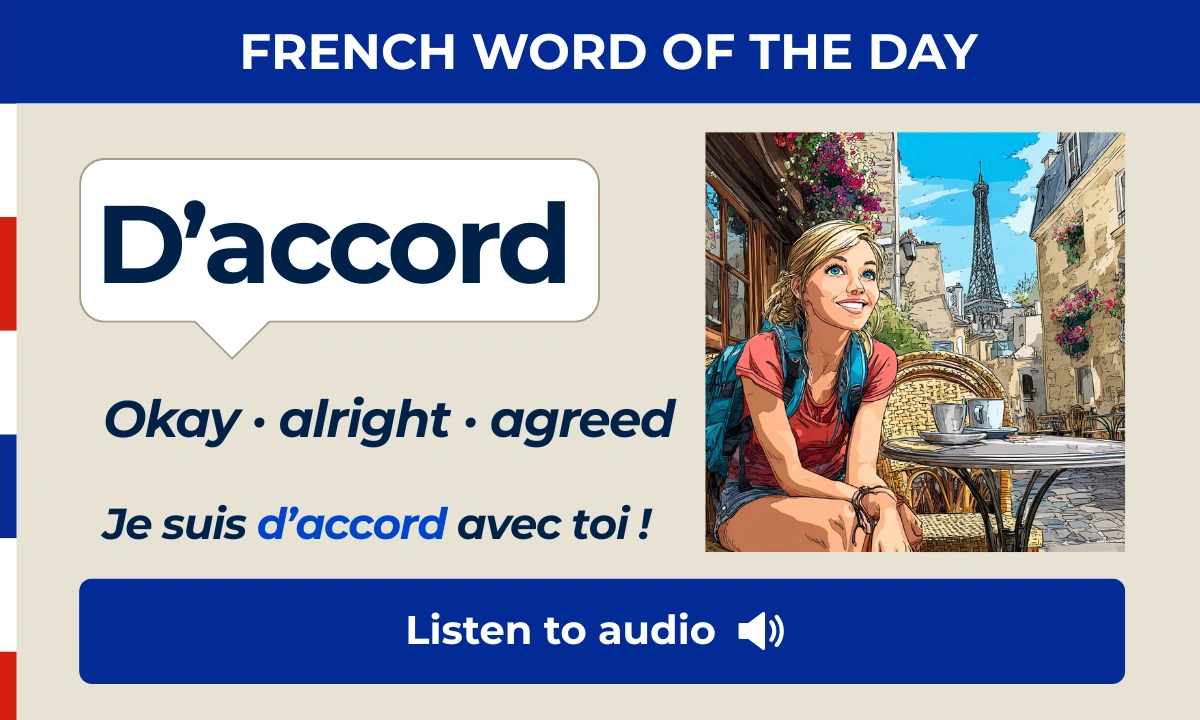
D’accord is a French interjection meaning “okay” or “alright”. It’s used to show agreement or to confirm that you’ve understood. It can stand alone — “D’accord !” — or be combined with être (to be) in “Je suis d’accord”, meaning “I agree”.
🎧 D’accord pronunciation
The pronunciation of d’accord is /da‿kɔʁ/ — roughly “dah-kor”.
📝 French and English example sentences
1. Être d’accord avec = to agree with
Je suis d’accord avec vous. I agree with you.
Désolé. Je ne suis pas d’accord avec vous. Sorry. I don’t agree with you.
Non ! Je ne suis pas d’accord ! Ça n’a rien à voir !
No! I don’t agree! That has nothing to do with it!
👉 See also: Rien à voir (to have nothing to do with) »
2. D’accord ! = Okay! / alright!
Person 1: D’accord ? Okay/Alright?
Person 2: D’accord ! Okay! Alright!
3. Se mettre d’accord = to come to an agreement
Après de longues discussions, Pierre et Marie se mettent d’accord.
After long discussions, Pierre and Marie reach an agreement.
👉 See also: Être (to be) Word of the Day and être conjugation chart (with audio) »
⚠️ Common mistakes with d’accord
Many learners get confused with d’accord. Here are the two main errors to avoid:
❌ Saying “c’est d’accord” to mean “okay / alright”
✅ To simply say okay, use “D’accord !” on its own.
✅ “C’est d’accord” actually means it’s agreed — used after confirming terms, not in everyday replies.
❌ Using “d’accord !” to mean “I agree”
✅ To say I agree, you must use “Je suis d’accord.”
✅ On its own, “D’accord !” sounds more like Alright then!
➡️ Need a clearer path to follow?
If you like Word of the Day but want a more structured path, check out À Moi Paris from French Today. Camille teaches through real-life audio stories and guides you step by step from A1 to C1.
👉 Try the course »
👉 Read my review »
If you purchase the courses, I may earn a small commission — at no extra cost to you.
🔗 Related words and expressions
- oui — yes
- bien sûr — of course / sure
- pas de problème — no problem / that’s fine
- ça marche — that works / sounds good
- entendu — understood / noted
- je suis partant(e) — i’m in / i’m up for it
- volontiers — gladly / sure
- pourquoi pas ? — why not?
📚 Related Word of the Day lessons
👉 French interjections »
👉 C’est ça — that’s it, that’s right »
👉 Volontiers (gladly) »
🚀 Continue growing your French vocabulary!
👉 French Word of the Day »
👉 French adverbs overview »
👉 French Vocabulary lists »
👉 French for beginners guide »
👉 French song lyrics hub »
👉 French conjugations hub


