
Published October 15, 2025 • Updated April 1, 2026 — Lesson written by French teacher David Issokson for students who want to learn French online, with native audio by Marie Assel Cambier, a voice artist from France.
📘 Être meaning and pronunciation
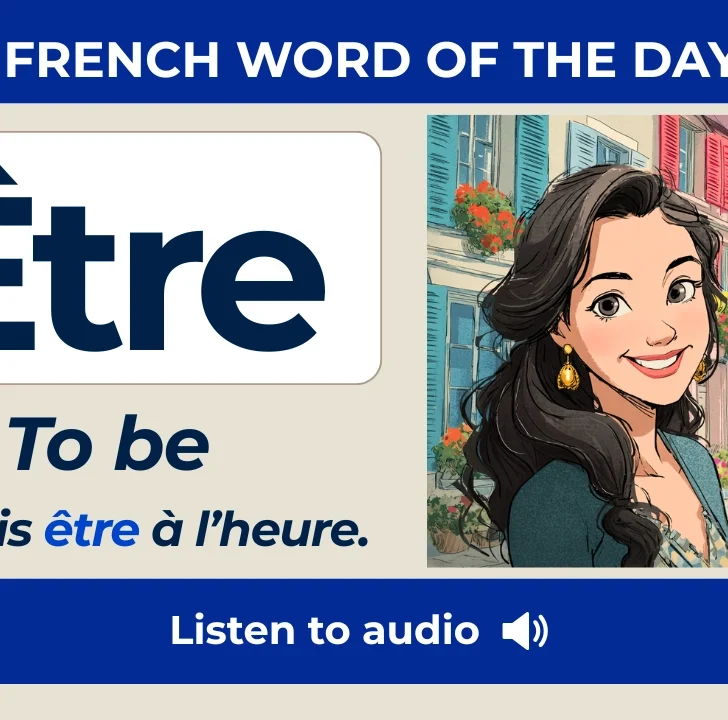
Être is a common and essential irregular French verb meaning “to be.” It is used to describe identity, characteristics, emotions, and location. Être also serves as an auxiliary verb in compound tenses and is used to form the passive voice.
The pronunciation of être is /ɛtʁ/, which sounds like eh-tr(uh).
👉 See also: Être conjugation chart »
📝 Être examples
1. Nationality, Profession
Je suis français(e).
I am French.
Pierre est étudiant.
Pierre is a student.
2. Physical or Emotional State
Je suis heureux. / Je suis heureuse.
I am happy.
3. Location
Je suis en France.
I am in France.
4. Auxiliary in Passé Composé
Je suis allé(e) en France.
I went to France.
5. Ongoing Action (être en train de)
Je suis en train de travailler.
I am working.
6. Agreement / Shared Opinion
Je suis d’accord avec vous.
I agree with you.
7. Possession / Ownership
Le stylo est à moi.
The pen belongs to me.
8. Fixed Expression / Idiom
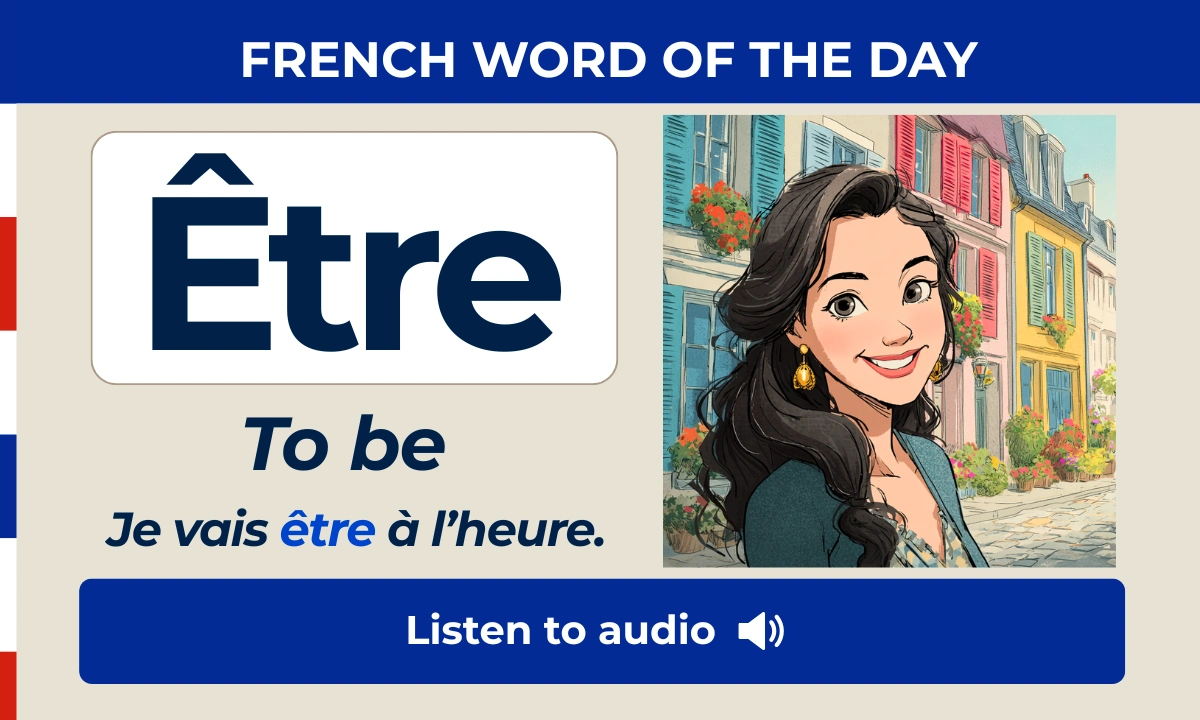
Je suis à l’heure.
I am on time.
9. Passive Voice
La porte est fermée.
The door is closed.
10. Opinion / Assessment
C’est une bonne idée.
That’s a good idea.
11. Other – peut-être (maybe)
Est-ce qu’il va venir ce soir ? – Peut-être.
Is he going to come tonight? – Maybe.
❓ Need extra help with verbs?
🎯 French Verb Drills — Camille’s course from French Today gives you clear, step-by-step audio drills to lock in conjugation patterns.
👉 See Verb Drills »
📖 À Moi Paris — Prefer a complete self-study program? Camille’s flagship course teaches French through stories and includes verb work in real conversations.
👉 Explore À Moi Paris »
If you purchase the courses, I may earn a small commission — at no extra cost to you.
🤔 What is the difference between être and avoir?
In French, être means “to be” and avoir means “to have.” Both are used as main verbs in everyday sentences.
➞ Je suis content. — I am happy.
➞ J’ai un vélo. — I have a bike.
Both verbs are also used as auxiliary (helper) verbs in the passé composé.
➞ Je suis allé en France. — I went to France. (être as auxiliary)
➞ J’ai mangé. — I ate. (avoir as auxiliary)
👉 See also: French passé composé (common past tense) »
🔗 Related words and expressions
- être d’accord — to agree
- être en colère — to be angry
- être fatigué(e) — to be tired
- être en forme — to be in good shape / feeling well
- être en train de — to be in the middle of doing something
- être de retour — to be back
- être sur le point de — to be about to
👉 See also: Être expressions »
📚 Related lessons
👉 Être conjugation chart »
👉 Je suis (I am) »
🚀 Discover more on FrenchLearner
👉 Verb conjugations hub »
👉 French Word of the Day »
👉 French Vocabulary lists »


