
Published September 11, 2012 • Updated June 25, 2026 — By French teacher David Issokson, teaching French online since 2014
In French, the subject pronouns are je (I), tu (you singular informal), il (he/it), elle (she/it), on (one/we/people), nous (we), vous (you formal and plural), ils (they masculine or mixed) and elles (they feminine). These are also called personal pronouns. A subject pronoun tells us who or what carries out the action of a verb.
For example, in the sentence Je vais à la plage (I am going to the beach), je is the subject pronoun because it tells us who is going.
Free PDF: French Grammar Made Easy Cheat Sheet
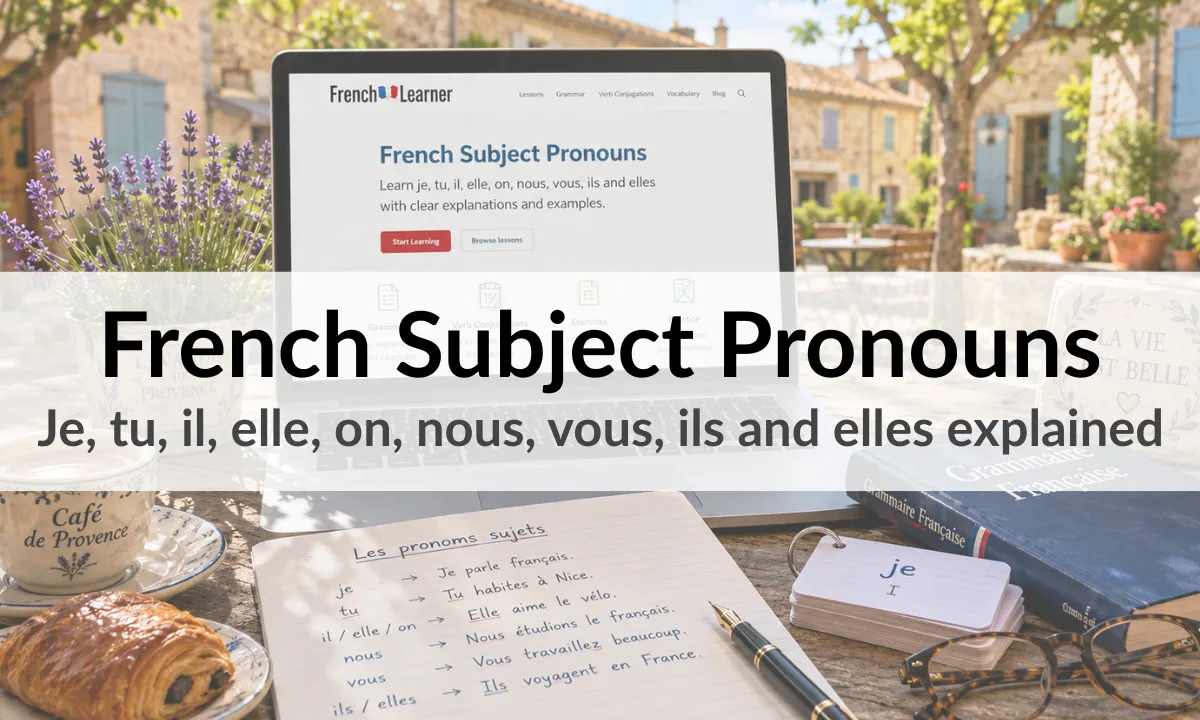
French subject pronouns chart
| Subject pronoun | Meaning and use |
|---|---|
| je | I |
| tu | you, singular informal |
| il | he, it |
| elle | she, it |
| on | one, we, people |
| nous | we |
| vous | you, formal singular or plural |
| ils | they, masculine or mixed group |
| elles | they, feminine group only |
French subject pronouns explained
Now let’s look at each French subject pronoun individually.
Je (I)
Je means “I.” In grammatical terms, je is the first-person singular.
When je starts a sentence, it is capitalized. However, unlike English, je is not capitalized when it appears in the middle of a sentence.
Je parle français.
I speak French.
Il ne sait pas quand j’arrive.
He does not know when I am arriving.
Before a vowel or silent h, je becomes j’.
J’aime Paris.
I like Paris.
Tu (you singular informal)
Tu means “you” and is singular and informal. Use tu when speaking to one person you know well, such as a friend, family member, classmate or child.
Tu parles français ?
Do you speak French?
Tu viens d’où ?
Where are you from?
In formal situations, or with someone you do not know well, use vous instead.
Il, elle and on (he, she, one/we)
Il, elle and on are third-person singular subject pronouns.
Il means “he” when referring to a male person.
C’est Martin. Il est professeur.
This is Martin. He is a teacher.
Elle means “she” when referring to a female person.
C’est Marie. Elle est intelligente.
This is Marie. She is intelligent.
Unlike English, French also uses il and elle for things, because all French nouns are masculine or feminine.
C’est un vélo. Il est bleu.
It is a bike. It is blue.
C’est une pizza. Elle est chaude.
It is a pizza. It is hot.
On can mean “one,” “people” or “we.” In spoken French, on is very often used instead of nous to mean “we.”
On mange à 17h00 ?
Shall we eat at 5:00?
En France, on parle français.
People speak French in France.
Even when on means “we,” the verb form is singular.
On est prêts.
We are ready.
Not: On sommes prêts.
Nous (we)
Nous means “we.” In grammatical terms, nous is the first-person plural.
Nous commençons le repas à 18h00 ce soir.
We are starting the meal at 6:00 tonight.
Nous savons où nous sommes.
We know where we are.
In everyday spoken French, on is often more common than nous. However, nous is still important in writing, formal speech and verb conjugation charts.
Vous (you formal and plural)
Vous means “you.” It has two main uses.
Use vous when speaking formally to one person.
Bonjour madame, comment allez-vous ?
Hello, ma’am. How are you?
Use vous when speaking to more than one person.
Est-ce que vous comprenez ?
Do you understand?
This is an important difference between English and French. English has one main word for “you,” but French has both tu and vous.
Ils and elles (they)
Ils and elles both mean “they.” These are third-person plural subject pronouns.
Use ils for a group of males or for a mixed group of males and females.
Je connais Marie et Pierre, mais je ne sais pas où ils habitent.
I know Marie and Pierre, but I do not know where they live.
Use elles only for a group that is entirely feminine.
J’adore l’équipe féminine de rugby. Elles vont gagner !
I love the women’s rugby team. They are going to win!
If a group has 99 women and one man, use ils.
Subject pronouns and verb conjugation
French verbs change depending on the subject pronoun.
For example, here is the verb être (to be):
je suis
I am
tu es
you are
il/elle/on est
he/she/one is
nous sommes
we are
vous êtes
you are
ils/elles sont
they are
This is why subject pronouns are important: they help determine the correct verb form.
Common mistakes
Do not use tu with strangers or in formal situations. Use vous instead.
Vous parlez français ?
Do you speak French?
Do not use elles for a mixed group. Use ils.
Marie et Paul sont français. Ils habitent à Lyon.
Marie and Paul are French. They live in Lyon.
Do not use a plural verb form with on.
On est prêts.
We are ready.
Not: On sommes prêts.
📚 Related lessons
- Tu vs. vous
- French pronoun “on”
- French stressed pronouns
- French object pronouns
- French possessive adjectives
- French relative pronouns
🚀 More lessons on FrenchLearner


