
Published May 11, 2026 — Lesson written by French teacher David Issokson for students who want to learn French online. Lyrics provided for educational purposes to support French language learning. All rights belong to the original copyright holders.
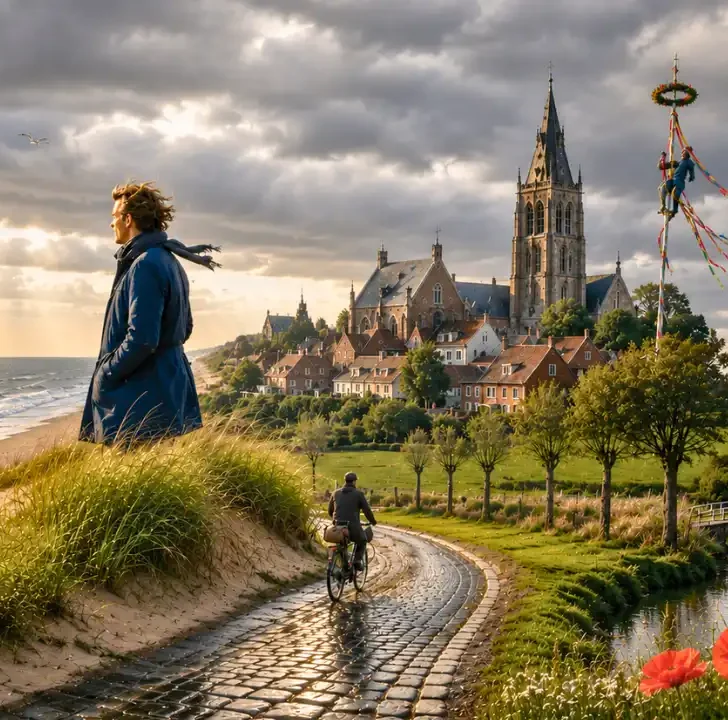
“Le plat pays” (the flat country) is one of Jacques Brel’s most famous songs. Released in 1962, the song describes the landscapes of Belgium through images of wind, canals, gray skies, cathedrals, and the North Sea coastline. Rather than telling a story, Brel focuses on creating a strong feeling and atmosphere. The poetic imagery and descriptive language make this song especially interesting for intermediate French learners.
In this lesson, we’ll look closely at the lyrics, with clear explanations to help you understand the song and learn useful French vocabulary and grammar.
🎙️ Listen to the song
📘 Meaning in French
✏️ Lyrics and notes

🎙️ Listen to “Le plat pays” by Jacques Brel
Listen to the song first and see how much French lyrics you can understand before reading the translation notes below.
📘 Le plat pays meaning
“Le plat pays” literally means “the flat country.” In the song, Jacques Brel uses images of flat land, low skies, fog, wind, and changing seasons to describe how Belgium looks and feels. The song is mainly about atmosphere and emotion rather than action or characters. Through vivid imagery, Brel expresses both the beauty and melancholy of his homeland.
✏️ Le plat pays lyrics and grammar notes
This section explains useful French vocabulary, expressions, and grammar structures from Le plat pays to help you understand how they’re used.
🎼 Song Title
Le plat pays → literal translation: The flat country.
- Plat means “flat.”
- Pays (m.) means “country” or “land.”
- Together, le plat pays refers to Belgium’s flat landscapes, especially the Flemish countryside.
- The title introduces the song’s themes of identity, nature, nostalgia, and attachment to homeland.
🧩 Sentence Structures & Grammar
Avec la mer du Nord
👉 “With the North Sea”
- Avec means “with.”
- La mer du Nord refers to the North Sea bordering Belgium.
- The repeated use of avec creates poetic rhythm throughout the song.
Pour dernier terrain vague
👉 “As the final wasteland”
- Terrain vague means “empty lot,” “wasteland,” or “vacant land.”
- Pour here means “as” or “for.”
Et des vagues de dunes / Pour arrêter les vagues
👉 “And waves of dunes / To stop the waves”
- Vagues can mean both “waves” and “vague” depending on context.
- Arrêter means “to stop.”
Et de vagues rochers / Que les marées dépassent
👉 “And vague rocks / That the tides pass over”
- Rochers means “rocks” or “cliffs.”
- Les marées means “the tides.”
- Dépassent comes from dépasser (to go beyond, overtake).
Et qui ont à jamais le cœur / À marée basse
👉 “And which forever have their heart at low tide”
- À jamais means “forever.”
- Le cœur means “the heart.”
- À marée basse means “at low tide.”
Avec infiniment de brumes à venir
👉 “With endlessly more fogs to come”
- Infiniment means “infinitely” or “endlessly.”
- Brumes means “mists” or “fog.”
- À venir means “to come.”
Avec le vent de l’est / Écoutez-le tenir
👉 “With the east wind / Listen to it endure”
- Le vent de l’est means “the east wind.”
- Écoutez-le means “listen to it.”
- Le here is a definite article (the).
- Tenir means “to hold,” “endure,” or “stand firm.”
Le plat pays / Qui est le mien
👉 “The flat country / Which is mine”
- Le mien means “mine,” a possessive pronoun.
- Relative pronoun qui introduces a descriptive clause.
Avec des cathédrales / Pour uniques montagnes
👉 “With cathedrals / As its only mountains”
- Cathédrales means “cathedrals.”
- Belgium’s flatness is contrasted with tall church buildings.
- Uniques montagnes means “only mountains.”
Et de noirs clochers / Comme mâts de cocagne
👉 “And black bell towers / Like festive poles”
- Clochers means “bell towers” or “steeples.”
- Comme means “like.”
- Mâts de cocagne refers to traditional festival poles.
Où des diables en pierre / Décrochent les nuages
👉 “Where stone devils pull down the clouds”
- Des diables en pierre refers to stone gargoyles.
- Décrochent comes from décrocher (to unhook, pull down).
Avec le fil des jours / Pour unique voyage
👉 “With the thread of days / As the only journey”
- Le fil des jours literally means “the thread of days.”
- A poetic metaphor for the passing of time.
Et des chemins de pluie / Pour unique bonsoir
👉 “And rainy roads / As the only good evening”
Avec le vent d’ouest / Écoutez-le vouloir
👉 “With the west wind / Listen to it desire”
- Vouloir means “to want.”
- The wind is personified throughout the song.
Avec un ciel si bas / Qu’un canal s’est perdu
👉 “With such a low sky / That a canal got lost”
- Si… que means “so… that.”
- S’est perdu is reflexive passé composé of se perdre (to get lost).
Avec un ciel si bas / Qu’il fait l’humilité
👉 “With such a low sky / That it creates humility”
- Il fait here means “it creates” or “it causes.”
- L’humilité means “humility.”
Avec un ciel si gris / Qu’un canal s’est pendu
👉 “With such a gray sky / That a canal hanged itself”
- Gris means “gray.”
- S’est pendu comes from se pendre (to hang oneself).
- Strong poetic imagery expressing sadness and heaviness.
Avec un ciel si gris / Qu’il faut lui pardonner
👉 “With such a gray sky / That one must forgive it”
- Il faut means “it is necessary.”
- Pardonner means “to forgive.”
- Lui is an indirect object pronoun referring back to the sky.
Avec le vent du nord / Qui vient s’écarteler
👉 “With the north wind / That comes tearing itself apart”
- S’écarteler means “to tear apart” or “be pulled apart.”
- The reflexive form adds dramatic imagery.
Avec le vent du nord / Écoutez-le craquer
👉 “With the north wind / Listen to it crack”
- Craquer means “to crack” or “creak.”
Avec de l’Italie / Qui descendrait l’Escaut
👉 “With Italy descending the Scheldt”
- Descendrait is conditional tense of descendre (to do down, to descend).
- L’Escaut is the Scheldt River.
Avec Frida la Blonde / Quand elle devient Margot
👉 “With blonde Frida / When she becomes Margot”
- Devient comes from devenir (to become).
- The line evokes changing identities and village life.
Quand les fils de novembre / Nous reviennent en mai
👉 “When the sons of November return to us in May”
- Reviennent comes from revenir (to return).
- See: months of the year
- Seasonal imagery symbolizes renewal.
Quand la plaine est fumante / Et tremble sous juillet
👉 “When the plain is steaming / And trembles beneath July”
- La plaine means “the plain.”
- Fumante means “smoking” or “steaming.”
- Sous juillet literally means “under July.”
Quand le vent est au rire / Quand le vent est au blé
👉 “When the wind is with laughter / When the wind is with wheat”
- Le blé means “wheat.”
- Repetition creates musical rhythm and atmosphere.
Quand le vent est au sud / Écoutez-le chanter
👉 “When the wind is from the south / Listen to it sing”
- Chanter means “to sing.”
- Nature is personified throughout the song.
🔤 Verb Forms & Tenses
- Present tense: est, ont, dépassent, fait, faut, vient, devient, tremble
- Imperfect-style poetic descriptions dominate the atmosphere of the song
- Reflexive passé composé: s’est perdu, s’est pendu
- Conditional tense: descendrait
- Infinitives: arrêter, tenir, vouloir, pardonner, chanter
- Reflexive infinitive: s’écarteler
💬 Idioms & Natural Expressions
- à jamais → forever
- à marée basse → at low tide
- le fil des jours → the thread of days
- chemins de pluie → rainy roads
- il faut → it is necessary
- le vent est au sud → the wind is from the south
- le cœur à marée basse → emotionally low or melancholy
📘 Vocabulary
- la mer du Nord — North Sea
- la dune — dune
- la vague — wave
- le rocher — rock
- la marée — tide
- la brume — fog, mist
- le vent — wind
- la cathédrale — cathedral
- le clocher — bell tower
- le nuage — cloud
- le canal — canal
- le ciel — sky
- la plaine — plain
- le blé — wheat
- le cœur — heart
- l’humilité — humility
- la pluie — rain
- le voyage — journey
- le bonsoir — good evening
🎶 Take your learning to the next level!
FrenchLearner offers one of the largest collections of French song lessons online. Visit the French song lyrics hub to explore classics from the 1950s to the 2000s.
🎵 More Jacques Brel songs you’ll love
👉 Ne me quitte pas »
👉 Amsterdam »
👉 La Valse à mille temps »
📚 See all Jacques Brel songs »
🇫🇷 More French classic songs you’ll love
👉 La vie en rose (Édith Piaf) »
👉 Non, je ne regrette rien (Édith Piaf) »
👉 C’est si bon (Yves Montand) »
👉 La mer (Charles Trenet) »
About this lesson: I create these song-based lessons to help French learners improve vocabulary, grammar, and cultural understanding in a fun, engaging way. Song lyrics are provided for educational purposes under fair use. All rights to the original works belong to their respective copyright holders.


