
Published January 30, 2026 — Lesson written by French teacher David Issokson for students who want to learn French online, with native audio by Marie Assel Cambier, a voice artist from France.
📘 Café au lait meaning in French
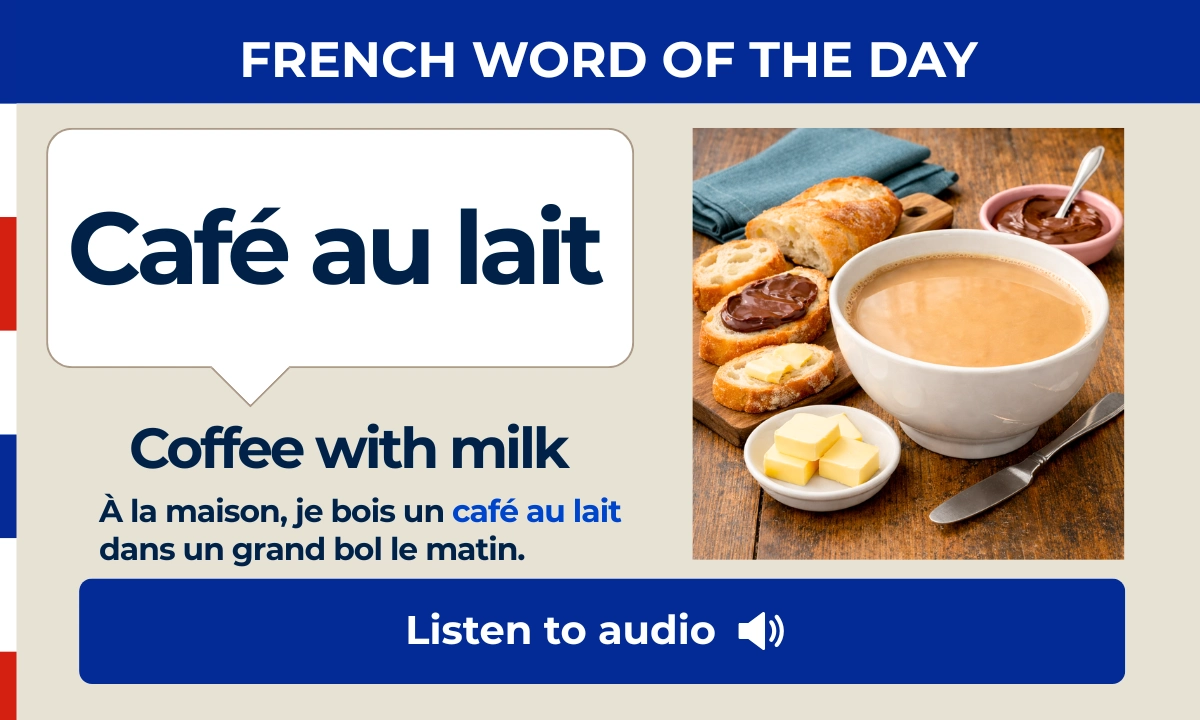
Café au lait literally means “coffee with milk.” It’s a classic French drink made by mixing hot milk with regular coffee (not espresso), usually in roughly equal parts. Unlike a latte, which uses espresso, café au lait has a smoother, lighter taste and a pale, creamy color with little or no foam. Café au lait is a French loanword in English. Its pronunciation and overall meaning are essentially the same in both languages. 🔊 Jump to examples now
☕ Do the French drink café au lait?
Yes — but mainly at home, and almost always in the morning. In France, café au lait is a traditional breakfast drink, served in a large bowl or wide cup so you can dip a croissant or baguette with butter or Nutella. In cafés, you usually don’t order “un café au lait” — instead, ask for un café crème, which is an espresso served with a large portion of hot steamed milk.
🎧 Café au lait pronunciation in French
The pronunciation of café au lait is /ka.fe o lɛ/ (IPA), which sounds roughly like “ka-fay oh leh.”
📝 Café au lait usage examples
Le café au lait est une boisson chaude souvent bue au petit-déjeuner en France.
Café au lait is a hot drink often consumed at breakfast in France.
À la maison, je bois un café au lait dans un grand bol le matin.
At home, I drink a café au lait in a large bowl in the morning.
Au café, les Français commandent plutôt un café crème qu’un café au lait.
At cafés, French people usually order a café crème rather than a café au lait.
Elle préfère le café au lait le matin, mais prend un espresso plus tard dans la journée.
She prefers café au lait in the morning, but has an espresso later in the day.
Traveling to France and want to know how to order a coffee? This lesson covers an essential term you must know.
👉 See also: Café allongé meaning and explanation »
❓ Want to feel more confident in French?
🎯 À Moi Paris — This is my top recommendation for online French courses, and it pairs wonderfully with my daily lessons. Camille Chevalier teaches with engaging audio stories that she records at three speeds. Her specialty is helping students with pronunciation and bridging the gap between textbook French and real spoken French as you hear it on the streets of Paris.
👉 Explore À Moi Paris »
👉 Read my review »
🎧 French Verb Drills — Having trouble with French verb conjugations? Camille’s audio drills break everything down step by step so you can finally lock in the patterns and speak with confidence.
If you purchase the courses, I may earn a small commission — at no extra cost to you.
🔗 Related words and expressions
- un café crème — a coffee with cream (what you usually order in cafés)
- une noisette — an espresso with a splash of milk
- un grand crème — a large coffee with milk/cream
- le petit déjeuner — breakfast
- un bol — a bowl (traditional way to drink café au lait at home)
- du lait chaud — hot milk
📚 Related lessons on FrenchLearner!
👉 Café allongé — espresso with hot water »
👉 Café — coffee »
👉 Petit déjeuner (breakfast) »
👉 Beignet (fritter, donut) »


