
See also:
👉 Café au lait »
👉 Café allongé »
Today we’ll have a close look at the word café, meaning coffee and café (English borrow word from French). We’ll discover how to order coffee in French and look at the different kinds of coffee on the menu in France. “Un café, s’il vous plait!” (a coffee please!).
le café
coffee, café
Café: Coffee in French
Word origin
Café (coffee) in French comes from kahve in Ottoman Turkish, which in turn comes from qahwah in Arabic.
Example sentences
These first two example sentences are autobiographical. Somehow I manage to limit myself to deux tasses (two cups) of coffee per day.
En général, je prends deux tasses de café par jour.
I generally have two cups of coffee per day.
For this second example sentence, accro is slang for dépendant, which means “addicted to”.
Je suis accro au café depuis l’âge de douze ans.
I’ve been addicted to coffee since I was twelve years-old.
This next example sentence plays into a common French stereotype of American coffee. Some readers may agree; some may disagree. Dégueulasse is a slang adjective for gross or disgusting.
Les Français disent souvent que le café américain est dégueulasse.
The French often say the American coffee is disgusting.
Ordering coffee in French
These next three example sentences show how to order a coffee in French. The French use the verb prendre (to take) where English speakers would say “I’d like” or “I’ll have”. In France, if you order “un café” you’ll most likely be served a small espresso without any milk.
Je prends un café, s’il vous plaît.
I’ll have a coffee, please.
In France, it’s practically unheard of to be given a milk with coffee. In fact, if you even attempt to ask for it after you’ve paid, the sever may give you a nasty look (based on my experience in Paris). If you want milk with your coffee, you must say say une dosette de lait, s’il vous plaît while ordering the coffee. Une dosette translates loosely to “a small portion”. The milk will cost you a little extra.
Je prends une dosette de lait, s’il vous plaît.
I’ll have some milk on the side, please.
The following example sentence shows how to ask for sugar. Again, use je prends for “I’ll have”. Note that to be a bit more polite you could also say this in the conditional tense: Je prendrais.
Je prends deux sucres, s’il vous plaît.
I’ll have two sugars, please.
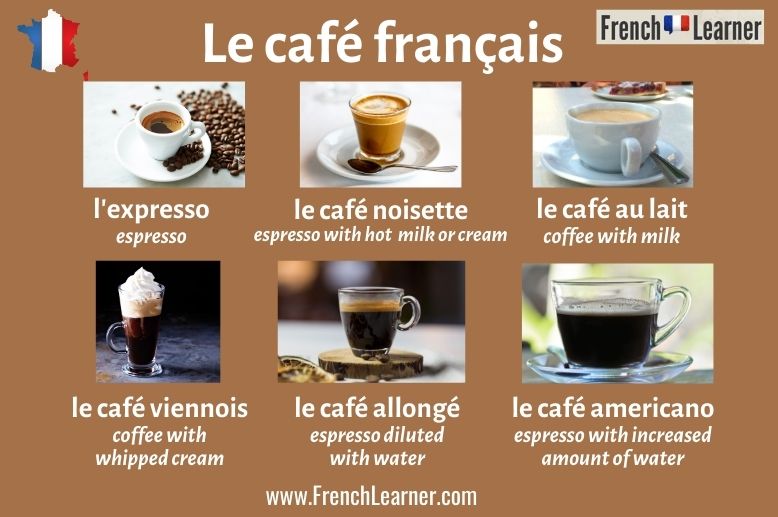
Kinds of coffee in France
The following is a list of the kinds of coffee you’re likely to see on a menu in France. If you insist on having a coffee that’s similar to the coffee you’d get served in the North American, you may order a café américano or a café filtre and make it a point to ask for une dosette de lait (see above) while ordering.
- l’expresso – Tiny amount of super strong coffee.
- le café noisette – A shot of espresso with a small amount of hot milk or cream
- le café au lait – Coffee with milk
- le café viennois – Coffee with whipped cream – yum!
- le café allongé – Espresso diluted with water
- le café américano – Espresso with increased amount of water
- le café filtre – Filtered coffee (less common in cafés but can be found in homes)
Café – cafe, coffee shop
We’ve included this final example sentence to show that similar to English, a café is the place you can go for a coffee. The French use the verb rejoindre to express joining another person or group of people at an indicated place.
Je vous rejoins au café dans une heure.
I’ll join you at the café in one hour.

Related lessons
References


