
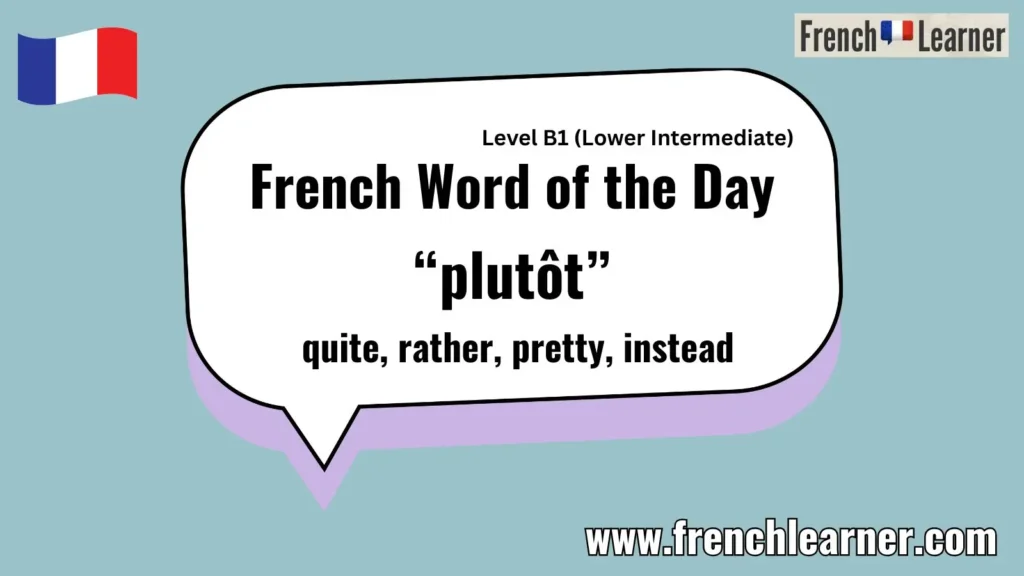
The French word of the day is plutôt which translates to ‘quite’, ‘rather’ and ‘pretty’ as an intensifier and ‘instead’ and ‘preferably’ to indicate choice. Today you will learn:
How To Use Plutôt In French
Pronunciation of plutôt
Kind of word
Plutôt is an adverb.
Example sentences
This first example sentence is in the conditional tense. The verb prendre means ‘to take’ and means ‘have’ in the context of ordering meals.
Je prendrais plutôt du champagne.
I’d rather have champagne.
For this second sentence, the reflexive verb se donner rendez-vous means ‘to arrange to meet’.
Je suis très occupé demain. On peut se donner rendez-vous samedi plutôt?
I’m very busy tomrorow. Can we arrange to meet on Saturday instead?
For this final sentence, plutôt que can translate to ‘rather than’ or ‘instead of’.
Je préférerais acheter une camionnette plutôt qu‘une voiture.
I’d prefer to buy a pickup truck rather than a car.
Word origin
Plutôt in Modern French comes from plustost in Middle French and plus tost in Old French. From the 16th century onwards, these words replaced ains et ainçois, which came from antius in Latin.
Note that while the single word plutôt means rather, the two separate words plus tôt mean ‘earlier’ as the adjective tôt means ‘early’.
RELATED LESSON
Assez also means ‘quite’, ‘rather’ and ‘pretty’ but has a different usage than plutôt. The word assez is used to express sufficiently or a degree. For example, “J’ai assez d’argent” (I have enough money) or “Elle est assez belle” (She’s quite/rather beautiful). Plutôt, however, is mainly used to indicate preference. “Je prendrais plutôt un café” (I’d rather have a coffee).
There is an overlap between plutôt and assez. For example, “Elle est assez/plutôt grande” (She’s rather/quite tall). Using plutôt suggests a subjective observation that her height is quite noticeable, whereas using assez is more of a neutral statement.


