
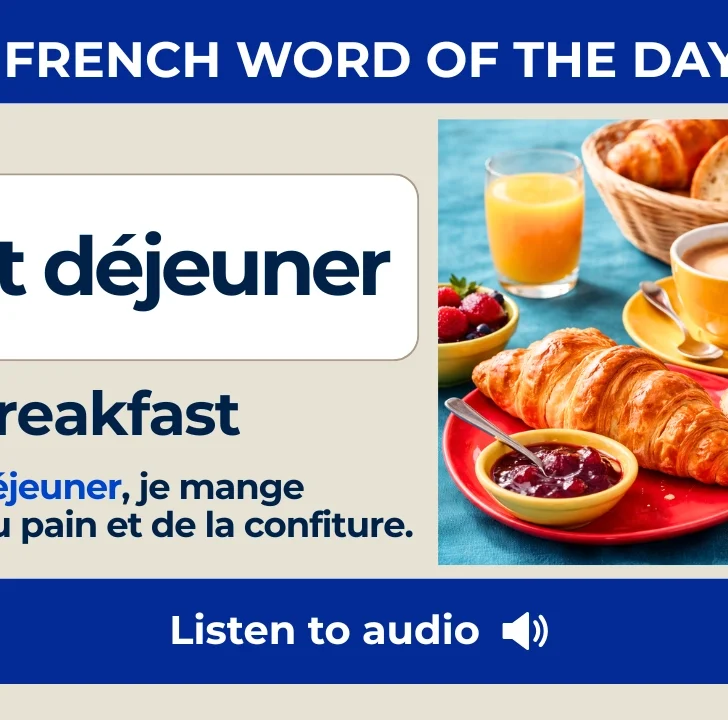
Published November 13, 2025 — Lesson written by French teacher David Issokson for students who want to learn French online, with native audio by Marie Assel Cambier, a voice artist from France.
📘 Petit déjeuner meaning
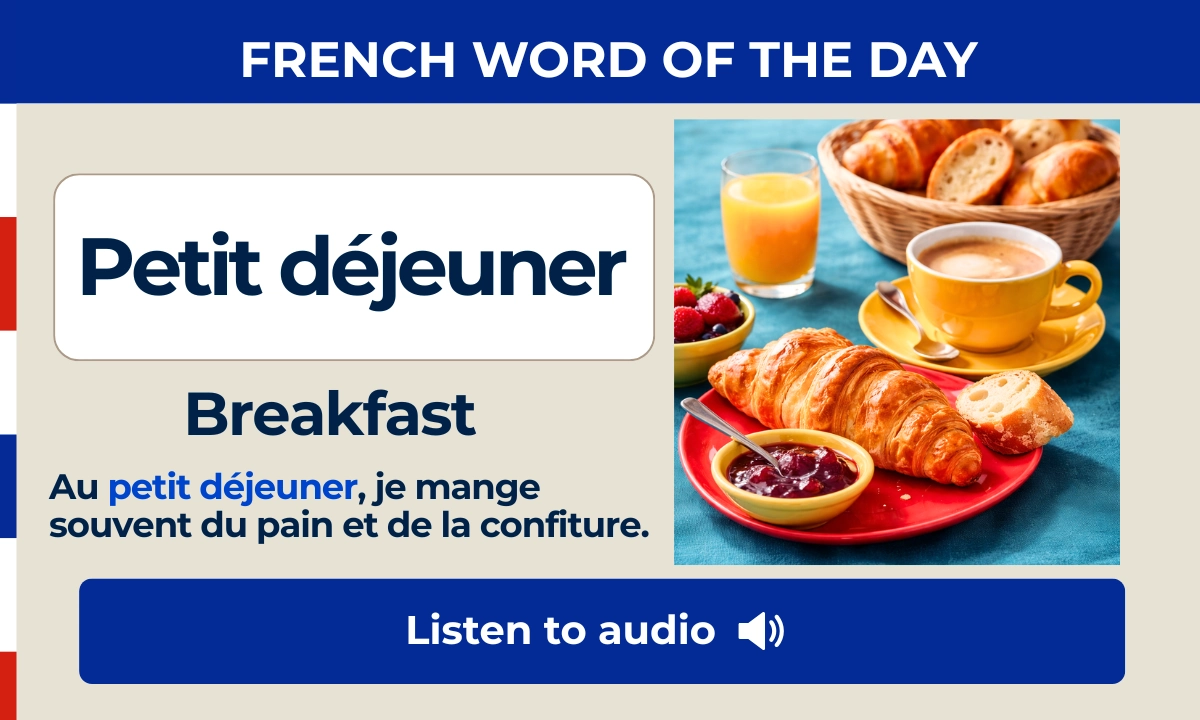
In everyday French, petit déjeuner refers specifically to the morning meal. The expression literally means “little lunch,” from petit (small) and déjeuner (to eat lunch), reflecting the idea of a light meal to start the day, often with coffee, bread, butter, or a croissant. Petit déjeuner is often shortened to petit déj’ or p’tit déj’ in spoken French.
🥐 Breakfast in France
In France, breakfast is usually light and sweet rather than savory. Most people have coffee (often café au lait at home or an espresso at a café) with bread or a pastry like a croissant. The bread is typically eaten as tartines — sliced baguette with butter and jam. Eggs, bacon, and heavy hot foods are uncommon except in hotels or on weekends.
👉 Want to see a full breakdown of what French people really eat?
Read: Typical breakfast in France »
🎧 Petit déjeuner pronunciation
The pronunciation of petit déjeuner is /pəti deʒøne/ (IPA), which sounds roughly like “puh-tee day-zhuh-nay”.
📝 Petit déjeuner examples
Au petit déjeuner, je mange souvent du pain et de la confiture.
At breakfast, I often eat bread and jam.
Le restaurant sert le petit déjeuner à partir de 7 heures.
The restaurant serves breakfast starting at 7:00.
Le petit déjeuner est compris dans le prix de la chambre.
Breakfast is included in the room price.
Je vais prendre un petit déjeuner avec un café et un croissant.
I’m going to have breakfast with a coffee and a croissant.
Why does “dîner” mean both the meal and the action?
👉 See real-life examples »
❓ Want to feel more confident in French?
🎯 À Moi Paris — This is my top recommendation for online French courses, and it pairs wonderfully with my daily lessons. Camille Chevalier teaches with engaging audio stories that she records at three speeds. Her specialty is helping students with pronunciation and bridging the gap between textbook French and real spoken French as you hear it on the streets of Paris.
👉 Explore À Moi Paris »
👉 Read my review »
🎧 French Verb Drills — Having trouble with French verb conjugations? Camille’s audio drills break everything down step by step so you can finally lock in the patterns and speak with confidence.
If you purchase the courses, I may earn a small commission — at no extra cost to you.
🔗 Related words and expressions
- le beurre — butter
- le café — coffee
- la baguette — French bread
- le déjeuner — lunch
- le dîner — dinner
- le croissant — croissant
- le pain — bread
- la confiture — jam
- le jus d’orange — orange juice
📚 Related lessons on FrenchLearner!
👉 Dîner (dinner, to have dinner) »
👉 Café au lait »
👉 Repas (meal) »
👉 Œuf (Egg) »


