
Level A1 (Beginner)
Published January 8, 2026 — Lesson written by French teacher David Issokson for students who want to learn French online, with native audio by Marie Assel Cambier, a voice artist from France.
The French Word of the Day is camembert, the famous French cheese. When I was an exchange student in 1991–92 in France, I loved eating this cheese!
In addition to showing you exactly how to pronounce camembert, I’ll also answer some common questions based on my first-hand experience: Is camembert a standard everyday food or is it considered a luxury? How do the French eat it — do they cut off the rind? And what’s the right way to choose a camembert in the store? Keep reading to learn how camembert is really enjoyed in France.
✅ Meaning
✅ Pronunciation
✅ Example sentences
✅ Related Words & Expressions
✅ Related lessons
📘 Camembert meaning in French
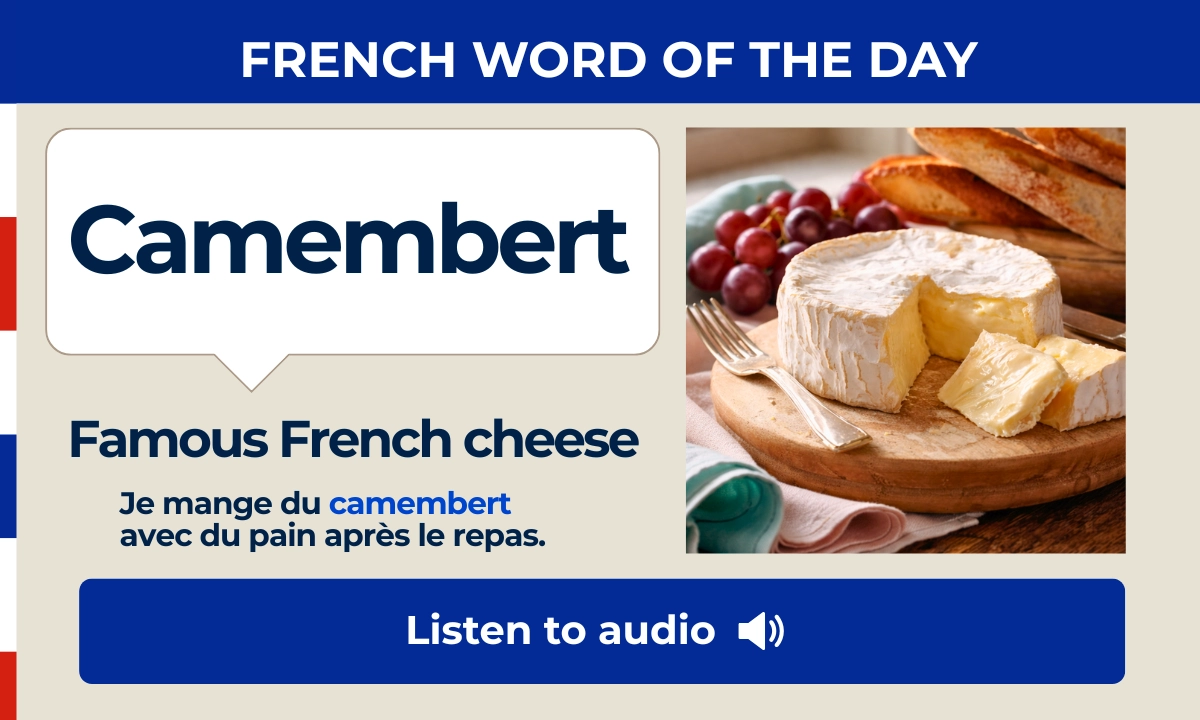
Camembert (m.) is a famous French soft and creamy cheese with a white rind, originally from Normandy. In French, camembert refers both to the cheese itself and to a whole wheel of cheese. French people commonly eat camembert with a baguette, often after meals. When talking about camembert, you’ll hear du camembert (some camembert) or un camembert (a whole camembert cheese). See cultural notes below usage examples.
🎧 Camembert pronunciation in French
The pronunciation of camembert is /ka.mɑ̃.bɛʁ/ (IPA), which sounds roughly like “kah-mahn-BAIR.” The Final -t is silent. When a French word ends in two consonants, the final consonant is silent.
👉 See this reading rule explained »
📝 Camembert usage examples
Le camembert est un fromage français à pâte molle et à croûte blanche.
Camembert is a French soft cheese with a white rind.
Nous mangeons du camembert avec du pain après le repas.
We eat camembert with bread after the meal.
Il achète un camembert chez le fromager du quartier.
He buys a camembert from the neighborhood cheese shop.
Elle aime le camembert quand il est bien fait.
She likes camembert when it is well aged.
Enjoy French cheese? Here are the names of 10 famous French cheeses with Marie’s audio:
👉 French cheese names pronunciation »
🧀 Cultural note: How the French eat camembert
When I lived in France, there were some aspects about camembert that surprised me. In France, camembert is not a luxury food. Unlike in North America, where cheeses like brie or camembert are often treated as something fancy or reserved for special occasions, camembert in France is a very normal, everyday cheese.
Most French families eat camembert regularly, often after the main meal, served with bread. It’s not usually part of a cheese board for entertaining — it’s simply le fromage of the day.
Do the French remove the rind?
No. The white rind (la croûte) is meant to be eaten, and most French people eat it without thinking about it. Removing the rind is generally seen as unnecessary and slightly odd, though no one would comment if a foreigner did it. I had always cut off the rind before my year in France.
Texture and ripeness
Camembert changes a lot as it ages:
- When young, it can be firm and mild.
- When ripe, it becomes soft, creamy, and sometimes slightly runny.
- It can be very runny if it’s fully mature.
- It can smell quite strong, which is completely normal.
A very ripe camembert is often described as bien fait or bien coulant. Personally, I like my camembert stinky and runny!
How do the French buy camembert?
In a fromagerie (cheese shop) or market, people often gently press the center of the cheese to check how soft it is. This isn’t rude — it’s normal. A little give usually means the cheese is ready to eat.
At the supermarket, people choose based on:
- softness
- brand or region
- how soon they plan to eat it
How is camembert eaten?
Camembert is usually eaten:
- at room temperature
- with bread (never crackers)
- in small pieces
- after the main dish, before dessert
It’s simple, everyday, and not treated as something precious — just good cheese.
❓ Want to feel more confident in French?
🎯 À Moi Paris — This is my top recommendation for online French courses, and it pairs wonderfully with my daily lessons. Camille Chevalier teaches with engaging audio stories that she records at three speeds. Her specialty is helping students with pronunciation and bridging the gap between textbook French and real spoken French as you hear it on the streets of Paris.
👉 Explore À Moi Paris »
👉 Read my review »
🎧 French Verb Drills — Having trouble with French verb conjugations? Camille’s audio drills break everything down step by step so you can finally lock in the patterns and speak with confidence.
If you purchase the courses, I may earn a small commission — at no extra cost to you.
🔗 Related words and expressions
- le fromage — cheese
- la croûte — rind
- le fromager — cheese seller
- le pain — bread
- le repas — meal
- bien fait — well aged (for cheese)
📚 Related lessons on FrenchLearner!
👉 cheese names »
👉 repas — meal »
👉 food vocabulary »
👉 ordering meals »
🚀 Continue learning French online on FrenchLearner!
👉 French Word of the Day »
👉 French Vocabulary lists »
👉 French for beginners guide »
👉 French song lyrics hub »
❓ Camembert — Common Questions
What does camembert mean in French?
Camembert is a type of soft French cheese from Normandy. In French, it can mean some camembert (du camembert) or a whole cheese (un camembert).
How do you pronounce camembert in French?
Camembert is pronounced /ka.mɑ̃.bɛʁ/. The final -t is silent.
Is camembert an everyday food in France?
Yes. In France, camembert is a very common, everyday cheese — not a luxury food.
Do the French eat the rind of camembert?
Yes. The white rind is meant to be eaten and is usually not removed.
Can camembert be very soft or smelly?
Yes. As camembert ripens, it can become soft, runny, and strong-smelling. This is completely normal.


