
🔊 Jump to examples now
See also:
👉 French loanwords (hub) »
👉 C’est la vie »
Level A2 (Upper Beginner)
Published March 5, 2026 — Lesson written by French teacher David Issokson for students who want to learn French online, with native audio by Marie Assel Cambier, a voice artist from France.
The French Word of the Day is déjà-vu, a famous French expression describing the strange feeling that you have already experienced a situation before. It’s one of the most widely used French loanwords in English. In this lesson, you’ll learn how it is pronounced in French, what it actually means, and how French speakers use it in everyday conversation.
📘 Déjà-vu meaning in French
In French, déjà-vu (m.) refers to the strange feeling that you are experiencing a situation you have already experienced before. It literally means “already seen.” Déjà vu is a French loanword in English and has essentially the same meaning: the sensation that a current situation feels familiar or has happened before, even though it has not. In English it is usually written déjà vu (without a hyphen), although the accents are sometimes dropped as “deja vu”.
🎧 Déjà-vu pronunciation in French
The pronunciation of déjà-vu is /de.ʒa vy/ (IPA), which sounds roughly like “day-zhah voo” (with the final -u pronounced like the u in the French word “tu”).
📝 Déjà-vu usage examples
Le déjà-vu est une impression étrange de vivre une situation que l’on a déjà vécue.
Déjà vu is a strange feeling of experiencing a situation that one has already lived.
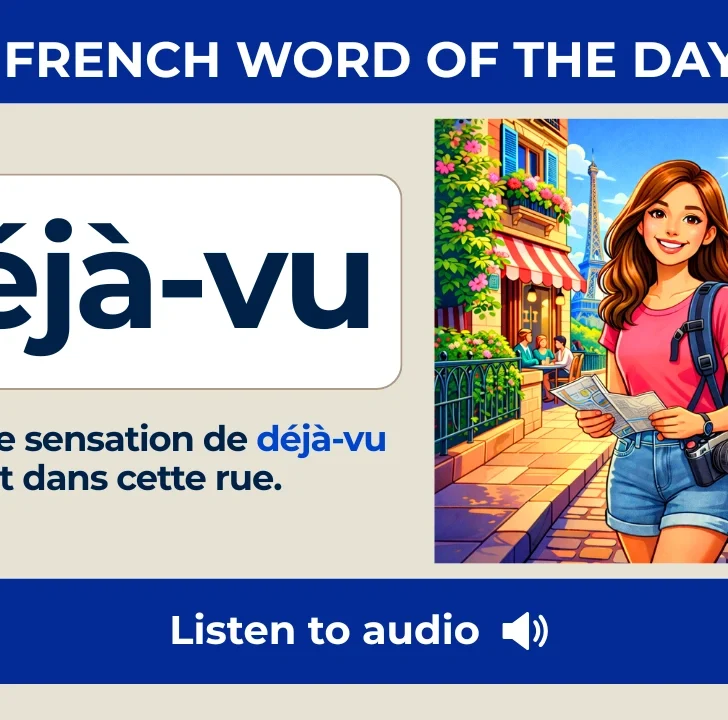
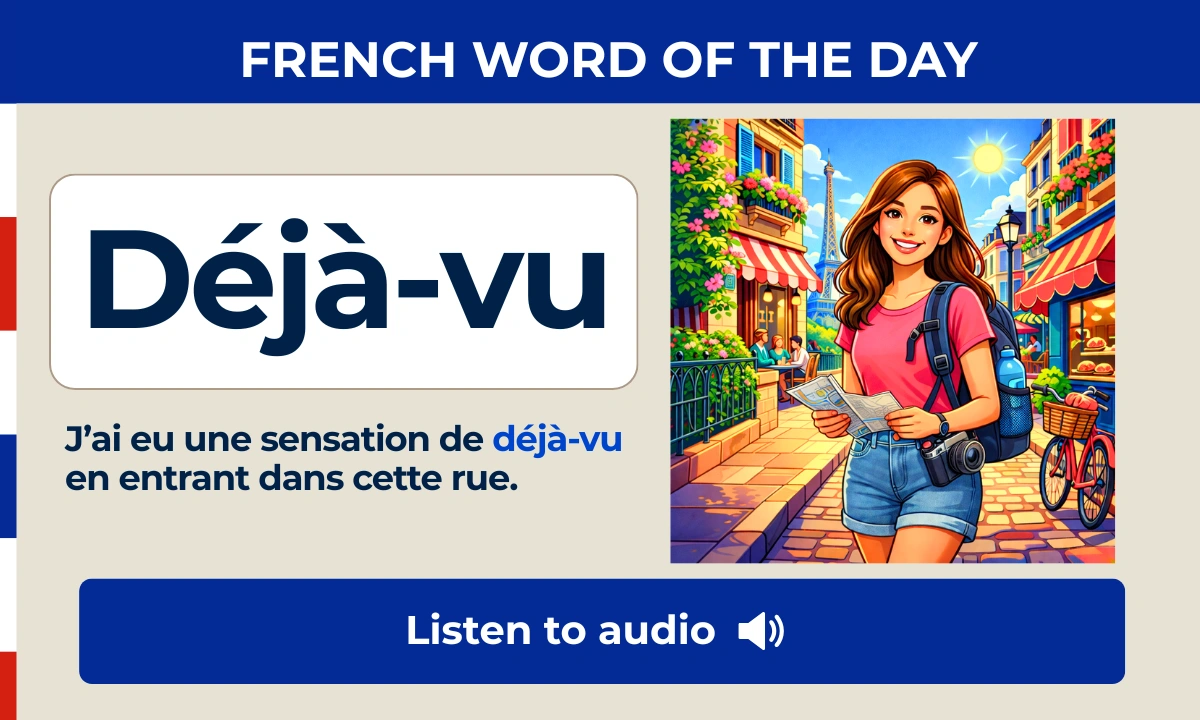
J’ai eu une sensation de déjà-vu en entrant dans cette rue.
I had a feeling of déjà vu when entering this street.
Je resens un déjà-vu pendant la conversation.
I feel a sense of déjà vu during the conversation.
Elle a parlé d’un sentiment de déjà-vu après son voyage.
She spoke about a feeling of déjà vu after her trip.
After déjà-vu, c’est la vie is probably the second most famous French expression used in English.
👉 See also: C’est la vie (that’s life) »
❓ Want to feel more confident in French?
🎯 À Moi Paris — This is my top recommendation for online French courses, and it pairs wonderfully with my daily lessons. Camille Chevalier teaches with engaging audio stories that she records at three speeds. Her specialty is helping students with pronunciation and bridging the gap between textbook French and real spoken French as you hear it on the streets of Paris.
👉 Explore À Moi Paris »
👉 Read my review »
🎧 French Verb Drills — Having trouble with French verb conjugations? Camille’s audio drills break everything down step by step so you can finally lock in the patterns and speak with confidence.
If you purchase the courses, I may earn a small commission — at no extra cost to you.
🔗 Related words and expressions
- le souvenir — memory
- la mémoire — memory (ability to remember)
- une sensation — a sensation, feeling
- un rêve — a dream
- la prémonition — a premonition
- le pressentiment — a presentiment, intuition
- la coïncidence — a coincidence
📚 Related lessons on FrenchLearner!
👉 French loanwords hub »
👉 C’est la vie (that’s life) »
👉 Déjà (already) »
👉 Souvenir (memory, souvenir) »
👉 Voir conjugation chart (to see) »


