
🔊 Jump to examples now
👉 See also: Quitter (to leave) »
Level A1-A2 (Beginner)
Published March 4, 2026 — Lesson written by French teacher David Issokson for students who want to learn French online, with native audio by Marie Assel Cambier, a voice artist from France.
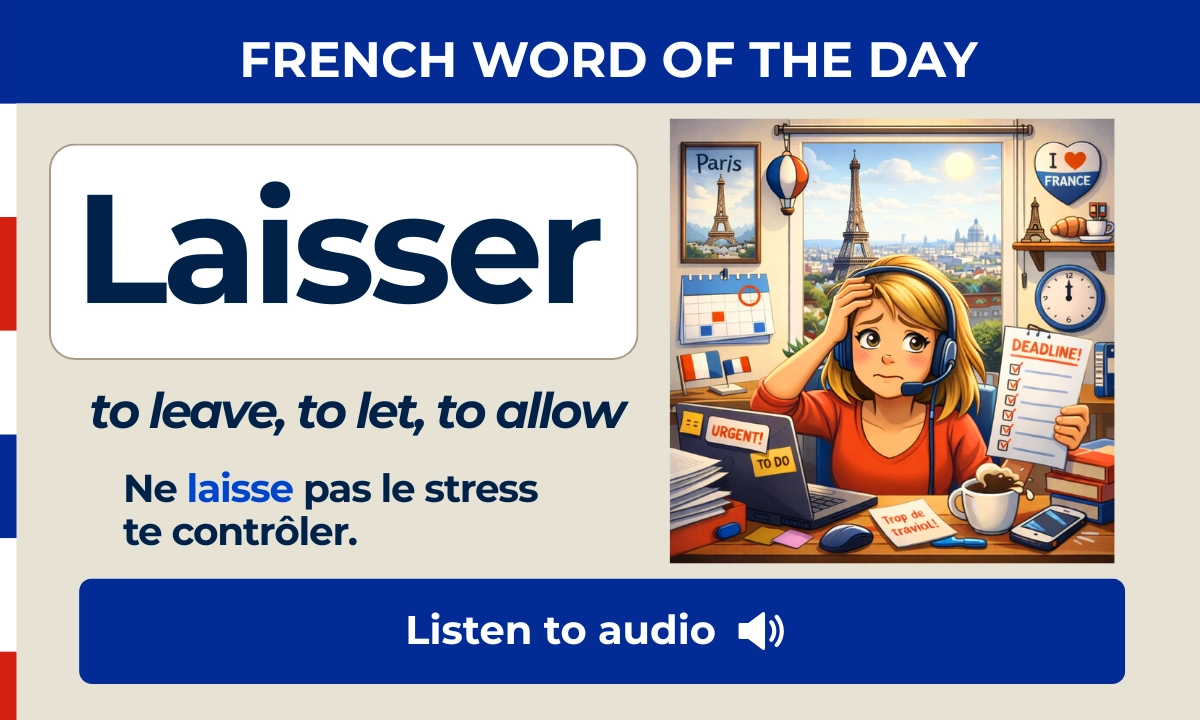
The French Word of the Day is laisser, meaning “to leave,” “to let,” or “to allow.” Today I’ll cover six usages of this high-frequency verb with native audio by Marie.
📘 Laisser meaning in French
Laisser is a French verb meaning “to leave,” “to let,” or “to allow.” It can describe leaving something behind, allowing someone to do something, or letting something remain unchanged. For example, “J’ai laissé mes clés sur la table” (I left my keys on the table), “Laisse-moi entrer” (Let me come in), and “Il laisse la porte ouverte” (He leaves the door open).
🎧 Laisser pronunciation in French
The pronunciation of laisser is /lɛ.se/ (IPA), which sounds roughly like “leh-say.”
📝 Laisser usage examples
1. Imperative usage — “let me + verb”
Laisse-moi parler.
Let me speak.
2. To let someone do something (allow)
Je laisse mes enfants regarder la télé.
I let my children watch TV.
3. To leave something somewhere
J’ai laissé mon téléphone à la maison.
I left my phone at home.
4. To say goodbye / end a conversation
Je dois te laisser.
I have to go (I must leave you).
👉 See also: Devoir conjugation chart (must, to have to) »
5. To leave someone (relationship / family)
Il a laissé sa famille pour le travail.
He left his family for work.
6. To let something happen / allow something
Ne laisse pas le stress te contrôler.
Don’t let stress control you.
💡 Laisser vs. quitter — What’s the difference?
Both laisser and quitter can translate to “to leave” in English, but they are used differently. Laisser means to leave something behind or let something remain somewhere, while quitter means to leave or depart from a place or person. In simple terms, laisser focuses on what stays behind, while quitter focuses on the act of departing.
➞ J’ai laissé mon sac au bureau. I left my bag at the office.
➞ J’ai quitté le bureau. I left the office.
➞ Elle a quitté son mari. She left her husband.
👉 See also: Quitter Word of the Day lesson »
❓ Want to feel more confident in French?
🎯 À Moi Paris — This is my top recommendation for online French courses, and it pairs wonderfully with my daily lessons. Camille Chevalier teaches with engaging audio stories that she records at three speeds. Her specialty is helping students with pronunciation and bridging the gap between textbook French and real spoken French as you hear it on the streets of Paris.
👉 Explore À Moi Paris »
👉 Read my review »
🎧 French Verb Drills — Having trouble with French verb conjugations? Camille’s audio drills break everything down step by step so you can finally lock in the patterns and speak with confidence.
If you purchase the courses, I may earn a small commission — at no extra cost to you.
🔗 Related words and expressions
- laisser tomber — never mind
- lâcher — to let go, release
- quitter — to leave (a place or person)
- abandonner — to abandon
- permettre — to allow, permit
- autoriser — to authorize, allow
- tolérer — to tolerate, allow reluctantly
- renoncer à — to give up, renounce
- délaisser — to neglect, abandon
📚 Related lessons on FrenchLearner!
👉 Quitter (to leave) »
👉 Laisser tomber (never mind) »
👉 Laissez les bons temps rouler (expression) »
👉 Laisser conjugation chart »
👉 Regular ER verb conjugations »


