
Level A1-A2 (Beginner – Upper Beginner)
Published January 10, 2026 — Lesson written by French teacher David Issokson for students who want to learn French online, with native audio by Marie Assel Cambier, a voice artist from France.
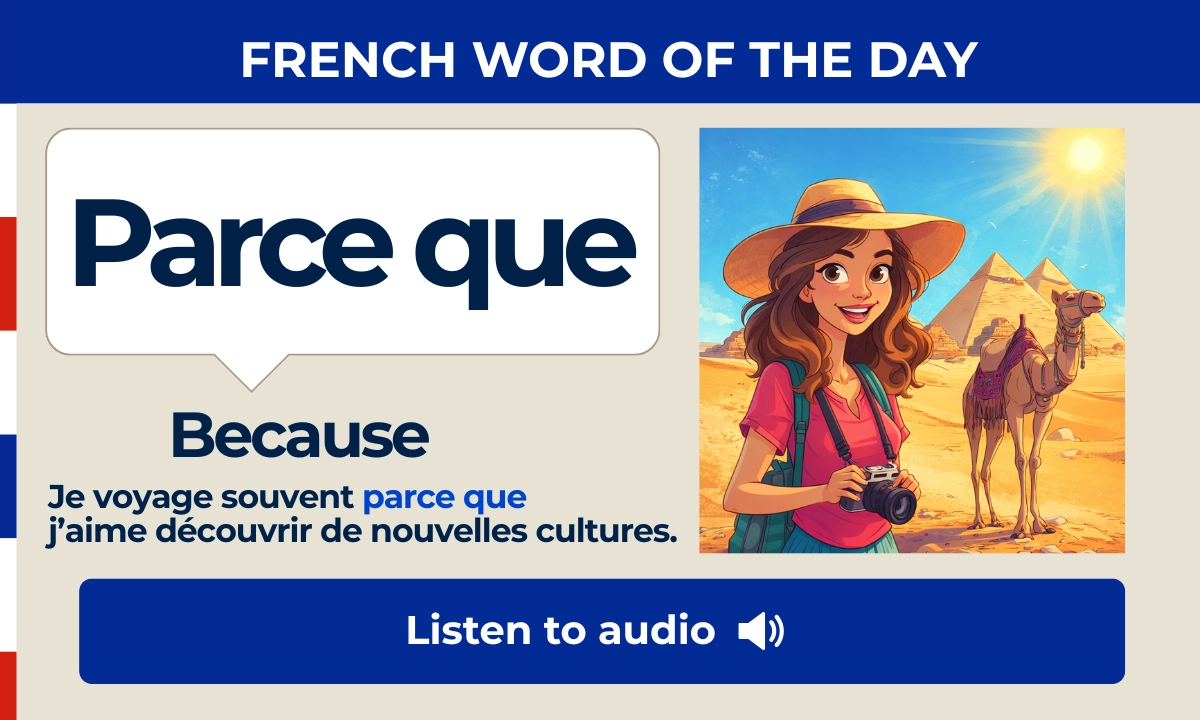
The French Word of the Day is parce que, meaning “because.” It’s one of the most important connector words in French, and in today’s lesson I explain the difference between parce que and car, which also means “because.”
✅ Meaning
✅ Pronunciation
✅ Example sentences
✅ Related Words & Expressions
✅ Related lessons
📘 Parce que meaning in French
Parce que means “because” and is used to explain the reason for an action, situation, or opinion. It introduces a cause and is typically followed by a full sentence with a subject and a verb. For example, “Il est content parce qu’il a réussi.” (He’s happy because he succeeded.)
💡 Parce que vs. car — what’s the difference?
Both parce que and car mean “because” in French. The difference is mainly register, not meaning. Parce que is the most common and natural choice in everyday spoken French, while car is more formal and mostly used in writing. Car can also translate as “as” in English, depending on the context.
Elle étudie le français parce que c’est une belle langue.
She studies French because it’s a beautiful language.
Elle étudie le français car c’est une belle langue.
She studies French as it’s a beautiful language.
👉 To go further, see my full lesson on car (because / as).
🎧 Parce que pronunciation in French
The pronunciation of parce que is /paʁs kə/ (IPA). It sounds roughly like “PARS-kuh”.
📝 Parce que usage examples
Je voyage souvent parce que j’aime découvrir de nouvelles cultures.
I travel often because I like discovering new cultures.
Il étudie beaucoup parce qu’il veut réussir son examen.
He studies a lot because he wants to pass his exam.
Elle est fatiguée parce qu’elle s’est levée très tôt.
She is tired because she woke up very early.
👉 See also: être (to be) — conjugation charts with audio »
Nous restons à la maison parce qu’il pleut beaucoup aujourd’hui.
We are staying at home because it is raining a lot today.
Check out these related words (with audio):
👉 car — because »
👉 puisque — since / because »
👉 donc — therefore / so »
❓ Want to feel more confident in French?
🎯 À Moi Paris — This is my top recommendation for online French courses, and it pairs wonderfully with my daily lessons. Camille Chevalier teaches with engaging audio stories that she records at three speeds. Her specialty is helping students with pronunciation and bridging the gap between textbook French and real spoken French as you hear it on the streets of Paris.
👉 Explore À Moi Paris »
👉 Read my review »
🎧 French Verb Drills — Having trouble with French verb conjugations? Camille’s audio drills break everything down step by step so you can finally lock in the patterns and speak with confidence.
If you purchase the courses, I may earn a small commission — at no extra cost to you.
🔗 Related words and expressions
- car — because (more formal)
- puisque — since / because (obvious reason)
- à cause de — because of (negative cause)
- grâce à — thanks to (positive cause)
- donc — therefore / so
- c’est pourquoi — that’s why
📚 Related lessons on FrenchLearner!
👉 car — because »
👉 puisque — since / because »
👉 donc — therefore / so »
👉 à cause de vs. grâce à — because of »
🚀 Continue learning French online on FrenchLearner!
👉 French Word of the Day »
👉 French Vocabulary lists »
👉 French for beginners guide »
👉 French song lyrics hub »
❓ Parce que — Common Questions
What does parce que mean in French?
Parce que means “because” and is used to explain a reason or cause in a sentence.
What’s the difference between parce que and car?
Both mean “because.” Parce que is common and natural in spoken French, while car is more formal and mostly used in writing.
Can car also mean “as” in English?
Yes. Depending on the context, car can translate as “as” or “because” in English.
Which one should beginners use?
Beginners should use parce que. It’s always correct in everyday French and never sounds too formal.
Can you start a sentence with parce que?
In spoken French, yes. In formal writing, it’s usually better to place it in the middle of the sentence.


