
Level A1-A2 (Beginner, Upper Beginner)
Published January 11, 2026 — Lesson written by French teacher David Issokson for students who want to learn French online, with native audio by Marie Assel Cambier, a voice artist from France.
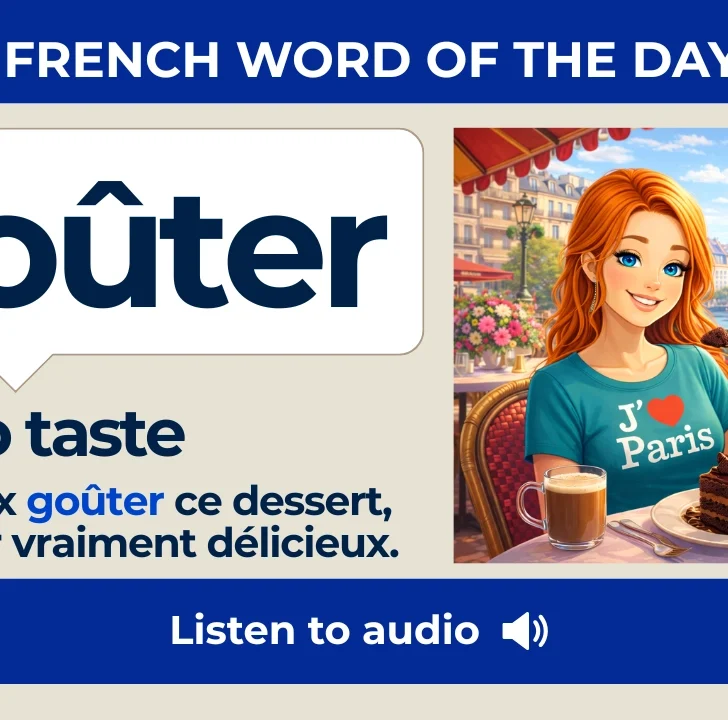
The French Word of the Day is goûter, meaning “to taste” or “to try (food)”. I specifically chose this word because it has some very specific (and tricky!) rules for intermediate students. For example, what’s the subtle change when it’s followed by the preposition à? And what does goûter mean as a noun? I’ll answer all these questions with Marie’s fantastic audio.
✅ Meaning
✅ Pronunciation
✅ Example sentences
✅ Related Words & Expressions
✅ Related lessons
📘 Goûter meaning in French
Goûter is a French verb meaning “to taste” or “to try (food).” When goûter is followed by a noun, it means to taste something. For example, Je goûte ce gâteau (I taste this cake). When goûter is followed by the preposition à, it means to sample or try for the first time. For example, Je goûte à la truffe (I taste the truffle). As a masculine noun, le goûter means “snack” or “afternoon snack.” For example, Les enfants prennent le goûter après l’école (The children have their afternoon snack after school).
🎧 Goûter pronunciation in French
The pronunciation of goûter is /ɡu.te/ (IPA), which sounds roughly like “goo-tay.”
📝 Goûter usage examples
1. Goûter + noun = to taste
Je veux goûter ce dessert, il a l’air vraiment délicieux.
I want to taste this dessert; it looks really delicious.
👉 See also: Vouloir conjugation chart (to want) — with audio »
Elle me demande de goûter sa soupe pour avoir mon avis.
She asks me to taste her soup to get my opinion.
2. Goûter à + noun = to taste for the first time
Nous goûtons à plusieurs spécialités au marché pour découvrir de nouvelles saveurs.
We taste several specialties at the market to discover new flavors.
3. Le goûter (noun) = snack
Les enfants prennent le goûter après l’école avec un jus et un petit biscuit.
The children have their afternoon snack after school with a juice and a small cookie.
👉 See also: Prendre conjugation chart (to take) — with audio »
Check out these related words (with audio):
👉 cochonnerie (f.) — junk food »
👉 bon appétit — enjoy your meal »
👉 goinfre — glutton »
❓ Want to feel more confident in French?
🎯 À Moi Paris — This is my top recommendation for online French courses, and it pairs wonderfully with my daily lessons. Camille Chevalier teaches with engaging audio stories that she records at three speeds. Her specialty is helping students with pronunciation and bridging the gap between textbook French and real spoken French as you hear it on the streets of Paris.
👉 Explore À Moi Paris »
👉 Read my review »
🎧 French Verb Drills — Having trouble with French verb conjugations? Camille’s audio drills break everything down step by step so you can finally lock in the patterns and speak with confidence.
If you purchase the courses, I may earn a small commission — at no extra cost to you.
🔗 Related words and expressions
- le casse-croûte — snack
- goûteux — tasty, flavorful
- avoir bon goût — to taste good
- tester — to test (less food-specific)
- le dessert — dessert
- le goûter de 16 heures — afternoon snack at 4 p.m.
📚 Related lessons on FrenchLearner!
👉 cochonnerie (f.) — junk food »
👉 bon appétit — enjoy your meal »
👉 goinfre — glutton »
👉 French food vocabulary »
👉 Regular ER verbs »
🚀 Continue learning French online on FrenchLearner!
👉 French Word of the Day »
👉 French Vocabulary lists »
👉 French for beginners guide »
👉 French song lyrics hub »
❓ Goûter — Common Questions
What does goûter mean in French?
It means “to taste” or “to try (food)” as a verb, and “snack” or “afternoon snack” as a noun.
What’s the difference between goûter + noun and goûter à?
When goûter is followed by a noun, it means to taste something directly. When it’s followed by à, it often means to sample or try a food, sometimes for the first time.
Is goûter a verb or a noun?
Both. Context tells you whether it means “to taste” (verb) or “afternoon snack” (noun).
What is le goûter in French culture?
Le goûter is the traditional afternoon snack in France, usually eaten around 4 p.m., especially by children after school.


