

Level B1 (Lower Intermediate)
Published January 12, 2026 — Lesson written by French teacher David Issokson for students who want to learn French online, with native audio by Marie Assel Cambier, a voice artist from France.
The French Word of the Day is faute de, meaning “for lack of.” This is one of those intermediate (B1) expressions that can help you sound much more eloquent in French. For example, “Faute de temps, je n’ai pas pu voyager” (I couldn’t travel due to a lack of time).
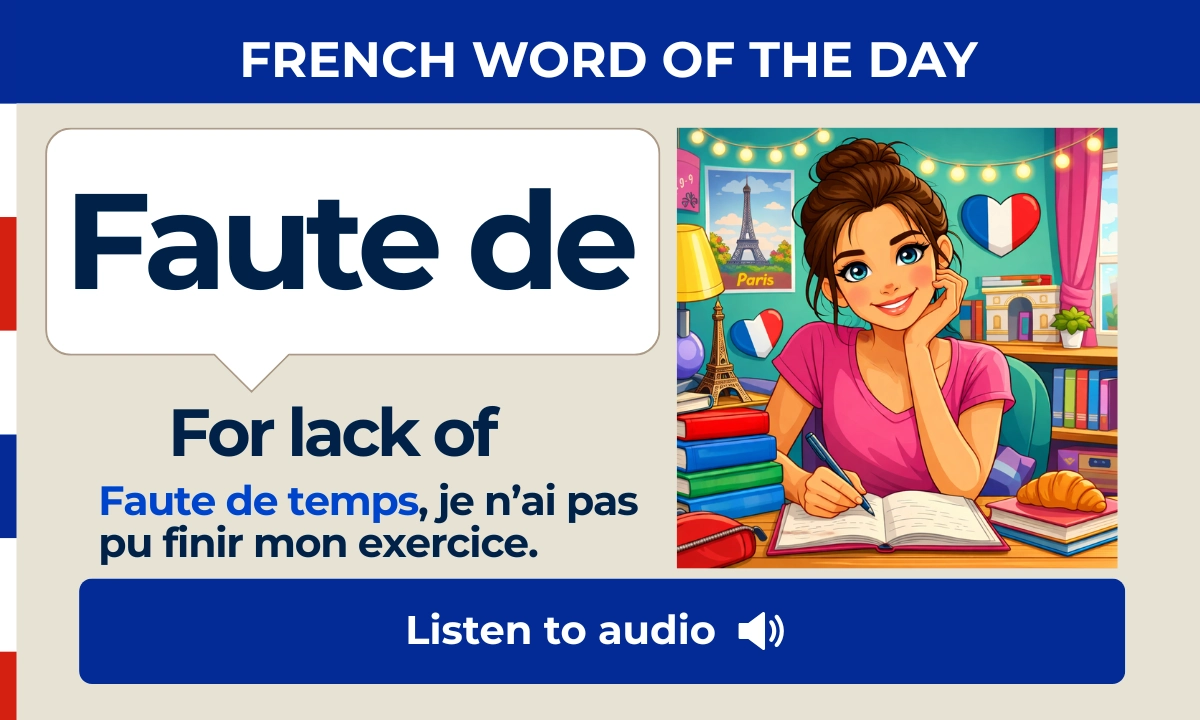
📘 Faute de meaning in French
Faute de is a French expression that translates literally to “fault of” and means “for lack of” or “because of a lack of.” The expression is used to explain a reason or limitation. For example, faute de temps (for lack of time), faute d’argent (for lack of money), or faute de mieux (for lack of anything better). It’s neutral to slightly formal in register and is especially common in written French and clear, structured speech.
🎧 Faute de pronunciation in French
The pronunciation of faute de is /fot də/ (IPA), which sounds roughly like “fot duh.”
📝 Faute de usage examples
Faute de temps, je n’ai pas pu finir mon exercice.
For lack of time, I couldn’t finish my exercise.
Nous sommes restés chez nous faute de soleil.
We stayed at home for lack of sunshine.
Rester (to stay) uses être (to be) as an auxiliary verb in the passé composé.
👉 See also: Être conjugation chart (with audio) »
Faute de preuves, la police a dû arrêter l’enquête.
For lack of evidence, the police had to stop the investigation.
Elle n’a pas acheté cette maison faute d’argent.
She didn’t buy that house for lack of money.
This lesson explains manquer (to lack, to miss), a related verb which causes a lot of confusion among intermediate students.
👉 manquer — usage examples with audio »
❓ Want to feel more confident in French?
🎯 À Moi Paris — This is my top recommendation for online French courses, and it pairs wonderfully with my daily lessons. Camille Chevalier teaches with engaging audio stories that she records at three speeds. Her specialty is helping students with pronunciation and bridging the gap between textbook French and real spoken French as you hear it on the streets of Paris.
👉 Explore À Moi Paris »
👉 Read my review »
🎧 French Verb Drills — Having trouble with French verb conjugations? Camille’s audio drills break everything down step by step so you can finally lock in the patterns and speak with confidence.
If you purchase the courses, I may earn a small commission — at no extra cost to you.
🔗 Related words and expressions
- le manque de — lack of
- par manque de — due to a lack of
- en raison de — because of / due to
- à cause de — because of
- ne pas avoir assez de — not to have enough of
- empêcher de — to prevent from
📚 Related lessons on FrenchLearner!
👉 manquer – to miss »
👉 à cause de — because of »
👉 parce que — because »
🚀 Continue learning French online on FrenchLearner!
👉 French Word of the Day »
👉 French Vocabulary lists »
👉 French for beginners guide »
👉 French song lyrics hub »
❓ Faute de — Common Questions
What does faute de mean in French?
It means “for lack of” or “because of a lack of.” Faute de temps, je n’ai pas pu finir mon exercice. For lack of time, I couldn’t finish my exercise.
What comes after faute de?
A noun always follows faute de, never a verb. For example, faute d’argent means for lack of money.
Is faute de formal or informal?
It is neutral to slightly formal and is common in written French and clear speech. Faute de preuves, la police a dû arrêter l’enquête. For lack of evidence, the police had to stop the investigation.


