
Published November 27, 2023 · Updated May 2, 2026 — By French teacher David Issokson • Native Audio by Marie Assel Cambier
The French verb rester means “to stay” and can cause quite a bit of confusion among students. For instance, it does not mean “to rest” and uses être as an auxiliary verb in the passé composé. This lesson covers 4 key uses — all with native audio.
📘 Rester meaning
Rester is a French verb meaning “to stay” or “to remain.” It’s used to describe staying in a place (Je reste à la maison — I stay at home) or remaining in a state or condition (rester calme — to stay calm). Rester is a false cognate and does not mean “to rest” — the verb for “to rest” is the reflexive se reposer. You’ll hear rester often in everyday conversation, especially when talking about plans, location, or situations that don’t change. Rester is a regular -er verb.
🎧 Rester pronunciation
The pronunciation of rester is /ʁɛste/ (IPA), which sounds roughly like “reh-stay”.
📝 Rester examples
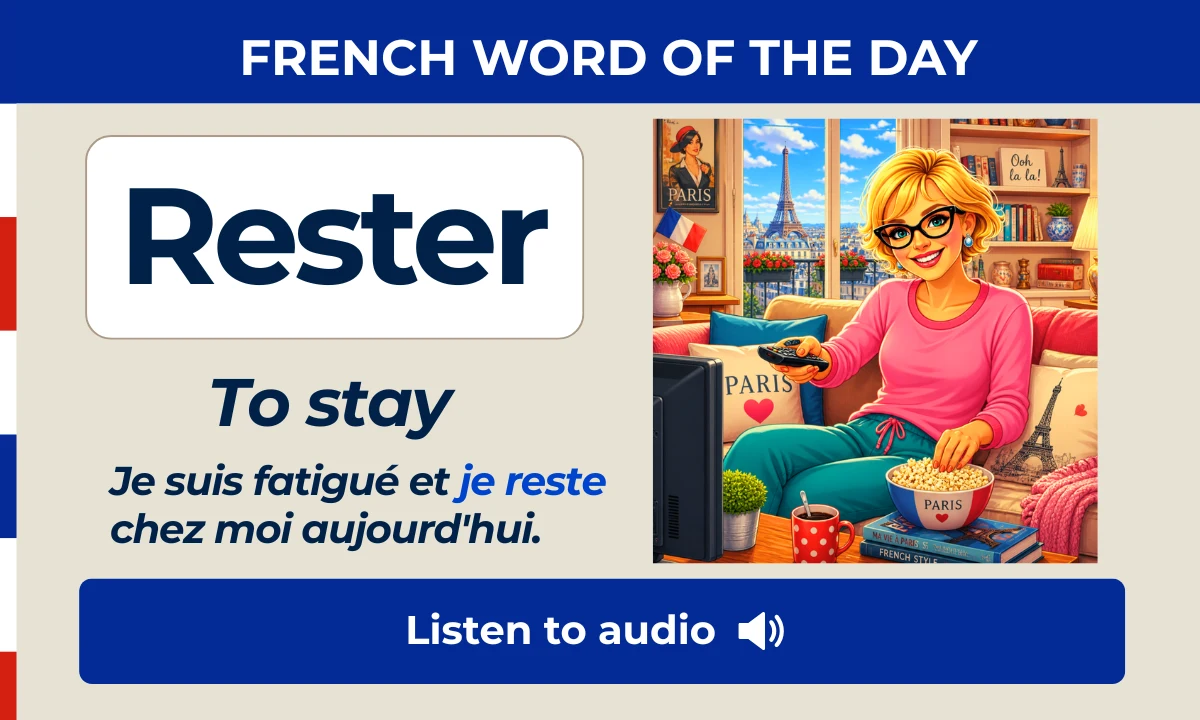
Je suis fatigué et je reste chez moi aujourd’hui.
I’m tired and I’m staying home today.
In the passé composé, rester uses être (to be) as an auxiliary verb.
Nous sommes restés dans un hôtel de luxe hier soir.
We stayed in a luxury hotel yesterday night.
⚠️ Avoid this common mistake: You cannot use avoir as an auxiliary verb in the passé composé for rester. Hence, “j’ai resté” for “I stayed” is incorrect.
To remain
One other common usage of rester is “to remain”.
Je suis resté debout pendant tout le concert.
I remained standing during the entire concert.
Il reste = remains
When used as an impersonal expression, il reste translates literally to “it remains” or “left”.
Il ne nous reste qu’un quart d’heure.
We only have 15 minutes remaining.
Il me reste deux œufs dans le frigo.
I have two eggs left in the fridge.
👉 Now that you’ve gone through the examples, check out my rester conjugation charts, which covers six key tenses with native audio.
❓ Want to feel more confident in French?
🎯 À Moi Paris — My top recommended course by Camille Chevalier, featuring engaging audio stories (3 speeds) to help you understand real spoken French and improve pronunciation.
👉 Explore À Moi Paris »
👉 Read my review »
🎧 French Verb Drills — Camille’s step-by-step audio drills help you finally master verb conjugations.
👉 See Verb Drills »
If you purchase the courses, I may earn a small commission — at no extra cost to you.
🔗 Related words and expressions
- se reposer — to rest
- loger — to stay (at a hotel/house)
- séjourner — to stay (for a period of time)
- demeurer — to remain/dwell
- s’installer — to settle in
- il reste… — there is/are… left
- rester en contact — to stay in touch
- rester bouche bée — to stay speechless
- rester calme — to stay calm
📚 Related lessons
👉 Rester conjugation chart »
👉 False cognates »
👉 French être verbs in the passé composé »
👉 Se reposer (to rest) »
🚀 Continue learning on FrenchLearner!
👉 French Word of the Day (200+ lessons) »
👉 French verb conjugations »
👉 French vocabulary lists »


