
Level: A2-B1 (Upper Beginner, Lower Intermediate)
Lesson written by French teacher David Issokson with native audio by Marie Assel Cambier, a voice artist from France.
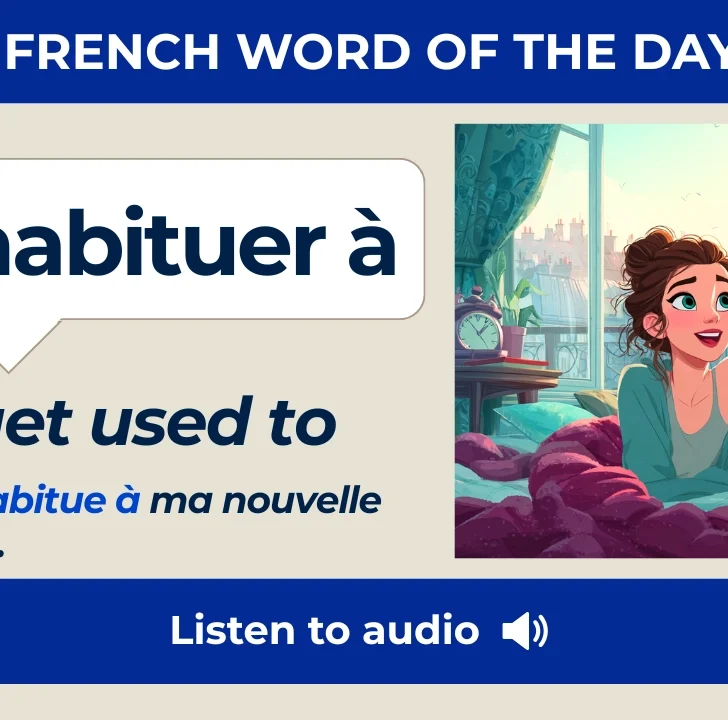
The French Word of the Day is s’habituer, meaning “to get used to.” I chose this verb because it has a few particularities — it’s always followed by à + a noun or infinitive, and it requires the use of the tricky pronoun y. Everything is explained below with clear examples and native audio.
✅ Meaning
✅ Pronunciation
✅ Example sentences
✅ Related Words & Expressions
✅ Related lessons
Subscribe to the French Word of the Day

📘 S’habituer meaning
S’habituer means “to get used to” or “to become accustomed to something”. It’s a reflexive verb that’s always followed by à + a noun or infinitive. For example:
👉 Je m’habitue à la chaleur. I’m getting used to the heat.
👉 Nous nous habituons à travailler ensemble. We’re getting used to working together.
🎧 S’habituer pronunciation
The pronunciation of s’habituer à is /sa.bi.ty.e/, which sounds like sah-bee-tu-ay.
📝 French and English example sentences
Je m’habitue à ma nouvelle routine.
I’m getting used to my new routine.
Elle ne s’habitue pas au climat froid de cette région.
She isn’t getting used to the cold climate of this region.
Ils commencent à s’habituer à vivre ensemble.
They’re starting to get used to living together.
Au début, il a eu du mal, mais maintenant il s’habitue à son travail.
At first, he had a hard time, but now he’s getting used to his job.
❓ How do you say “to get used to it”?
Since s’habituer is followed by the preposition à, you must use the pronoun y to mean “it” or “them.”
Je m’habitue à la vie ici → Je m’y habitue.
I’m getting used to it.
Je m’habitue aux nouvelles règles → Je m’y habitue.
I’m getting used to them.
👉 See also: Pronoun y — explanation and examples »
❓ Need extra help with verbs?
🎯 French Verb Drills — Camille’s course from French Today gives you clear, step-by-step audio drills to lock in conjugation patterns.
👉 See Verb Drills »
📖 À Moi Paris — Prefer a complete self-study program? Camille’s flagship course teaches French through stories and includes verb work in real conversations.
👉 Explore À Moi Paris »
If you purchase the courses, I may earn a small commission — at no extra cost to you.
🤔 Difference between s’habituer à and avoir l’habitude de
S’habituer à → to get used to (the process)
Je m’habitue à me lever tôt.
I’m getting used to getting up early.
Avoir l’habitude de → to be used to / to usually do (the state)
J’ai l’habitude de me lever tôt.
I’m used to getting up early.
👉 Quick tip:
Think s’habituer = getting used to vs. avoir l’habitude = being used to.
👉 Learn more: Avoir l’habitude — French Word of the Day »
📊 S’habituer conjugation
Here’s the basic s’habituer conjugation in the present tense. It’s a regular -er reflexive verb, following the same pattern as se laver (to wash yourself). The stem stays consistent (habitu-), and each form uses the typical -e, -es, -e, -ons, -ez, -ent endings, with reflexive pronouns in front.
- Je m’habitue — I get used to
- Tu t’habitues — You get used to (informal)
- Il / Elle s’habitue — He / She gets used to
- Nous nous habituons — We get used to
- Vous vous habituez — You get used to (formal/plural)
- Ils / Elles s’habituent — They get used to
See also:
👉 Guide to regular ER verbs in French »
👉 Guide to French reflexive verbs »
🔗 Related words and expressions
- l’habitude — habit, custom
- avoir l’habitude de — to be used to, to be in the habit of
- prendre l’habitude de — to get into the habit of
- se familiariser avec — to become familiar with
- s’adapter à — to adapt to
- s’acclimater à — to acclimate to
- se faire à — to get used to (informal alternative)
🚀 Continue growing your French vocabulary!
👉 Verb conjugations hub »
👉 French irregular verbs hub »
👉 French Word of the Day »
👉 French song lyrics hub »
👉 French Vocabulary lists »
👉 French for Beginners (start here) »


