

Level B1 (Intermediate)
Published January 21, 2026 — Lesson written by French teacher David Issokson for students who want to learn French online, with native audio by Marie Assel Cambier, a voice artist from France.
The French Word of the Day is façade, meaning “facade” or “front.” This is one of those French loanwords that comes up all the time in English. But what does it mean in French, and do the French use it in the same way?
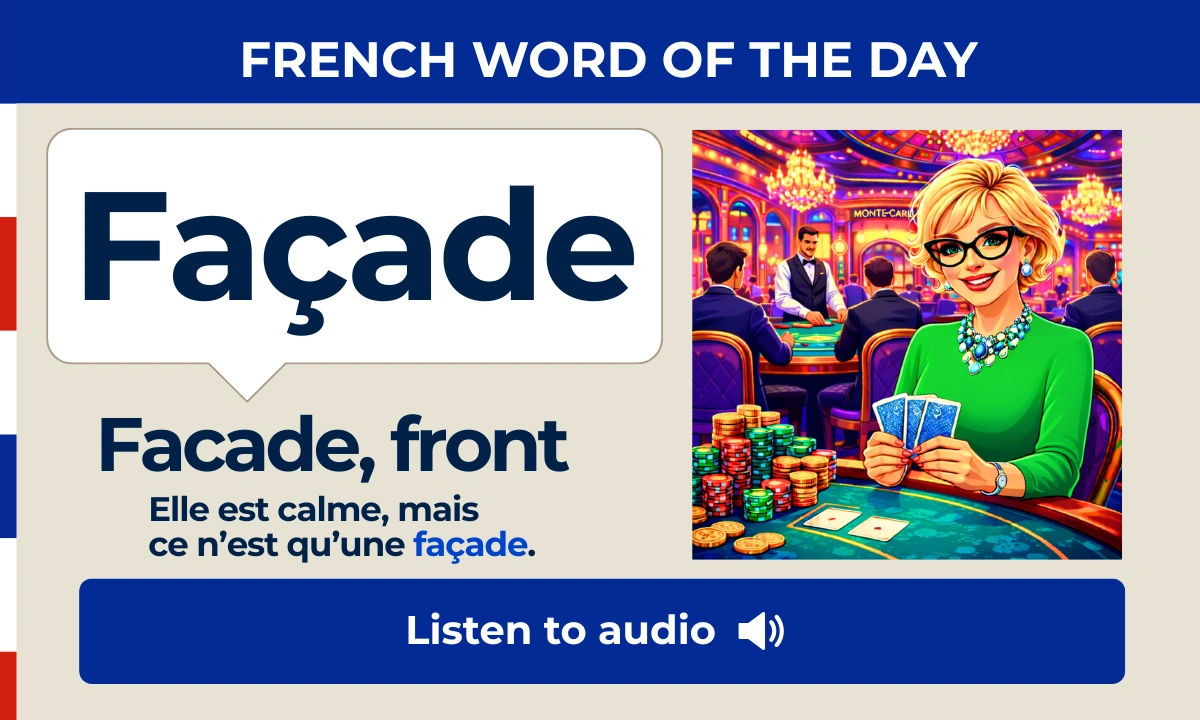
📘 Façade meaning in French
Façade (f.) means “facade” or “front” in French. It refers literally to the front exterior of a building, especially the main or most visible side, and figuratively to an outward appearance that hides true feelings, intentions, or reality.
Façade is a French loanword that is commonly used in English, with the same pronunciation and the same literal and figurative meanings in both languages. Whether describing architecture or a false or polished outward image, the usage is essentially identical in French and English.
🎧 Façade pronunciation in French
The pronunciation of façade is /fa.sad/ (IPA), which sounds roughly like “fa-saad.” The ç (c with a cedilla) causes the c to be pronounced like an s sound.
📝 Façade usage examples
Elle est calme, mais ce n’est qu’une façade.
She is calm, but it is only a facade.
Il est difficile de savoir ce qu’il pense derrière cette façade.
It is difficult to know what he’s thinking behind that facade.
La façade donne sur la place principale.
The facade faces the main square.
La façade de l’immeuble est en pierre.
The facade of the building is made of stone.
Cul-de-sac is another French word that comes up all the time in English. But, how do the French use it?
👉 Cul-de-sac — French meaning and usage examples »
❓ Want to feel more confident in French?
🎯 À Moi Paris — This is my top recommendation for online French courses, and it pairs wonderfully with my daily lessons. Camille Chevalier teaches with engaging audio stories that she records at three speeds. Her specialty is helping students with pronunciation and bridging the gap between textbook French and real spoken French as you hear it on the streets of Paris.
👉 Explore À Moi Paris »
👉 Read my review »
🎧 French Verb Drills — Having trouble with French verb conjugations? Camille’s audio drills break everything down step by step so you can finally lock in the patterns and speak with confidence.
If you purchase the courses, I may earn a small commission — at no extra cost to you.
🔗 Related words and expressions
- l’apparence — appearance
- l’extérieur — exterior
- l’image publique — public image
- le masque — mask
- cacher ses émotions — to hide one’s emotions
📚 Related lessons on FrenchLearner!
👉 Feelings and emotions vocabulary »
👉 Physical appearances vocabulary »
👉 Keep learning with the French Word of the Day »
Façade meaning — Frequently asked questions (FAQ)
What does the French word façade mean?
The French word façade means “facade” or “front.” It refers to the front exterior of a building and, in a figurative sense, to an outward appearance that hides true feelings, intentions, or reality.
Is façade a French word?
Façade is a French word. English borrowed it directly from French, which is why the spelling and pronunciation are nearly identical in both languages.
How do you pronounce façade in French?
In French, façade is pronounced /fa.sad/ (IPA). The ç (c with a cedilla) makes the c sound like an s, not a k.


