
See also:
👉 Amuse-bouche »
👉 Apéritif »
Level A1-A2 (Beginner)
Lesson written by French teacher David Issokson for students who want to learn French online, with native audio by Marie Assel Cambier, a voice artist from France.
The French Word of the Day is hors d’œuvre, meaning “appetizer.” It’s a word that confuses a lot of learners — the spelling looks strange, the letters don’t behave like English, and the pronunciation isn’t obvious. What does it literally mean? Why does it use the œ letter? And how do you actually say it in real French? Let’s break it all down below.
✅ Meaning
✅ Pronunciation
✅ Example sentences
Hors d’œuvre Meaning, Pronunciation and Examples
📘 Hors d’œuvre meaning
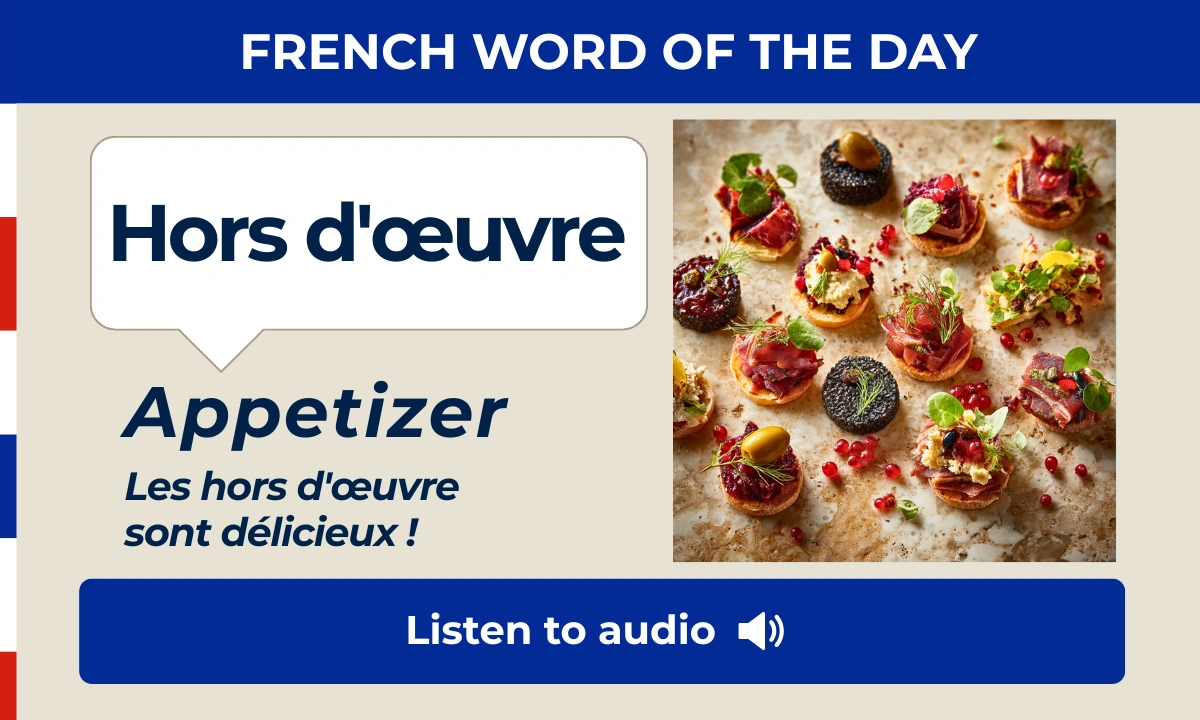
Hors-d’œuvre (m.) means “appetizer” or “starter” in French. The literal meaning is “outside the work,” referring to a dish served before the main course. In modern spelling, the plural is hors-d’œuvre (no added -s).
🇫🇷 Cultural note
In France, an hors d’œuvre can be as simple as olives, pâté, or a small salad served before the meal. Today, most French restaurants use the word entrée for the first course. The term hors-d’œuvre is still correct but sounds more traditional or formal.
🎧 Hors d’œuvre pronunciation
The pronunciation of hors d’œuvre is /ɔʁ dœvʁ/, which sounds like or duhvr. The tricky part is the œu sound in œuvre — it uses the special French letter “œ” (l’e dans l’o), so it’s no surprise many learners wonder how to spell hors d’œuvre. This sound doesn’t exist in English, so think of a rounded “uh” while keeping the lips slightly pursed.
📝 Hors d’œuvre examples & usages
On a servi des hors d’œuvre avant le dîner.
We served appetizers before dinner.
Ces hors d’œuvre sont délicieux, surtout les petits canapés.
These appetizers are delicious, especially the little canapés.
J’adore goûter des hors d’œuvre dans les réceptions.
I love tasting appetizers at receptions.
👉 See also: Goûter — meaning, usage examples »
Le chef a préparé un hors d’œuvre froid à base de saumon.
The chef prepared a cold appetizer made with salmon.
Looking for more essential French food terms? Check out my full French food vocabulary list — all the key words you need for eating and ordering meals in French.
👉 See the French food vocabulary lesson »
❓ Want to feel more confident in French?
🎯 À Moi Paris — Camille’s step-by-step course teaches you how French really sounds in everyday life. Through stories and dialogues, you’ll hear natural phrases you won’t find in textbooks — the kind you’d actually use when ordering food or chatting at a café.
👉 Explore À Moi Paris »
👉 Read my review »
🎧 French Verb Drills — If today’s lesson reminded you how important pronunciation and patterns are, these audio drills will help you master the verb forms you need for smooth, confident conversation.
If you purchase the courses, I may earn a small commission — at no extra cost to you.
🔗 Related words and expressions
- l’entrée — the starter (first course)
- le plat principal — the main course
- le dessert — dessert
- les amuse-bouches — bite-sized appetizers
- le pâté — pâté
- une salade composée — mixed salad
- une tartine — small slice of bread with a spread
- un apéritif — pre-dinner drink
- des olives — olives (common hors d’œuvre)
- un canapé — canapé (small appetizer on bread)
📚 Related lessons on FrenchLearner!
👉 French food vocabulary »
👉 Ordering meals »
👉 Bon appétit »
👉 Le repas (meal) »
👉 How to order steak »
👉 Champagne brands »
👉 Wine brands »
🚀 Continue learning French online on FrenchLearner!
👉 French Word of the Day »
👉 French Vocabulary lists »
👉 French for beginners guide »
👉 French song lyrics hub »
👉 French conjugations hub »


