

Published September 9, 2025 — Lesson written by French teacher David Issokson for students who want to learn French online, with native audio by Marie Assel Cambier, a voice artist from France.
📘 Plus meaning
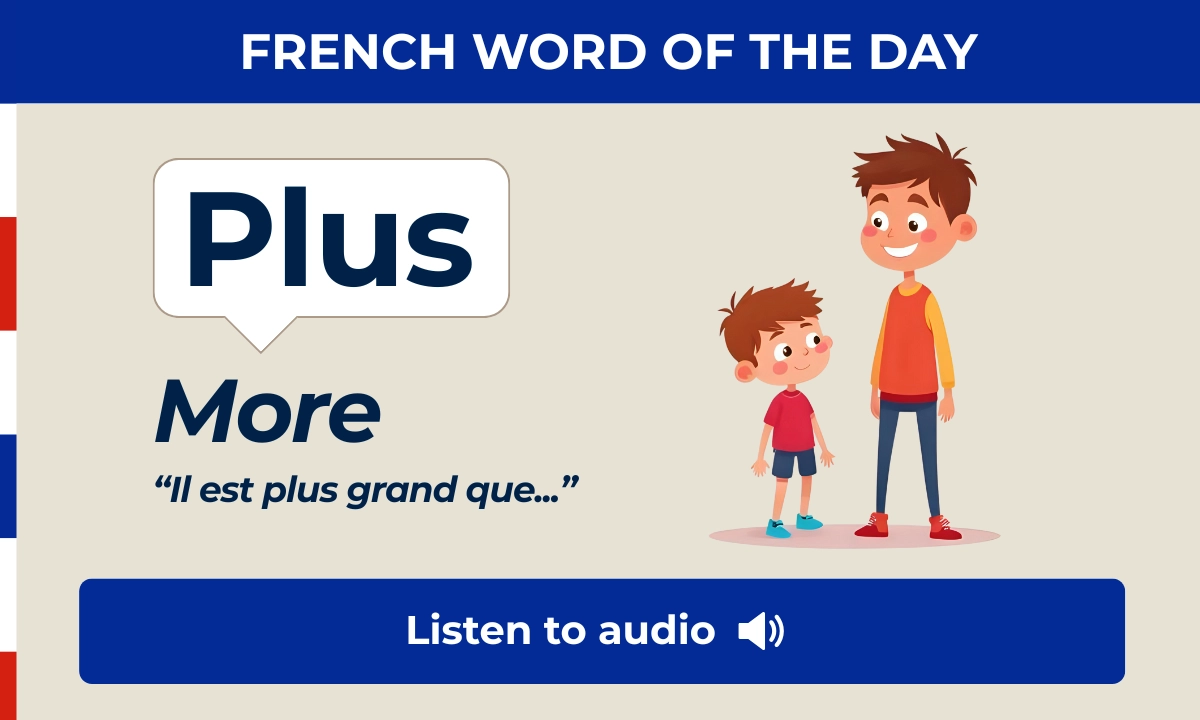
The French word plus means “more.” It is used to compare, to add quantity, and in several adverbial phrases. It also appears in math. While the meaning is simple, the tricky part is knowing when to pronounce the final -s and when to keep it silent. 🔊 Hear real examples now.
🎧 Plus pronunciation
Plus is usually pronounced /ply/ in IPA with a silent -s. In some cases, the final -s is pronounced /plys/. Listen to the two audio files to hear both pronunciations.
📝 French and English examples
When the final -s is silent
👉 The final -s is not pronounced when plus comes before an adjective or an adverb.
Mon frère est plus grand que moi.
My brother is taller than me.
Elle marche plus vite que son ami.
She walks faster than her friend.
👉 The final -s remains silent when plus functions as an adverb of quantity.
Il faut plus de patience.
You need to be more patient.
👉 The final -s is silent when plus appears in negation — ne…plus (no longer, not anymore) and ne…non plus (either).
Je ne viens pas non plus.
I’m not coming either.
👉 In this sentence, the final -s is pronounced like -z because of the liaison rule.
Paul est plus intelligent que son cousin.
Paul is more intelligent than his cousin.
When the final -s is pronounced
👉 The final -s of plus is pronounced when it stands at the end of an adverbial phrase.
Il est gentil, et de plus il aide toujours ses amis.
He is kind, and moreover, he always helps his friends.
👉 In mathematics, the final -s of plus is pronounced, as in un plus un (one plus one).
Deux plus trois font cinq.
Two plus three equals five.
Summary of plus pronunciation rules
| Usage | Pronunciation | Example |
|---|---|---|
| Before adjective/adverb | Silent -s | plus grand |
| Negation (ne…plus) | Silent -s | je ne mange plus |
| Liaison | -z | plus intéressant |
| Adverbial phrases (de plus, du plus) | Pronounced -s | de plus, il aide toujours ses amis |
| Math | Pronounced -s | deux plus deux |
🗣️ Need help with pronunciation?
Mastering French pronunciation can be one of the toughest challenges for learners. I recommend checking out the À Moi Paris course by French Today, where teacher Camille guides you through the tricky sounds step by step in clear, engaging audio lessons.
👉 Explore the course »
📖 Read my review »
Disclosure: If you purchase through this link, I may earn a small commission at no extra cost to you.
🔗 Related words and expressions
- ne… plus — no longer, not anymore
- moins — less, fewer
- autant — as much, as many
- davantage — more, further (formal, common in writing)
- encore plus — even more
- de plus en plus — more and more
- de moins en moins — less and less
- en plus — in addition, also
- en plus de ça — on top of that
- non plus — neither, not either
🚀 Expand your French vocabulary!
👉 Ne… plus (no longer, not anymore) »
👉 En plus (in addition) »
👉 De plus (furthermore, moreover) »
👉 Davantage (Formal synonym for plus) »
👉 Comparative and superlative »
Discover more on FrenchLearner
👉 French Word of the Day »
👉 French song lyrics hub »
👉 French Vocabulary lists »


